
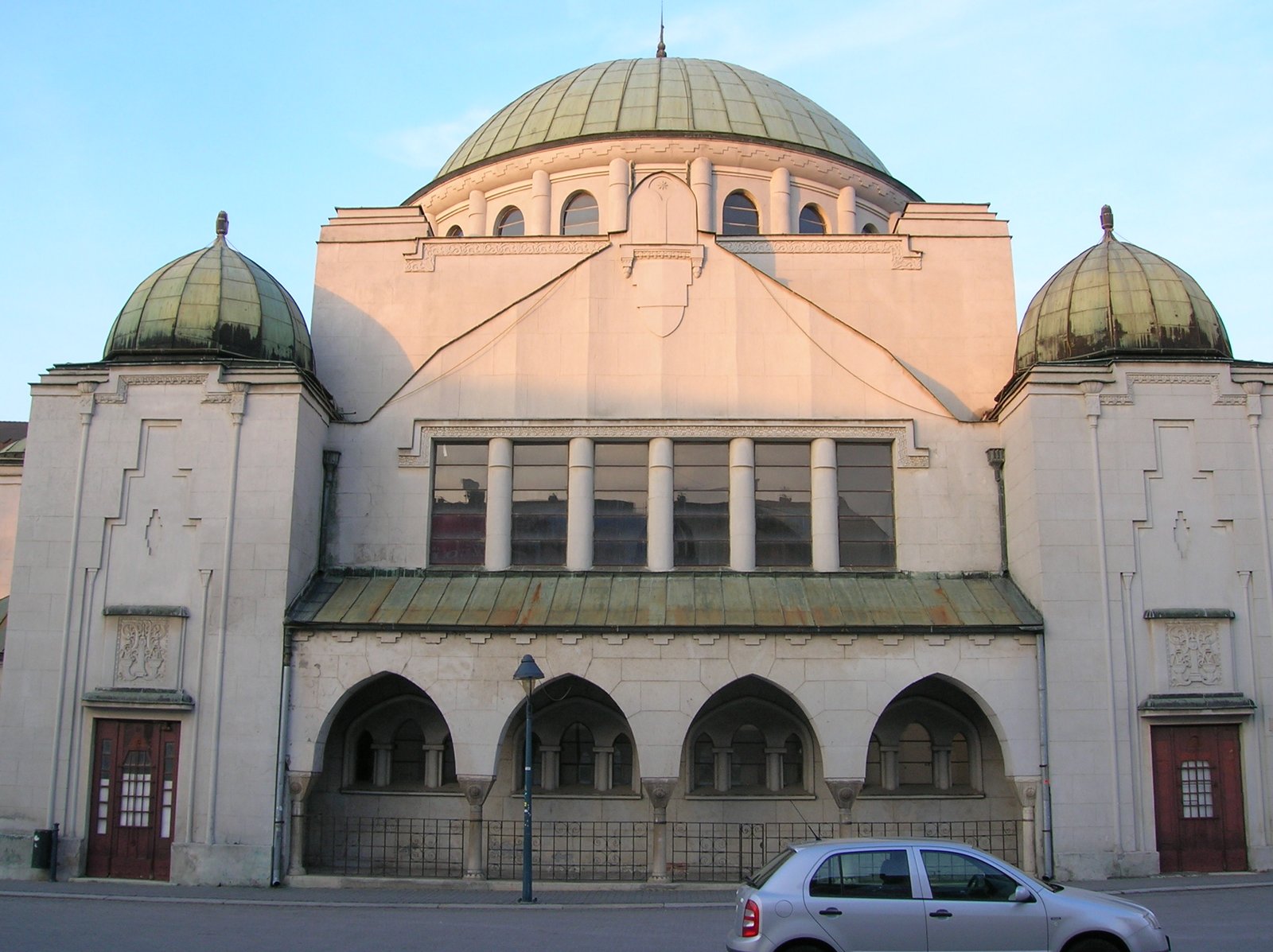
An Art Nouveau synagogue that survived war, confiscation and decades as a storage shed to become the city’s cultural centre.
At a glance
Built in 1913 for Trenčín’s Neolog Jewish congregation, the synagogue replaced a wooden predecessor from 1781. It stands as a Cultural Heritage Monument of Slovakia, its Art Nouveau design attributed to Richard Scheibner. Today the building serves as a cultural centre rather than a place of worship.
History
Trenčín’s Jewish community once numbered around 2,000 people. Their new synagogue opened in September 1913, replacing an earlier wooden building on the same site. War brought damage in 1941, when the Hlinka Guard attacked the structure. Afterward the state seized the property and used it as a warehouse. Local Jews, deprived of their synagogue, gathered instead in a nearby prayer room. Renovation came only at the end of the 1970s, converting the building into the cultural centre it remains today.
What you see
The synagogue reflects the Art Nouveau taste popular across Central Europe in the early twentieth century. Richard Scheibner, born in Piešťany in 1880 and later active in Berlin, provided the plans. His design replaced a modest wooden structure with something more permanent and civic in scale. Later repurposing altered its interior use without erasing its architectural identity.
Cultural significance
The building is a rare physical trace of Trenčín’s once-substantial Jewish community. Its survival through vandalism, confiscation and institutional neglect makes it a marker of twentieth-century Slovak Jewish history. Protected status now acknowledges that history formally. As a cultural centre, it continues to serve public life in the city.
Key facts
- Location: Trenčín, Slovakia
- Completed: 1913
- Style: Art Nouveau
- Architect: Richard Scheibner (attributed)
- Predecessor: wooden synagogue, 1781
- Status: Cultural Heritage Monument of Slovakia
- Current use: cultural centre
Practical information & getting there
The synagogue stands within Trenčín, a city easily reached by train or bus from Bratislava and other regional centres. As a functioning cultural venue, it hosts public events rather than religious services. Check local listings before visiting, since access depends on the centre’s current programme.
Sources & resources
Find it on the map
See this place and what’s around it →📷 Become a Cultural Heritage Online photographer
Share your photos of places: they stay published under your name as the author. The more they're seen, the more you get noticed — and soon a contest will reward the most appreciated photos.
Log in or sign up free to add a photoIs this page about you?
This page is read by travellers and heritage enthusiasts who find it on Google. Tell us how you are connected to this place and we will take it from there.