
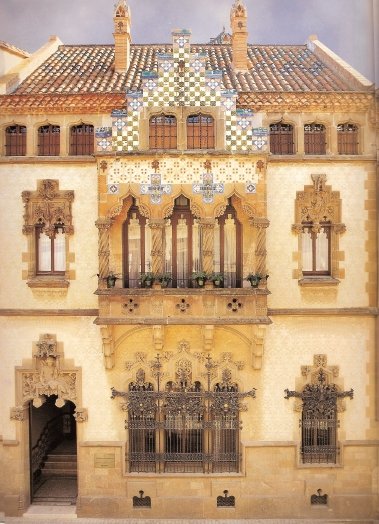
A textile manufacturer’s townhouse on Argentona Street, reworked by Josep Puig i Cadafalch into one of Catalan Modernisme’s most confident civic statements.
At a glance
Casa Coll i Regàs stands on Carrer d’Argentona in Mataró, a coastal city near Barcelona. Josep Puig i Cadafalch designed it in 1897–1898 for Joaquim Coll i Regàs, a local textile manufacturer. The building fuses Montjuïc stone, sgraffito, wrought iron and sculpture into a single decorative program. It was declared a historical monument in 2000 and is now cared for by the Fundació Iluro.
History
On 12 May 1897, Coll i Regàs petitioned Mataró’s city council for permission to fully renovate two adjoining houses, numbers 55 and 57. The request followed a pattern common among the city’s urban bourgeoisie, who often absorbed and rebuilt existing structures rather than start anew. What resulted, however, was unusual. It became the only grand modernist mansion built in Mataró during the period. Puig i Cadafalch was by then the dominant architectural voice in the city, shaping much of its civic and cultural life alongside his buildings. It is likely no coincidence that Coll i Regàs turned to him.
What you see
The street facade combines a stone socket, an imposing portal and a projecting ground-floor tribune, all carved from Montjuïc stone by sculptor Eusebi Arnau, a frequent collaborator of Puig i Cadafalch. Above the entrance, a carved spinner figure crowns the portal. It has become an informal emblem of the city. Sgraffito and glazed tiling cover much of the upper facade, culminating in a large decorated pediment over the rostrum. Catalan-style eaves finish the roofline. Ground-floor window bars, likely forged in Manuel Ballarín’s Barcelona workshop, incorporate motifs drawn from knitting machinery. Throughout the house, cotton flowers and textile-gear emblems recur in sgraffito and leaded glass. The architect never let visitors forget whose house this was.
Cultural significance
Casa Coll i Regàs embodies Modernisme’s ambition to unite architecture with sculpture, ironwork and applied craft into one expressive whole. Its plant-derived ornament, asymmetry and sense of movement typify the style’s break from academic convention. As Mataró’s sole grand modernist private residence, it also documents how the city’s textile-driven bourgeoisie used architecture to signal status and industry. The building’s protected status since 2000 and its stewardship by the Fundació Iluro affirm its place among Catalonia’s key Modernisme landmarks, alongside Puig i Cadafalch’s better-known Barcelona works.
Key facts
- Location: Carrer d’Argentona, Mataró, Spain
- Architect: Josep Puig i Cadafalch
- Built: 1897–1898
- Style: Catalan Modernisme / Art Nouveau architecture
- Sculptor: Eusebi Arnau (facade stonework)
- Ironwork attributed to: Manuel Ballarín’s workshop
- Heritage status: Declared historical monument, 2000
- Current custodian: Fundació Iluro, Mataró
Practical information & getting there
Mataró sits on the coast northeast of Barcelona, easily reached by regional train. Once in the city center, Casa Coll i Regàs stands on Carrer d’Argentona, within walking distance of the seafront and main train station. Check the official website before visiting, as access may depend on scheduled openings or guided visits arranged through the Fundació Iluro.
Sources & resources
Find it on the map
See this place and what’s around it →📷 Become a Cultural Heritage Online photographer
Share your photos of places: they stay published under your name as the author. The more they're seen, the more you get noticed — and soon a contest will reward the most appreciated photos.
Log in or sign up free to add a photoIs this page about you?
This page is read by travellers and heritage enthusiasts who find it on Google. Tell us how you are connected to this place and we will take it from there.