
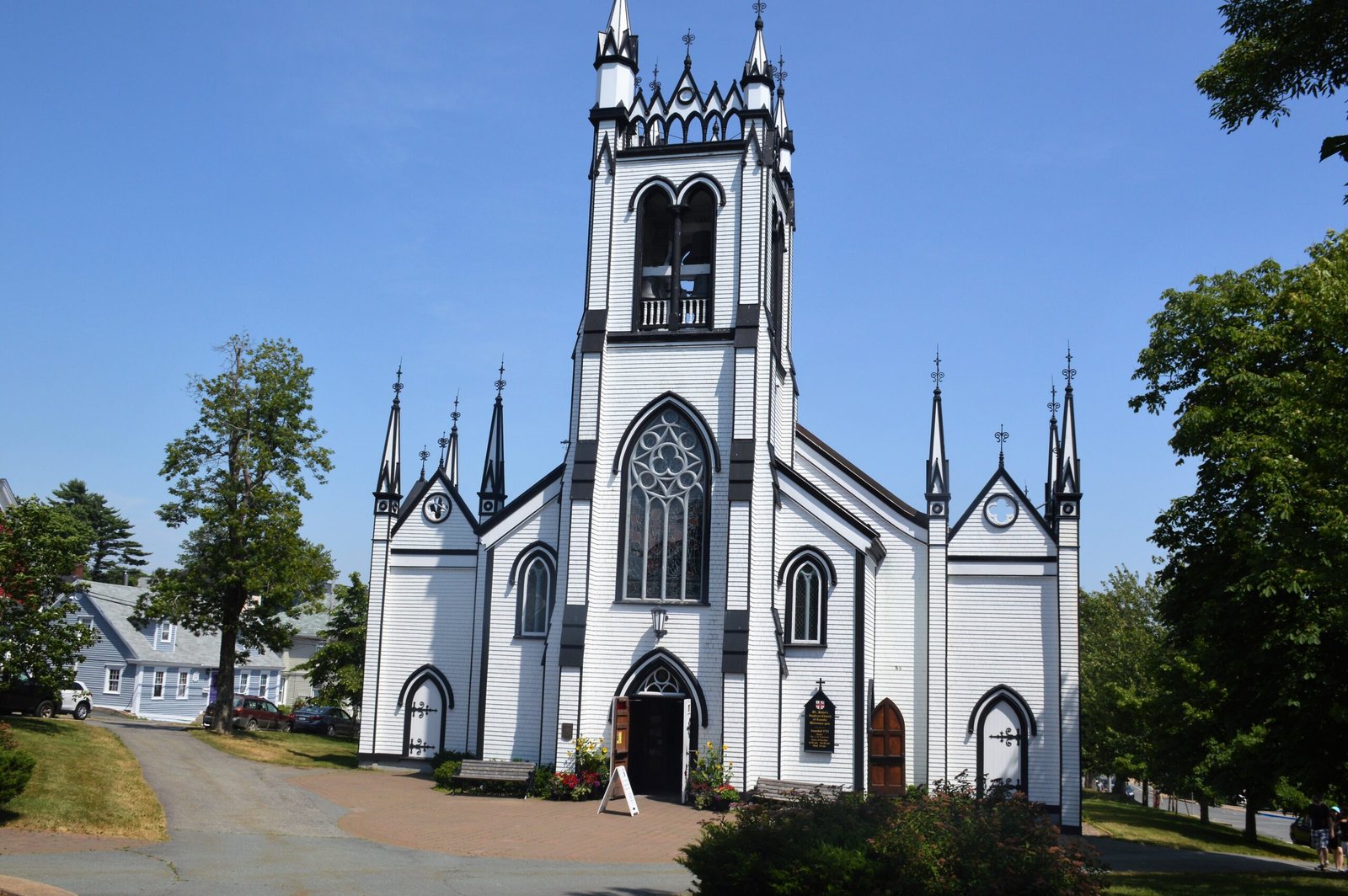
The Anglican church of St. John’s presides over the parade ground of the Old Town of Lunenburg. The town was founded in 1753 by the foreign Protestant settlers of the British crown. The building of the church began in 1754, the 1753 on the signs being the year of the founding of the town and of the first open-air service, not of the church, and it was completed in the early sixties of the eighteenth century. It is the second oldest Anglican church in Canada, after St. Paul’s in Halifax. Born as a plain New England meeting house, it was transformed over the nineteenth century, with Gothic elements from 1840 and the great enlargement of 1892, led by the local master builder Solomon Morash, into the «Carpenter Gothic» style: the Gothic carried out entirely in wood, with tracery, spires and fourteen pinnacles added to the roofline. The building has been a National Historic Site of Canada since 1994. Its recent history is marked by fire: on Halloween night in 2001 a blaze, suspected of being deliberate, devastated most of the building, which was then rebuilt with philological care from the ruins between 2002 and 2004 and reconsecrated on 12 June 2005. In the restoration the ceiling of the chancel was repainted: a deep blue night sky with about seven hundred golden stars which, according to the astronomical reconstruction, reproduces the sky of Lunenburg at sunset on 24 December of the year 1 BC, the traditional date of the birth of Christ. The church is a landmark building of the Old Town of Lunenburg, the best preserved planned British colonial settlement in North America, inscribed on the UNESCO World Heritage List in 1995 under criteria (iv) and (v).
About the Church
St. John’s Anglican Church stands on the Parade in the Old Town of Lunenburg, Nova Scotia. Its building was begun in 1754 — the second-oldest Anglican church in Canada, after St. Paul’s in Halifax — and remodelled through the 19th century into “Carpenter Gothic”, the Gothic Revival executed entirely in wood. A National Historic Site of Canada, it was devastated by a fire on Halloween night 2001 and meticulously rebuilt by 2005. Its chancel ceiling is painted as a night sky of some 700 gold stars. The church is a landmark of the Old Town of Lunenburg, a UNESCO World Heritage Site since 1995.
Key facts
- 1754: construction of the building begins (the town was founded, and its first service held, in 1753).
- Second-oldest Anglican church in Canada, after St. Paul’s, Halifax.
- c. 1840–1892: remodelled into Carpenter Gothic, the major enlargement of 1892 led by carpenter Solomon Morash.
- 1994: designated a National Historic Site of Canada.
- Halloween night 2001: a fire — arson was suspected — devastates the church; rebuilt 2002–2004, rededicated 12 June 2005.
- 1995: Old Town of Lunenburg inscribed by UNESCO, criteria (iv)(v).
History
Lunenburg was laid out in 1753 as a British “model town” for Foreign Protestant settlers, and its Anglican congregation built St. John’s from 1754 — the second-oldest Anglican church in the country, after St. Paul’s in Halifax. It began as a plain New England meeting house; the 19th century dressed it in wood-carved Gothic, with Gothic elements added from 1840 and a sweeping 1892 enlargement under the local master carpenter Solomon Morash, who gave the roofline its fourteen pinnacles. In 1994 the building was made a National Historic Site of Canada.
On Halloween night 2001 a fire — suspected to be arson — burned much of the church. Rather than replace it, the parish rebuilt from the surviving ruins between 2002 and 2004, rededicating St. John’s on 12 June 2005. In the restoration the chancel ceiling was repainted as a deep-blue night sky scattered with roughly 700 gold stars — a pattern, worked out with astronomical advice, that renders the Lunenburg sky at sunset on 24 December of the year 1 BC, the traditional date of Christ’s birth.
What you see
A tall white clapboard church edged everywhere in black board-and-batten trim — Carpenter Gothic at its most exuberant. A central square belfry tower rises to a crenellated crown ringed with pinnacles; a great traceried pointed window sits over the entrance, and the gabled wings carry quatrefoil oculi and their own corner spires, all rendered in wood where a stone church would carve them. Inside, the restored chancel ceiling is the sight to seek out: the painted night sky of Christ’s birth, its constellations named.
Practical information
- Opening hours: open to visitors in season and for worship; check current times before visiting.
- Location: on the Parade in Old Town Lunenburg, bordered by Cumberland, Duke and Townsend Streets, Lunenburg, Nova Scotia, Canada.
- Status: active Anglican congregation (Anglican Church of Canada).
Getting there
The church occupies a full block in the centre of Old Town Lunenburg, on the hillside grid above the working waterfront; Lunenburg is about 90 km southwest of Halifax. GPS: 44.3781°N, 64.3111°W.
Nearby
- Old Town of Lunenburg — the UNESCO-listed grid town, the best-preserved planned British colonial settlement in North America.
- Lunenburg waterfront and the Fisheries Museum of the Atlantic — the harbour that the town was designed around.
- St. Andrew’s Presbyterian Church — the dark-spired church visible nearby in the Old Town.
Sources
- Parks Canada — National Historic Sites of Canada record for St. John’s Anglican Church.
- Canadian Register of Historic Places (historicplaces.ca) — construction and Carpenter Gothic dates.
- St. John’s Anglican Church, Lunenburg — parish heritage record.
- Painted Rooms of Nova Scotia — the star-painted chancel ceiling.
- UNESCO World Heritage Centre — “Old Town Lunenburg” (ref. 741); CBC — the 2001 fire and 2005 reopening.
Find it on the map
See this place and what’s around it →📷 Become a Cultural Heritage Online photographer
Share your photos of places: they stay published under your name as the author. The more they're seen, the more you get noticed — and soon a contest will reward the most appreciated photos.
Log in or sign up free to add a photo