
The Cathedral of the Transfiguration, in Ukrainian Spaso-Preobrazhensky, is the mother church of Odesa: founded in 1794, the same year as the city, and consecrated in 1808. With the bell tower completed in 1837 it became the principal church and, as UNESCO, Al Jazeera and the Smithsonian confirm, the largest Orthodox place of worship in Odesa. Its history is marked twice by destruction. In 1936 the Soviets blew it up, in the Stalinist campaign against religion; the tomb of Prince Mikhail Vorontsov, governor general of New Russia, who died in 1856, and that of his wife were desecrated. The cathedral was rebuilt from 1999, the structure completed between 1999 and 2003, and reconsecrated in 2010 by Patriarch Kirill of Moscow, and the remains of the Vorontsovs were buried there again, in 2005, in the lower church. Then came the war. On 23 July 2023, a few months after the UNESCO inscription, a Russian missile struck the cathedral, according to the Ukrainian authorities and UNESCO, while Russia has denied targeting it, with a direct impact on the altar area. UNESCO classified it «severely damaged», with critical weaknesses in the bell tower and the nave. The director general Audrey Azoulay condemned the attack «in the strongest terms». The Historic Centre of Odesa had been inscribed on the World Heritage List, and at the same time on the list of heritage in danger, on 25 January 2023, under emergency procedure; the cathedral stands inside the site. Today it is under repair. On its ecclesiastical allegiance the sources point to the Ukrainian Orthodox Church historically tied to the Patriarchate of Moscow, and it is reported here with that caution.
About the Cathedral
The Transfiguration Cathedral (Spaso-Preobrazhensky) is the mother church of Odesa, founded in 1794 with the city and consecrated in 1808. Its bell tower, completed in 1837, made it the largest Orthodox church building in Odesa. Blown up by the Soviets in 1936, it was rebuilt between 1999 and 2010 and re-consecrated. On 23 July 2023, months after Odesa’s historic centre was inscribed by UNESCO, a Russian missile strike severely damaged it. It stands on Cathedral Square, within the Historic Centre of Odesa, a UNESCO World Heritage Site (and site in danger) since 2023.
Key facts
- 1794: founded with the city of Odesa; consecrated in 1808.
- 1837: the bell tower completed, making it the largest Orthodox church in Odesa.
- 1936: demolished by the Soviets in the Stalin-era campaign against religion.
- 1999–2010: rebuilt and re-consecrated; the tomb of Prince Vorontsov and his wife restored in the lower church (2005).
- 25 January 2023: the Historic Centre of Odesa inscribed by UNESCO, and placed on the List of World Heritage in Danger.
- 23 July 2023: severely damaged by a Russian missile strike (Russia denied targeting it), per Ukrainian authorities and UNESCO.
History
Odesa built its cathedral as it built itself, from 1794, and consecrated it in 1808; the tall bell tower of 1837 made it the city’s largest church. Beneath it were laid the Vorontsovs — Prince Mikhail, Governor-General of New Russia, and his wife Elizaveta. That first cathedral did not survive the 20th century: in 1936 the Soviets dynamited it, and the Vorontsov tomb was robbed. Reconstruction began only in 1999; the rebuilt cathedral was completed in the early 2000s and re-consecrated in 2010, with the Vorontsov remains reburied in the lower church in 2005.
Its second destruction came in war. On 23 July 2023 — six months after Odesa’s historic centre entered the World Heritage List under an emergency procedure, and its List of World Heritage in Danger — a Russian missile struck the cathedral, according to Ukrainian authorities and UNESCO; Russia denied targeting it. The hit fell on the altar area, and UNESCO classed the building “severely damaged”, singling out the bell tower and nave for immediate stabilization. Repairs, supported by UNESCO and international partners, have been under way since.
What you see
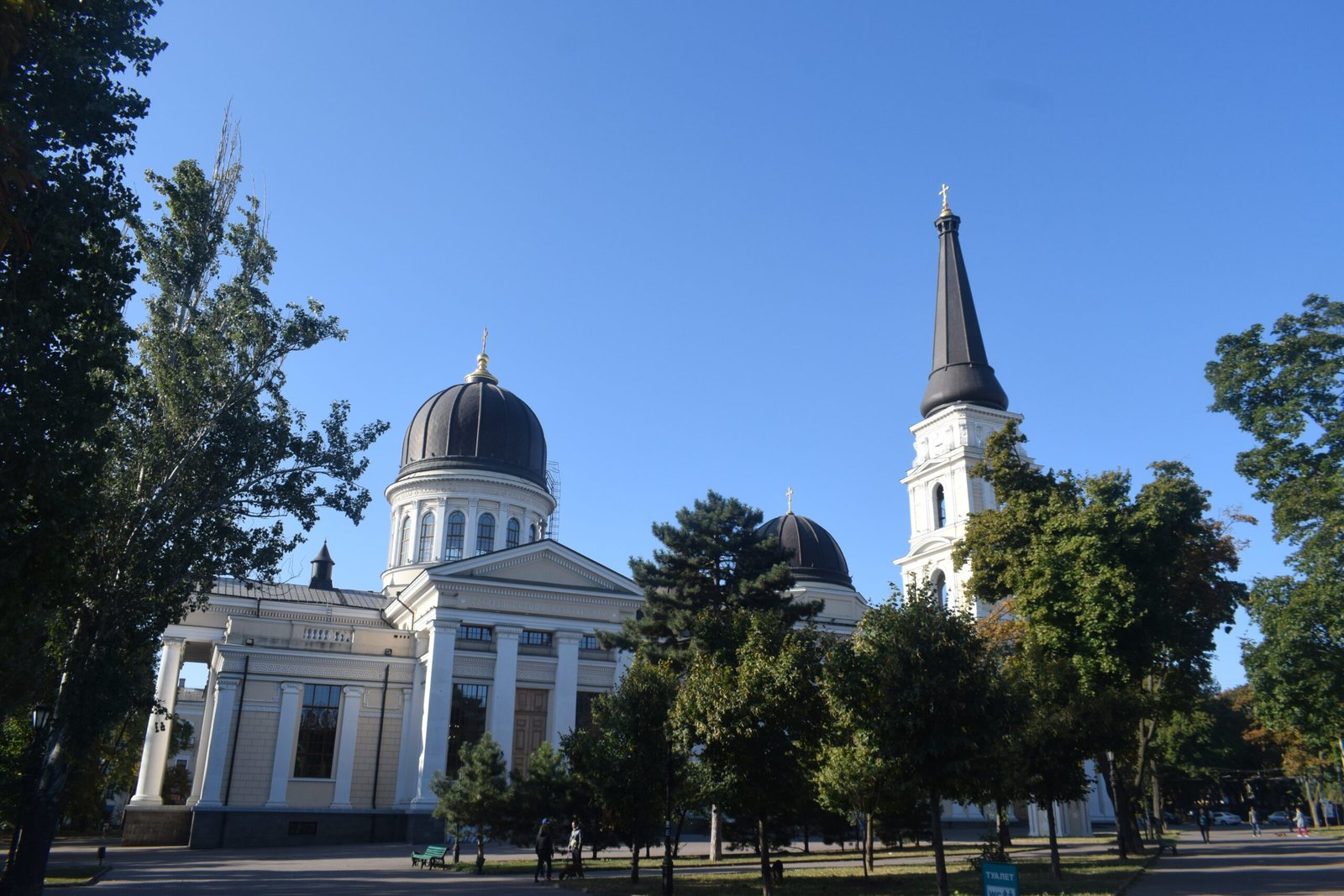
A large white Neoclassical Orthodox cathedral on the green expanse of Cathedral Square (Soborna Square): a black central dome on a colonnaded drum, a smaller side dome, and a tall multi-tiered white bell tower crowned with a dark spire and gold cross — the vertical landmark of the square. The image here shows the cathedral intact, before the 2023 strike; restoration of the war damage continues. Inside, the lower church holds the restored tomb of the Vorontsovs.
Practical information
- Status: active cathedral; under repair following the July 2023 damage — check access before visiting.
- Location: Soborna Square 3, Prymorskyi district, central Odesa, Ukraine.
- Jurisdiction: the Ukrainian Orthodox Church (historically the Moscow Patriarchate), per available sources.
Getting there
The cathedral stands on Soborna Square in the centre of Odesa, along Preobrazhenska Street, a short walk from Deribasivska and the city’s central axis. GPS: 46.4832°N, 30.7310°E.
Nearby
- Historic Centre of Odesa — the UNESCO-listed core, placed on the List of World Heritage in Danger at its 2023 inscription.
- Soborna Square — the cathedral’s green square, with the Vorontsov monument.
- Potemkin Stairs and Prymorskyi Boulevard — the seafront landmarks of central Odesa.
Sources
- UNESCO — statements on the Historic Centre of Odesa inscription (2023) and on the cathedral’s damage and repairs.
- Al Jazeera, CNN, Smithsonian Magazine, The Art Newspaper — reporting on the 23 July 2023 strike.
- Religiana and Geomerid — the cathedral’s chronology, demolition and reconstruction.
- RISU (Religious Information Service of Ukraine) — on the cathedral’s jurisdiction.
- Wikipedia (English) — “Transfiguration Cathedral, Odesa”, used as a map and cross-checked.
Find it on the map
See this place and what’s around it →📷 Become a Cultural Heritage Online photographer
Share your photos of places: they stay published under your name as the author. The more they're seen, the more you get noticed — and soon a contest will reward the most appreciated photos.
Log in or sign up free to add a photo