
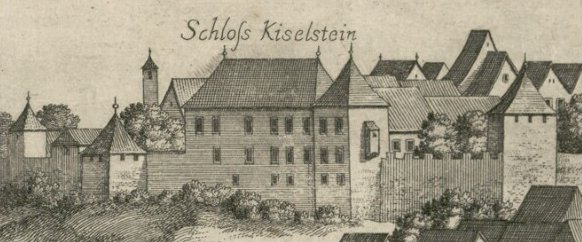
A medieval fortress guarding the Sava crossing, transformed from a defensive tower into an L-shaped castle and now home to a regional museum.
At a glance
Kieselstein Castle occupies a strategic point in Kranj where the river Sava narrows. Built in 1256 by the Counts of Ortenburg, it evolved from a 11th-century round keep into the castle visible today. The structure served military, administrative, and cultural purposes across seven centuries.
History
An 11th-century round keep first stood at this defensible site. In 1256, the Counts of Ortenburg commissioned the castle’s construction in partnership with Ulrich III, Duke of Carinthia, lord of Kranj. The von Chreinburch knights managed it as vassals until 1420, when it passed to Count Hermann II of Celje.
During Ottoman raids, the tower was incorporated into Kranj’s city defenses. After the Counts of Celje died out in 1456, the Habsburgs inherited the property. By the mid-16th century, Baron Hans Khiessl purchased it and secured Emperor Ferdinand I’s permission to rename it. Khiessl expanded the tower into an L-shaped castle, establishing its present form.
Successive noble families—von Moscon, Ravbar, Apfaltrer, Auersperg, and Pagliaruzzi—held it until 1913, when the state acquired the building. It housed government offices between the wars; post-1945, it was nationalized. Architect Jože Plečnik oversaw its 1952 renovation.
What you see
The castle’s most distinctive feature is its L-shaped plan, a direct result of Khiessl’s 16th-century expansion. The structure retains elements of its medieval origin while bearing marks of Renaissance modification. The 1952 renovation by Plečnik respected historical integrity while adapting the building for modern institutional use.
Cultural significance
Kieselstein represents Kranj’s strategic importance as a river crossing and the shifting political allegiances of Upper Carniola. The castle’s transformation—from military stronghold to baronial residence to state institution—mirrors broader European patterns of feudalism, empire, and modernization. Its preservation and adaptive reuse exemplify 20th-century heritage stewardship.
Key facts
- Built: 1256 by the Counts of Ortenburg
- Location: Kranj, Slovenia
- Coordinates: 46.238, 14.354
- Current use: Upper Carniola Museum and Municipal Heritage Agency
- Notable renovation: 1952, architect Jože Plečnik
Practical information & getting there
Kieselstein Castle is located in central Kranj, on the banks of the Sava River. The site is accessible by public transport and by car; parking is available in the city center. Check locally for current opening hours and exhibition schedules, as the castle operates as a museum and administrative office.
Sources & resources
Find it on the map
See this place and what’s around it →📷 Become a Cultural Heritage Online photographer
Share your photos of places: they stay published under your name as the author. The more they're seen, the more you get noticed — and soon a contest will reward the most appreciated photos.
Log in or sign up free to add a photoIs this page about you?
This page is read by travellers and heritage enthusiasts who find it on Google. Tell us how you are connected to this place and we will take it from there.