
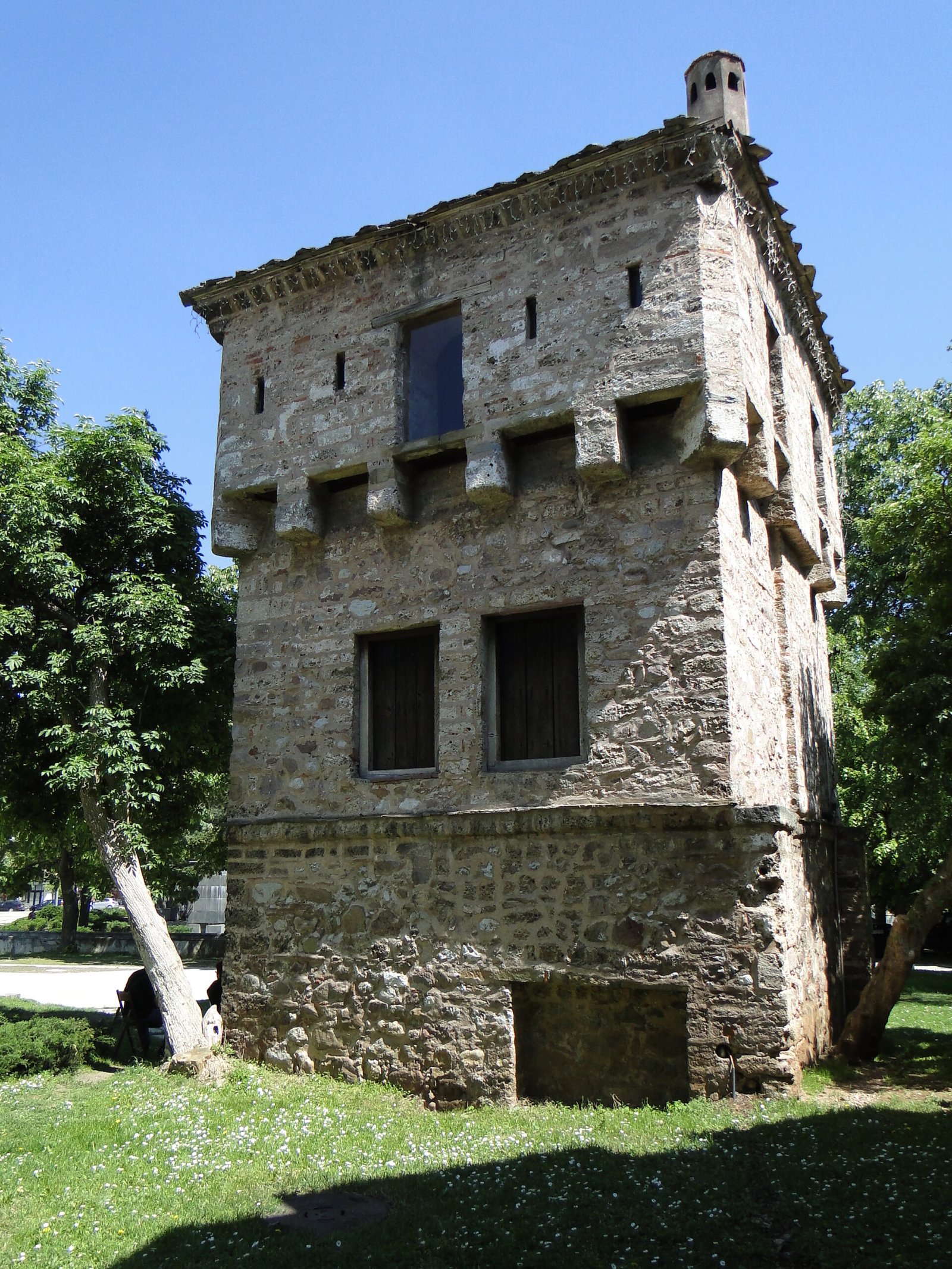
A compact Ottoman-era tower house in northwest Bulgaria, this four-story defensive dwelling once sheltered a local feudal family and now serves as a museum exhibition space.
At a glance
The Tower of Kurt Pasha stands as a surviving example of the tower-house architecture that emerged across the Balkans during the turbulent 17th century. Built by a local feudal lord as a fortified family residence, it exemplifies the specific defensive architecture adapted to Ottoman-era instability. Today it operates as an exhibition venue, bridging its historical military function with contemporary cultural use.
History
Constructed in the 17th century during a period of anarchic conditions within the Ottoman Empire, the tower was built by a local feudal lord to serve as a fortified abode for his family, the Kurtpashovtsi. According to legend, the family descended from medieval Bulgarian nobility and maintained their regional holdings after converting to Islam under Ottoman rule. The tower underwent minor conservation works in late 2011, valued at 10,000 Bulgarian leva. Since early 2012, it has functioned as a souvenir shop and exhibition space for the Vratsa Regional Historical Museum, attracting 40,000 visitors between 2012 and mid-2013.
What you see
The structure rises 11 meters from a square foundation of 6 by 6 meters, comprising four stories including basement and ground level. The two upper floors housed the owner’s family. Stone, mortar, and trimmer joists separate each floor—a deliberate fire-prevention measure characteristic of the period.
Defensive features dominate the design: the top floor features twelve arrow slits and openings positioned between corbels for pouring boiling liquids over attackers. The tower’s lack of windows and fortress-like silhouette give it the appearance of a small medieval stronghold despite being more modern and smaller than the nearby Tower of the Meshchii.
Cultural significance
The Tower of Kurt Pasha represents a distinctive architectural response to Ottoman-era instability in the Balkans. It documents the lives of local power holders navigating religious and political transformation, while its conversion to a cultural venue preserves that heritage for contemporary audiences.
Key facts
- Location: Vratsa, Bulgaria
- Coordinates: 43.20083333, 23.5475
- Date: 17th century
- Dimensions: 6 × 6 m base; 11 m height
- Stories: 4 (including basement)
- Current use: Exhibition space and souvenir shop
Practical information & getting there
The tower is located in Vratsa in northwest Bulgaria and operates as an exhibition space adjacent to the Vratsa Regional Historical Museum. Specific hours and admission details are available through the museum. The site welcomes visitors year-round, combining historical interpretation with a small souvenir shop on the ground floor.
Sources & resources
Find it on the map
See this place and what’s around it →📷 Become a Cultural Heritage Online photographer
Share your photos of places: they stay published under your name as the author. The more they're seen, the more you get noticed — and soon a contest will reward the most appreciated photos.
Log in or sign up free to add a photoIs this page about you?
This page is read by travellers and heritage enthusiasts who find it on Google. Tell us how you are connected to this place and we will take it from there.