
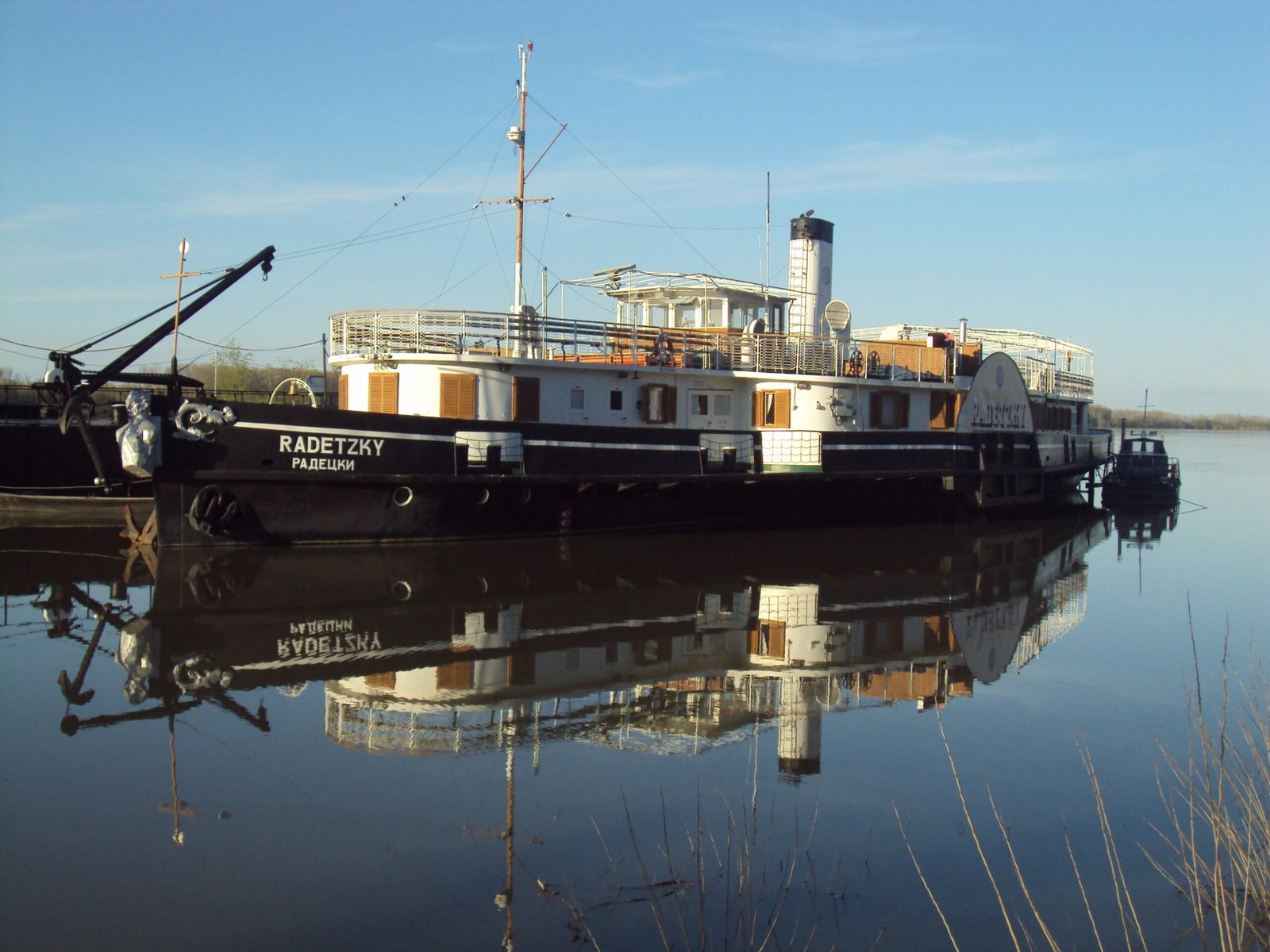
A restored Austro-Hungarian paddle steamer that carried Bulgarian revolutionaries toward liberation, now preserved as a floating monument to courage and national identity.
At a glance
The Radetzky is a composite reconstruction of an 1851 Austro-Hungarian passenger steamship, built as a museum vessel in 1966. It occupies a singular place in Bulgarian history—both as an artifact of imperial Danube commerce and as the ship commandeered by poet-revolutionary Hristo Botev in 1876. Today it stands at Kozloduy as a national relic.
History
The original Radetzky was constructed in 1851 at the Óbuda shipyard in Hungary and operated regular passenger services along the Danube between Orşova and Galaţi. The ship earned its place in Bulgarian memory on 29 May 1876, when Hristo Botev and his band—disguised as gardeners—boarded from various ports and bloodlessly commandeered the vessel from Captain Dagobert Engländer.
Botev’s written message to the captain was remarkable for its civility and clarity of purpose: the revolutionaries sought passage to Kozloduy to organize an anti-Ottoman uprising following the crushed April Uprising. The captain acquiesced to their demand, and upon arrival the rebels knelt and kissed Bulgarian soil in farewell, while passengers saluted them with waving caps.
The original ship was decommissioned in 1918 and destroyed in 1924. Key relics—including the ship’s flag, seal, and original licence—were preserved by Adolf Engländer, the captain’s brother, and gifted to Boris III.
Between 1964 and 1966, Bulgarian schoolchildren (1.2 million strong) raised funds for reconstruction on the initiative of journalist Lilyana Lozanova. The new Radetzky, built around a 1953 Soviet paddle tug and incorporating salvaged original components, was officially inaugurated as a museum ship on 30 May 1966.
What you see
The reconstructed vessel is a composite: its hull and working machinery derive from a Cold War-era Soviet tug, while elements of the original 1851 structure have been integrated where preserved. The ship’s design reflects mid-19th-century Austro-Hungarian passenger steamship standards, with the characteristic paddle-wheel configuration.
Visitors board a functioning river vessel rather than a static monument, experiencing the confined quarters and working spaces where Botev and his companions concealed themselves before their peaceful takeover.
Cultural significance
The Radetzky embodies a pivotal moment in Bulgarian national consciousness: a bloodless seizure of an imperial vessel for a revolutionary cause. Hristo Botev’s measured proclamation—respecting the ship’s crew, addressing passengers with courtesy, even toasting Franz Joseph and Count Andrássy alongside Bulgarian independence—presents a unique portrait of armed dissent conducted with restraint.
National writer Ivan Vazov immortalized the events in a poem that became the patriotic song “Still White Danube Undulates.” A village in Sliven Province also bears the ship’s name, Radetski, cementing it in the geography of memory.
Key facts
- Country: Bulgaria
- City: Kozloduy
- Built: 1851 (Óbuda, Hungary); reconstructed 1964–1966
- Commissioned as museum: 30 May 1966
- Coordinates: 43.79861111, 23.67805556
Practical information & getting there
The Radetzky Museum Ship is located at Kozloduy on the Danube. As an active museum vessel, visiting hours and access may vary seasonally; contact local tourism offices in Kozloduy for current information. The site is accessible by road from Sofia (approximately 200 km north) or by rail to Kozloduy station.
Sources & resources
Find it on the map
See this place and what’s around it →📷 Become a Cultural Heritage Online photographer
Share your photos of places: they stay published under your name as the author. The more they're seen, the more you get noticed — and soon a contest will reward the most appreciated photos.
Log in or sign up free to add a photoIs this page about you?
This page is read by travellers and heritage enthusiasts who find it on Google. Tell us how you are connected to this place and we will take it from there.