

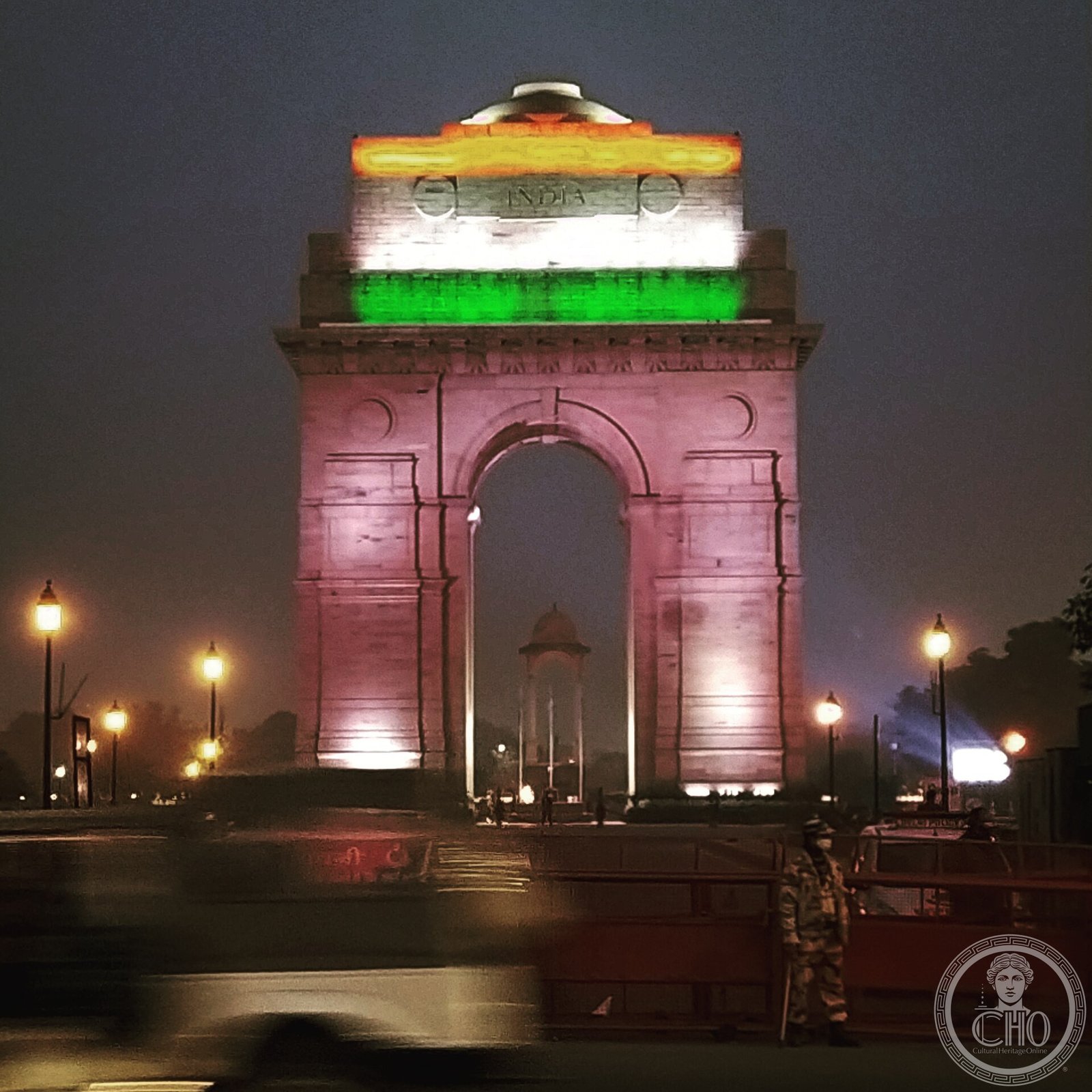
India Gate is a 42-metre-high triumphal arch in the heart of New Delhi, built to commemorate the 70,000 soldiers of the British Indian Army who died in the First World War and the Third Anglo-Afghan War. Designed by Sir Edwin Lutyens and inaugurated in 1931, it stands at the eastern end of Kartavya Path (formerly Rajpath) and functions today as India’s principal national war memorial, where an eternal flame — the Amar Jawan Jyoti — has burned since 1972 in honour of fallen soldiers.
At a glance
- Type
- Triumphal arch and national war memorial
- Period
- Designed 1917; construction completed 1931; Amar Jawan Jyoti added 1972
- Style
- Neo-classical / Imperial Delhi architecture (Edwin Lutyens)
- Location
- Kartavya Path, New Delhi 110001, India
- Coordinates
- 28.6129° N, 77.2273° E
Overview
India Gate is one of the most recognisable landmarks in India, serving simultaneously as a historic war memorial and a popular gathering place for Delhi residents and tourists. It anchors the ceremonial axis of New Delhi, with the Presidential Palace (Rashtrapati Bhavan) visible to the west along the broad boulevard of Kartavya Path. The structure is inscribed with the names of more than 13,000 soldiers who died on the North-West Frontier and in the Afghan campaign.
History
The memorial was conceived by the Imperial War Graves Commission after the First World War to honour Indian soldiers who died serving the British Crown. Edwin Lutyens, the principal architect of New Delhi, designed the arch between 1917 and 1921, drawing on the formal language of Roman triumphal arches. The foundation stone was laid by the Duke of Connaught in 1921 and the structure was inaugurated by Viceroy Lord Irwin on 12 February 1931. After India’s independence in 1947, it became a national symbol, and the Amar Jawan Jyoti — an eternal flame beneath an inverted rifle crowned with a soldier’s helmet — was installed in 1972 by Prime Minister Indira Gandhi to honour Indian soldiers who died in the 1971 Bangladesh Liberation War.
What you see
The arch rises 42 metres and is built of Bharatpur stone, a red and buff sandstone that glows golden at sunset. The word “INDIA” is inscribed on both faces of the arch, while the names of 13,516 servicemen are carved into the surface. Beneath the arch, the Amar Jawan Jyoti burns under an eternal black marble plinth. The surrounding lawns, fountains and canals of India Gate Lawns form one of Delhi’s most beloved public parks, particularly lively at dusk when families and visitors gather.
Cultural significance
India Gate occupies a unique position in the national consciousness as both an Imperial-era monument and a post-independence symbol of military sacrifice. The annual Republic Day parade on 26 January passes along Kartavya Path, with India Gate as its ceremonial backdrop and focal point. It also serves as a site of national mourning and tribute following major military events, reflecting its dual heritage as a British colonial work and an Indian national landmark.
Practical information
- Address
- Kartavya Path, New Delhi 110001, India
- Hours
- Open to visitors at all times; the surrounding lawns are busiest at dusk
- Admission
- Free
- Note
- Road access around the monument may be restricted during Republic Day preparations (late January)
Getting there
The nearest metro stations are Central Secretariat (Yellow and Violet Lines) and Udyog Bhawan (Yellow Line), both about 1 km away. Auto-rickshaws and taxis are available from Connaught Place. India Gate is a 10-minute walk from the Khan Market metro station (Violet Line).
Sources & resources
Find it on the map
See this place and what’s around it →📷 Become a Cultural Heritage Online photographer
Share your photos of places: they stay published under your name as the author. The more they're seen, the more you get noticed — and soon a contest will reward the most appreciated photos.
Log in or sign up free to add a photo