

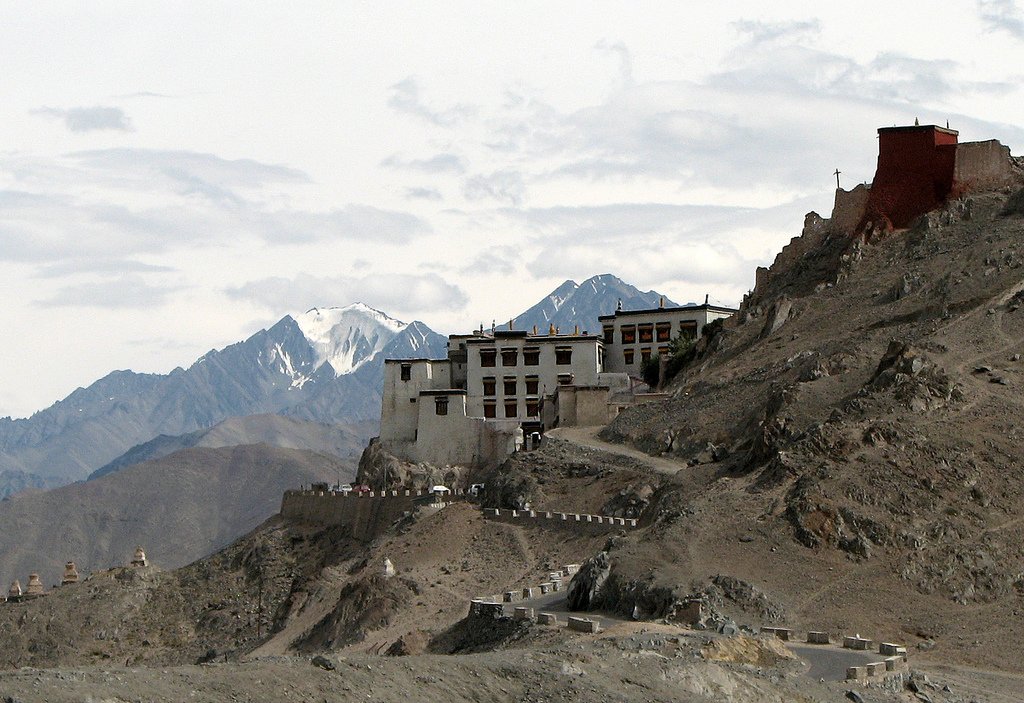
A royal sanctuary crowned by Ladakh’s second-largest Buddha statue, this hilltop complex traces its origins to the 10th-century palace of King Lhachen Palgyigon and evolved into a monastic centre under Deldan Namgyal in the 17th century.
At a glance
Shey Monastery stands on a hillock 15 kilometres south of Leh, strategically positioned on the Leh-Manali road. The compound merges royal residence and religious sanctuary, anchored by a colossal copper Buddha statue gilded in gold. Once the summer capital of Ladakh, Shey retains layers of architectural and political history across five centuries.
History
The original palace was built in the 10th century by Lhachen Palgyigon, king of Ladakh (then known as Maryul). The complex later housed the Moghul noble Mirza Haidar Dughlat during his 16th-century invasion of the region.
The monastery and its palatial structures were established in 1655 on the orders of Deldan Namgyal, who commissioned them as a memorial to his father, Sengge Namgyal. This later construction fundamentally transformed Shey from a secular seat of power into a centre of religious practice.
What you see
The site comprises two principal structures: ruins of the original 10th-century palace occupy the upper reaches, while the 17th-century monastery spreads below. The monastery is dominated by its monumental seated Shakyamuni Buddha, cast in copper and finished with gilded gold—the second largest such statue in Ladakh.
The Buddha’s epithet derives from his historical role as the sage (muni) of the Sakya people, whose ancient homeland lay in the Himalayan foothills with their capital at Kapilvastu.
Cultural significance
Shey embodies the intersection of political power and religious devotion in Himalayan societies. Its transformation from a royal summer residence into a monastic complex reflects broader shifts in Ladakh’s governance and spiritual priorities during the early modern period. The scale and artistry of its Buddha statue demonstrate the wealth and artistic sophistication of 17th-century Ladakhi courts.
Key facts
- Location: Shey, Ladakh, India, 15 km south of Leh
- Coordinates: 34.07°N, 77.63°E
- Original palace: 10th century, founded by King Lhachen Palgyigon
- Later monastery and palace: 1655, commissioned by Deldan Namgyal
- Notable feature: Second-largest Buddha statue in Ladakh
Practical information & getting there
Shey Monastery lies directly on the Leh-Manali highway, making it accessible by road from Leh. The site is open to visitors, though specific hours and seasonal closures should be confirmed locally. Photography policies may apply within the monastery. Leh, 15 kilometres north, offers the nearest substantial accommodation and services.
Sources & resources
Find it on the map
See this place and what’s around it →📷 Become a Cultural Heritage Online photographer
Share your photos of places: they stay published under your name as the author. The more they're seen, the more you get noticed — and soon a contest will reward the most appreciated photos.
Log in or sign up free to add a photoIs this page about you?
This page is read by travellers and heritage enthusiasts who find it on Google. Tell us how you are connected to this place and we will take it from there.