
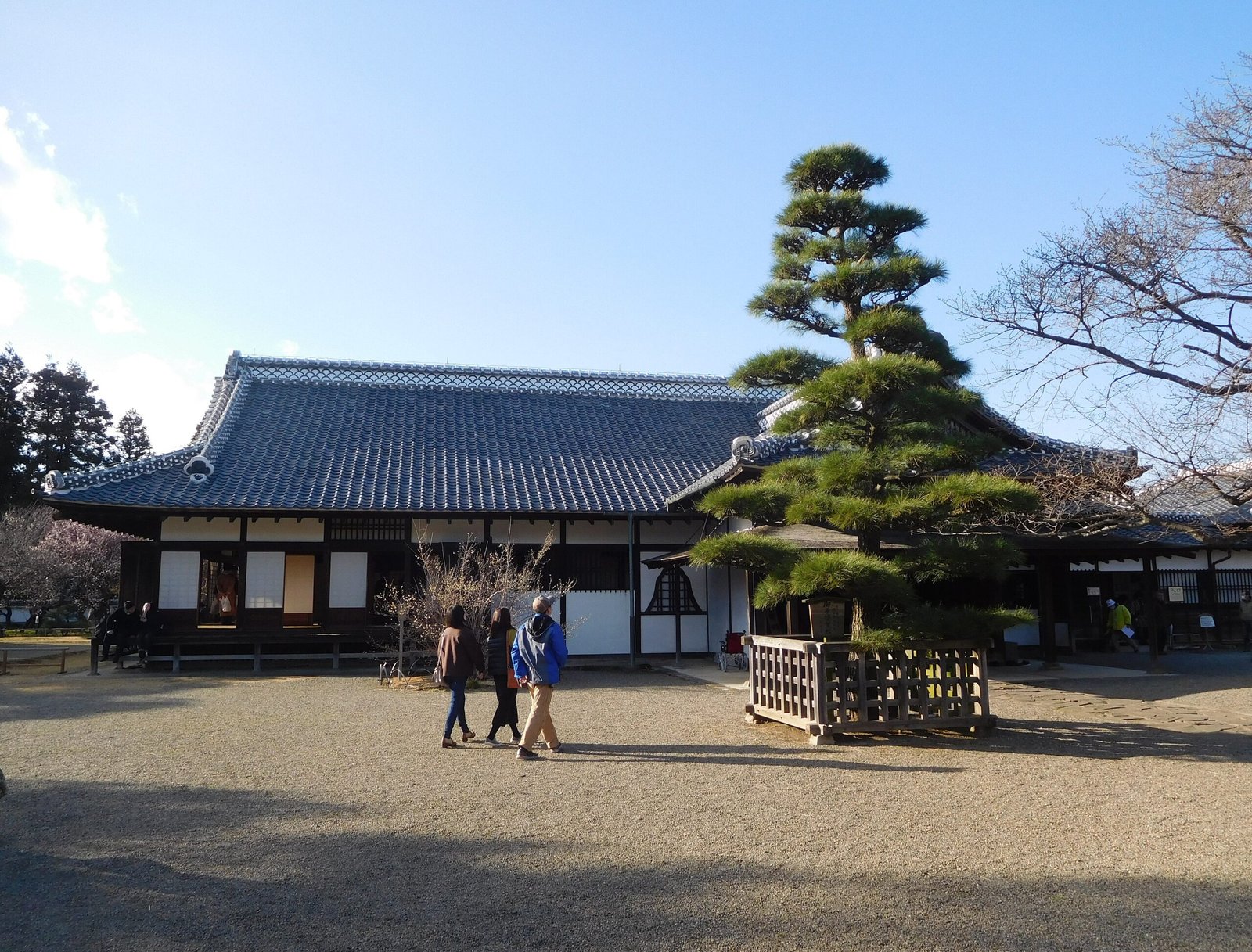
Founded in 1841 within Mito Castle’s third bailey, the Kōdōkan was the largest domain school of late Tokugawa Japan, a place where samurai sons studied swordsmanship alongside astronomy and Confucian texts.
At a glance
The Kōdōkan served Mito Domain as its han school, an institution for educating retainer families under a curriculum that ranged far beyond the martial arts its gates suggest. Three surviving buildings hold status as Important Cultural Properties, and the grounds themselves are designated a Special Historic Site.
History
Tokugawa Nariaki, ninth daimyō of Mito, founded the school in 1841. Construction dragged on. The last buildings were not finished until 1857. Nariaki was no quiet administrator. A vocal sonnō jōi advocate, he clashed repeatedly with tairō Ii Naosuke and drew on kokugaku nativist thought, ideas that fed directly into the Meiji Restoration and later State Shinto. The academy also carried forward Mitogaku, the scholarly tradition established generations earlier by Tokugawa Mitsukuni. Between 1863 and 1864 the Kōdōkan became the epicenter of the Mito rebellion, a bloody internal conflict pitting radical loyalists against shogunal authority. History returned in 1868. Tokugawa Yoshinobu, once a Kōdōkan student and the last shogun, was placed under house arrest here after his abdication. He did not stay long. Months later, survivors of the Battle of Aizu barricaded themselves inside the school, and government troops besieged them, damaging or destroying much of the complex. The school closed in 1872 as Japan’s education system was overhauled, and the site became a public park. Air raids on Mito in August 1945 destroyed much of what the Meiji-era high school had preserved of the original library. The 2011 Tōhoku earthquake caused further damage to surviving structures.
What you see
Three Edo-period buildings remain from the original 1841 construction. The Seimon, the main gate, still bears bullet holes from the 1868 fighting, a blunt physical record of the siege. The Seichō housed the school’s administration, including four dormitory buildings, sword-training grounds, and space for broader martial arts instruction. Nearby, the Shizendō held four rooms in the northeast corner, used as a waiting area for the daimyō and a study space for his children. Today the park around these structures is planted with roughly sixty varieties of Prunus mume, some trees reportedly dating to Nariaki’s own era.
Cultural significance
The Kōdōkan’s curriculum was notably broad for its time, covering medicine, mathematics, astronomy, Confucianism, history, and music alongside military training. Admission began at fifteen, but Mito Domain’s educational philosophy allowed students of any age to attend if their ability met the standard, with attendance requirements shaped by social rank. That flexibility reflected the domain’s wider intellectual ambitions, ambitions that helped push Japan toward the ideological currents of the Meiji Restoration.
Key facts
- Founded: 1841, by Tokugawa Nariaki, ninth daimyō of Mito Domain
- Location: Third bailey of Mito Castle, Ibaraki Prefecture, Japan
- Status: National Special Historic Site (designated 1922; special status 1952)
- Three buildings designated Important Cultural Properties: Seimon, Seichō, Shizendō
- School closed: 1872, following the Meiji educational reforms
Practical information & getting there
The site sits about a ten-minute walk from Mito Station on the JR East Jōban Line. You can wander the plum orchards freely as part of the surrounding park, though the historic buildings warrant a slower pace given the bullet-scarred gate and modest scale of the remaining structures. Spring brings the mume blossoms into bloom, drawing visitors to a landscape that once trained samurai for war and scholarship alike.
Sources & resources
Find it on the map
See this place and what’s around it →📷 Become a Cultural Heritage Online photographer
Share your photos of places: they stay published under your name as the author. The more they're seen, the more you get noticed — and soon a contest will reward the most appreciated photos.
Log in or sign up free to add a photoIs this page about you?
This page is read by travellers and heritage enthusiasts who find it on Google. Tell us how you are connected to this place and we will take it from there.