
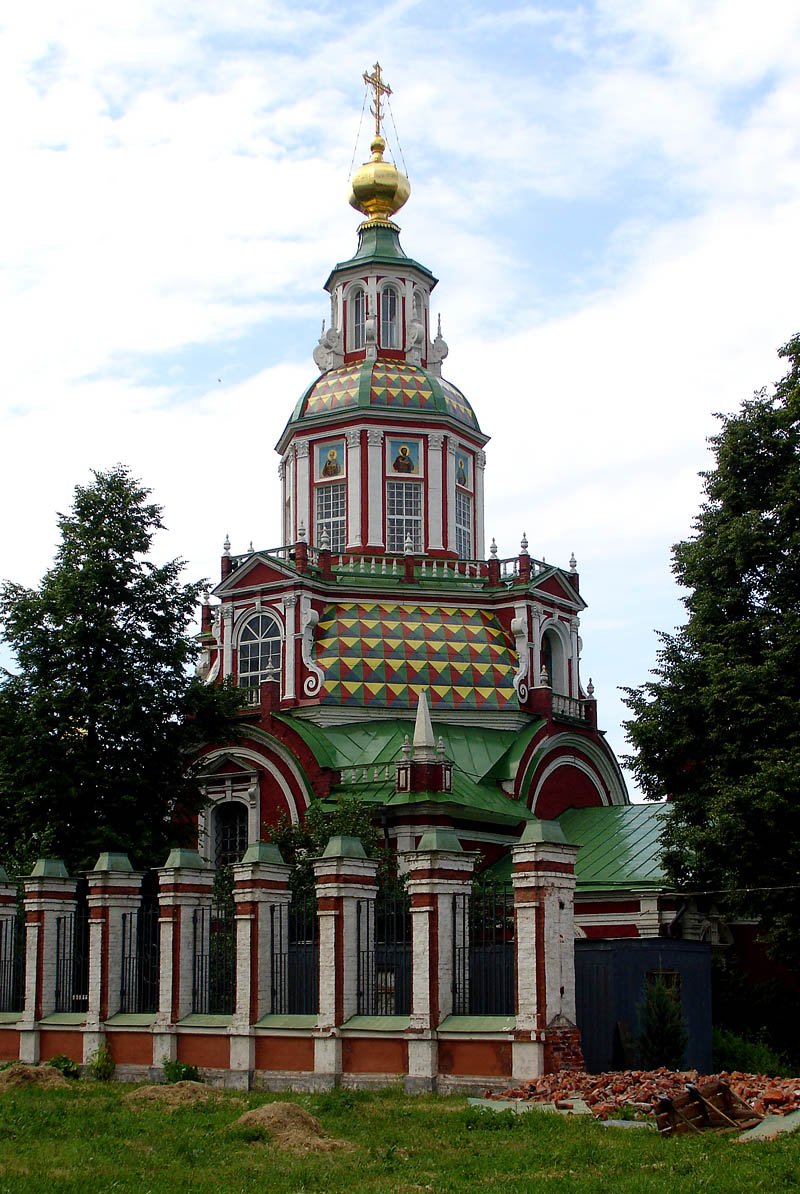
Two stacked octagons rise above Bolshaya Yakimanka Street, crowned by half-domes that catch the light differently through the day. Tsar Peter the Great is said to have ordered its rebuilding after a flood. The result is one of Moscow’s most distinctive Petrine Baroque survivors.
At a glance
Built between 1704 and 1717, the church replaced an older wooden structure from 1625 that stood on lower, flood-prone ground. Tradition attributes the design to Ivan Zarudny, though no signed record confirms this. The building survived the Soviet era in continuous use, a rare fact for a Moscow parish church.
History
The land along the Moskva River here once held sloboda settlements of Streltsy soldiers, Polish residents and farmers, regularly swamped by spring floods. Legend holds that Peter I, inspecting flood damage, found the earlier St. John church in ruins and ordered it rebuilt on safer, higher ground. He is said to have financed the new construction to mark the Battle of Poltava. A stone fence followed later, added in 1754–1758. Between 1779 and 1791 the interior gained frescoes by Gavriil Domozhirov and an iconostasis by Vasili Bazhenov, both lost during the 1860s. In 1928 a replacement iconostasis arrived, salvaged from the demolished Three Saints church at Red Gates. After the Revolution, the church took on an unexpected role: it sheltered icons and relics rescued from parishes the Communists tore down elsewhere in the city.
What you see
The church’s true architect is unrecorded. Stylistic echoes of the Menshikov Tower point many historians toward Ivan Zarudny, though the attribution stays unproven. Its form follows the Muscovite “octagon on a square” plan, familiar from countless Russian parish churches, but here doubled. Two coaxial octagons stack one atop the other, each sealed by its own half-dome. The overall effect blends Muscovite Baroque massing with Ukrainian Baroque ornament and the European decorative vocabulary fashionable under Peter’s rule. Little survives of the original 18th-century decoration; the frescoes and iconostasis added in the 1780s were both lost within a century, and the iconostasis seen today came secondhand from a demolished church in the 1920s.
Cultural significance
Few Moscow churches held their doors open through the entire Soviet period. This one did. That continuity made it a refuge for sacred objects removed from congregations that were not so fortunate, turning the building into an informal repository of Moscow’s lost ecclesiastical heritage. Its architecture also marks a transitional moment, when Russian church design absorbed European Baroque forms without abandoning older Muscovite habits of massing and silhouette.
Key facts
- Location: 46, Bolshaya Yakimanka Street, Moscow, Russia
- Built: 1704–1717, on the site of a 1625 predecessor
- Style: Russian Baroque, with Ukrainian Baroque and European influences
- Attributed architect: Ivan Zarudny (unconfirmed)
- Fence added: 1754–1758
- Heritage status: officially protected
Practical information & getting there
The church stands on Bolshaya Yakimanka Street, a short walk from central Moscow across the Moskva River from the Kremlin. You can reach the area easily via the nearby Metro stations serving the Yakimanka district. As an active parish, service times and visitor access are best checked through the church’s own website before you go.
Sources & resources
Find it on the map
See this place and what’s around it →📷 Become a Cultural Heritage Online photographer
Share your photos of places: they stay published under your name as the author. The more they're seen, the more you get noticed — and soon a contest will reward the most appreciated photos.
Log in or sign up free to add a photoIs this page about you?
This page is read by travellers and heritage enthusiasts who find it on Google. Tell us how you are connected to this place and we will take it from there.