
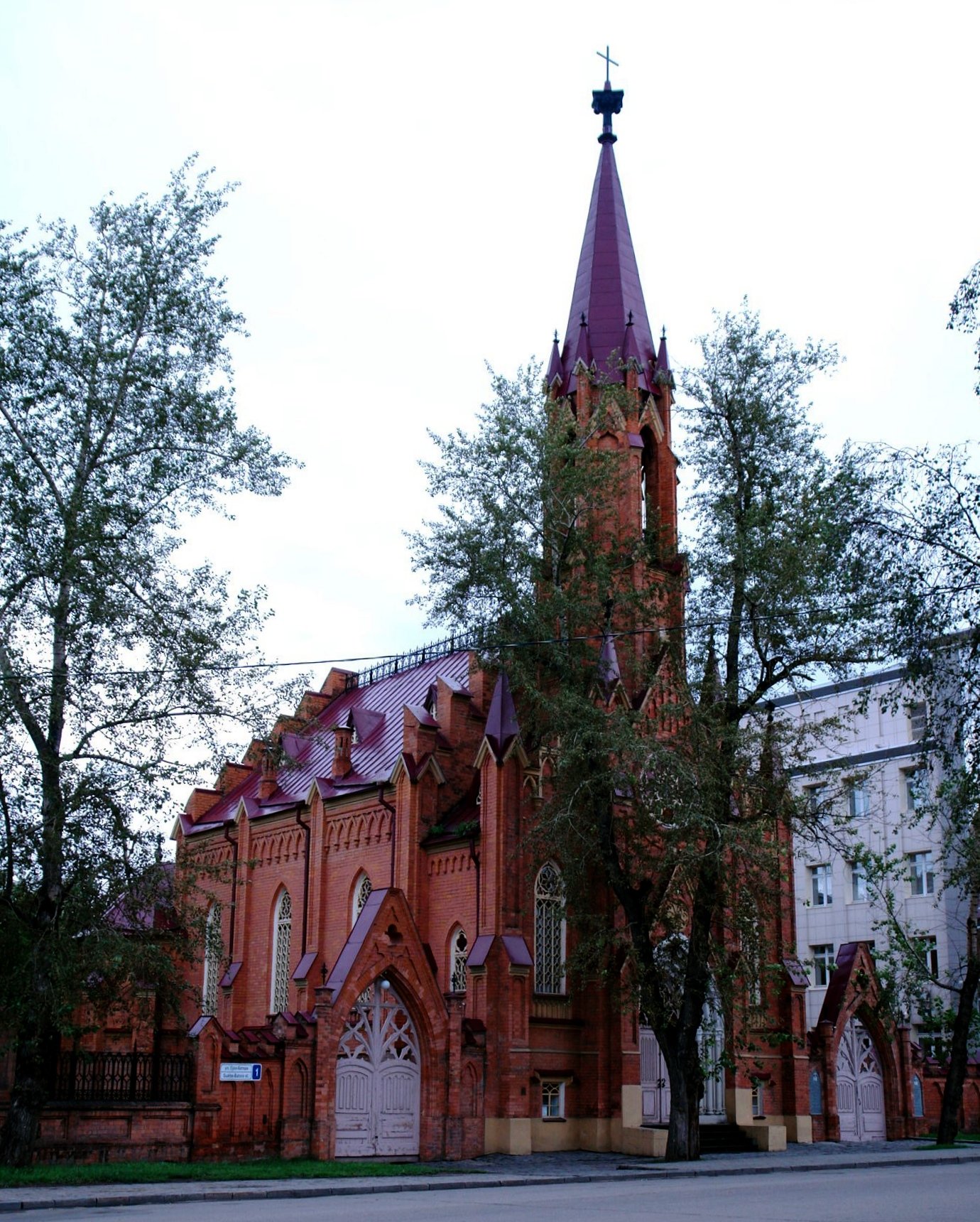
A red-brick Gothic Revival silhouette rising above Irkutsk, built by Poland’s exiled and settled community after fire destroyed its wooden predecessor.
At a glance
Known locally as the Polish Church, this Catholic parish church stands in Siberia’s Irkutsk, far from the tradition it echoes. Its pointed arches and steep roofline break sharply with the onion domes of the city’s Orthodox churches nearby. The building dates to 1881, a heritage-listed survivor of tsarist-era Siberia.
History
Catholic settlers first raised a small wooden church here in 1825. Irkutsk’s Catholic community, largely made up of Poles sent east under Russian rule, enlarged it in 1855. Then came disaster. The great fire of July 1879 swept through the city and burned the wooden church to the ground. Rebuilding began quickly in brick. Between 1881 and 1883 the Polish community constructed the present church, dedicating it to the Assumption of the Virgin Mary. The project reflected both faith and resilience, a permanent structure raised where a temporary one had failed.
What you see
The church follows plans by the Polish architect Jan Tamulewicz. Its neo-Gothic form sets it apart at once from the domed Orthodox skyline, including the nearby Church of the Saviour. Inside, decoration by Wojciech Koperski shaped the space parishioners still use today. The altarpiece predates the building itself, salvaged or commissioned in 1868. A harmonium, brought all the way from the United States in 1896, once filled the nave with sound. Brick replaced timber, but the vertical, pointed language of the facade remains the church’s most telling feature.
Cultural significance
The church is a physical record of Poland’s presence in Siberian exile and settlement. Catholicism in Russia has always been a minority faith, and this building marks one of its more visible outposts. It stands as a counterpoint to Orthodox church design in a city otherwise defined by domes. For Irkutsk’s Polish descendants, the church remains a point of continuity between a difficult history and present-day worship.
Key facts
- Location: Irkutsk, Siberia, Russia
- Style: Gothic Revival (neo-Gothic)
- Construction: 1881–1883, replacing an earlier wooden church of 1825
- Architect: Jan Tamulewicz
- Interior decoration: Wojciech Koperski
- Altarpiece dated 1868; harmonium imported from the United States in 1896
- Heritage-listed
Practical information & getting there
The church sits within central Irkutsk, reachable on foot from the city’s main historic sites. You can combine a visit with the nearby Church of the Saviour to compare Orthodox and Catholic forms side by side. Check the parish’s official site for current service times before visiting.
Sources & resources
Find it on the map
See this place and what’s around it →📷 Become a Cultural Heritage Online photographer
Share your photos of places: they stay published under your name as the author. The more they're seen, the more you get noticed — and soon a contest will reward the most appreciated photos.
Log in or sign up free to add a photoIs this page about you?
This page is read by travellers and heritage enthusiasts who find it on Google. Tell us how you are connected to this place and we will take it from there.