
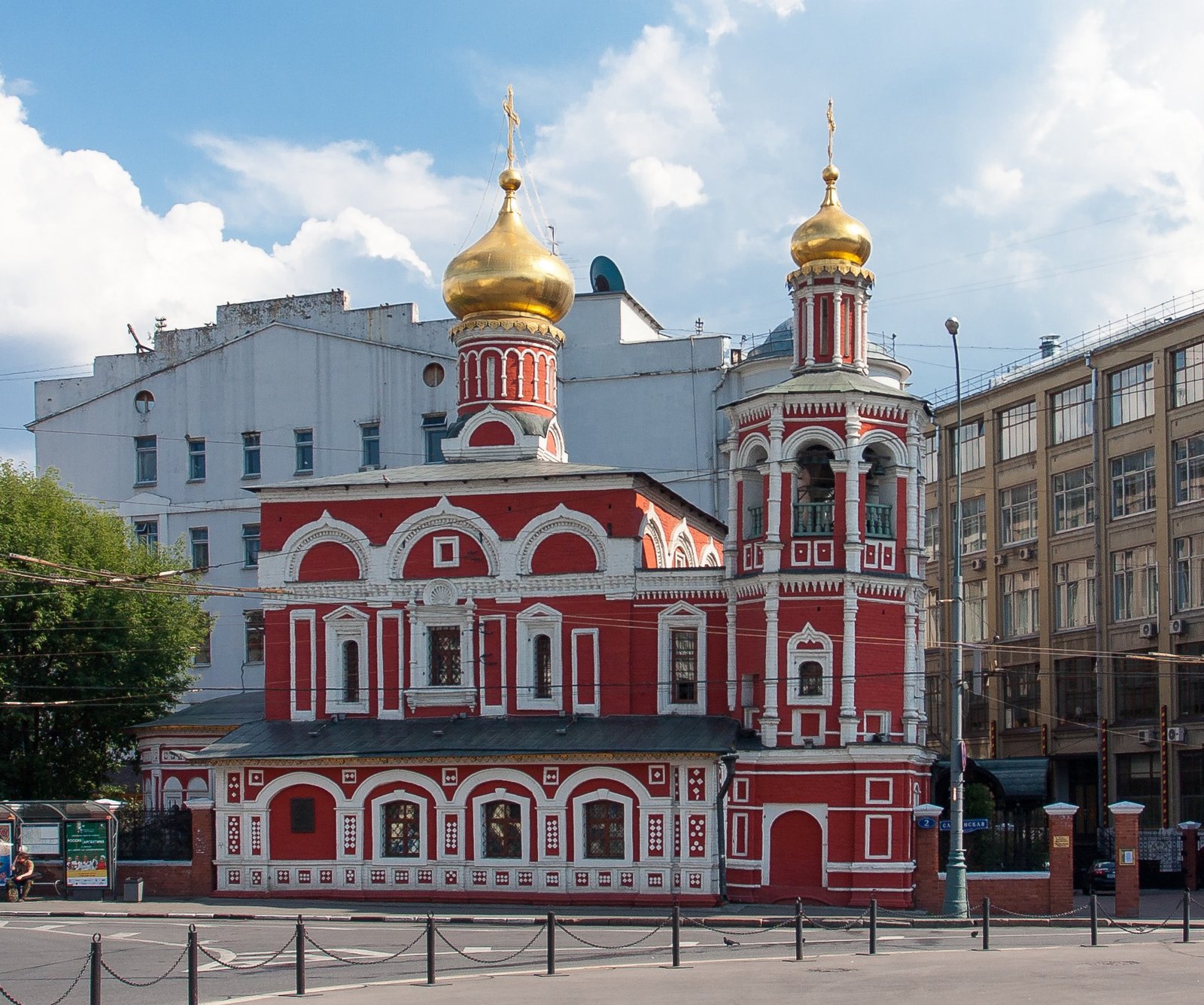
A modest church at Slavyanskaya Square carries six centuries of Moscow’s memory, from a battlefield vow to Stalin-era executions.
At a glance
Standing at 2 Slavyanskaya Square, this is among Moscow’s oldest surviving church sites. Its tradition traces to 1380, though the present stone structure dates largely from the late 17th century. The building is heritage-listed and still functions as a working parish church.
History
Tradition holds that Dmitry Donskoy raised the first wooden church here most likely in 1380, after returning from the Battle of Kulikovo. The site then sat well outside Moscow’s borders. Locals called it “kulichki” — the world’s end. That phrase entered Russian idiom for the middle of nowhere. It now sits in the city’s historic core. The church was rebuilt in stone in 1488, then reconstructed again in Muscovite Baroque style between 1687 and 1689. The Soviet period brought harsher change. Looted after the October Revolution, the church was shut in 1930. Through the 1930s, the NKVD reportedly used the building as a site of mass executions. It passed to the Museum of History of Moscow in 1975, then back to the Russian Orthodox Church in 1991. A memorial cross for victims of Soviet repression was installed in 1994.
What you see
The church’s most striking feature is its bell-tower, which leans visibly off vertical. The current form reflects the Muscovite Baroque rebuilding of 1687–1689, layered atop the 1488 stone church that itself replaced Donskoy’s original timber structure. Little else of the earlier phases is described in surviving accounts, but the compact footprint and the tilted tower give the building an unmistakable silhouette against the square.
Cultural significance
Few Moscow churches compress so much history into so small a space. It links a medieval military victory to twentieth-century state violence, and its 1994 memorial cross openly names that legacy. From 1999 the church served as the Moscow metochine of the Orthodox Church of Alexandria, a rare instance of Eastern Orthodox jurisdictions sharing sacred ground in the city. That arrangement ended abruptly in 2019 amid the dispute over Ukrainian church autocephaly. Since 2021 the building has been tied to the newly formed Patriarchal Exarchate of Africa, folding it into a fresh chapter of Orthodox ecclesiastical politics.
Key facts
- Location: 2 Slavyanskaya Square, Moscow, Russia
- Traditional founding: 1380, attributed to Dmitry Donskoy
- Rebuilt in stone: 1488
- Rebuilt in Muscovite Baroque style: 1687–1689
- Style: Moscow baroque
- Heritage status: officially listed
- Notable feature: leaning bell-tower
Practical information & getting there
The church stands at Slavyanskaya Square, within Moscow’s historic center, an easy walk from Kitay-gorod metro station. As an active parish, it is generally open around service times; visitors should approach it as a place of worship rather than a museum. Check the official website before planning a visit, since the church’s institutional affiliation has shifted more than once in recent years.
Sources & resources
Find it on the map
See this place and what’s around it →📷 Become a Cultural Heritage Online photographer
Share your photos of places: they stay published under your name as the author. The more they're seen, the more you get noticed — and soon a contest will reward the most appreciated photos.
Log in or sign up free to add a photoIs this page about you?
This page is read by travellers and heritage enthusiasts who find it on Google. Tell us how you are connected to this place and we will take it from there.