
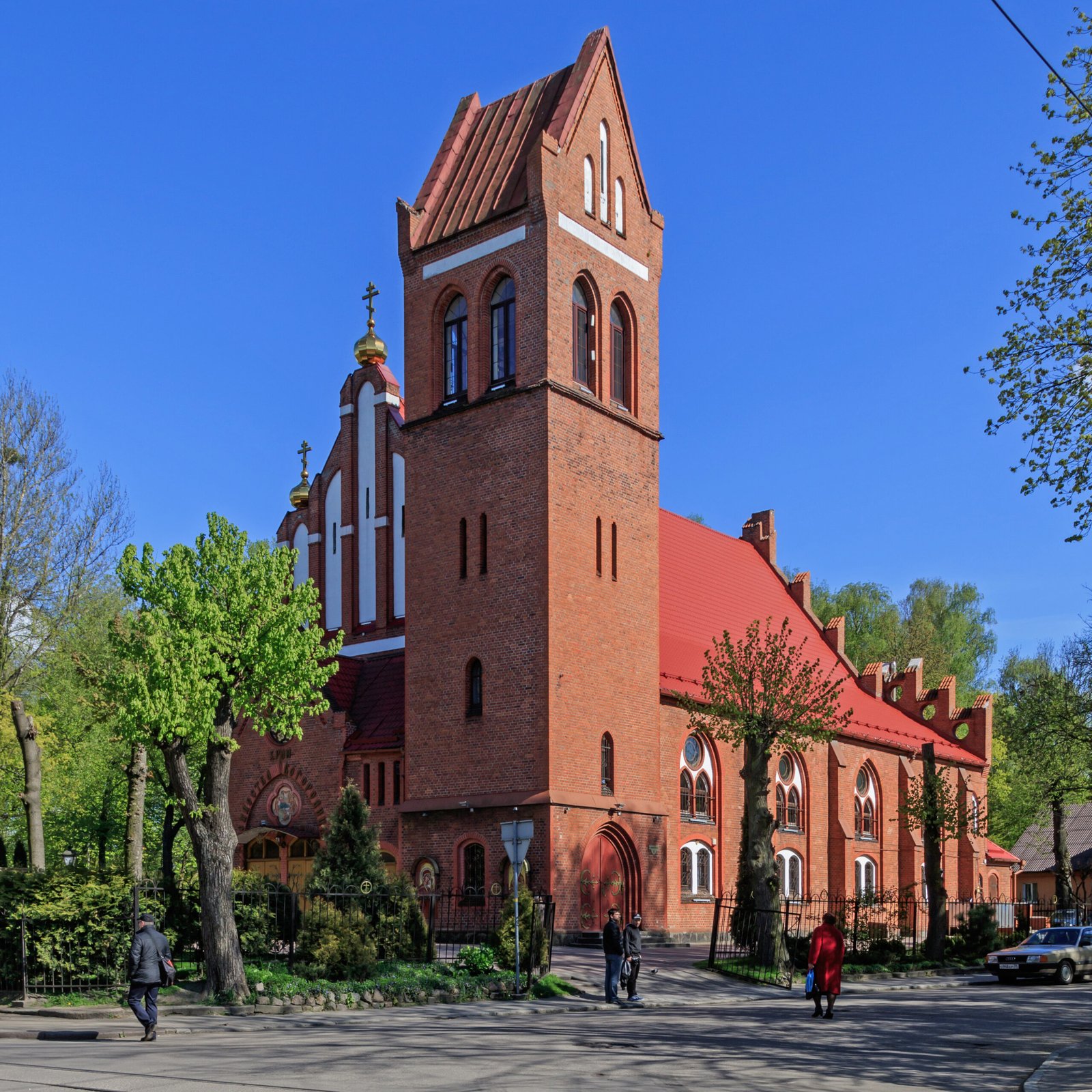
A brick Neo-Gothic church built for Königsberg’s Ponarth district, it has outlived the city that raised it, the war that scarred it, and the decades that repurposed it.
At a glance
Ponarth Church rose in the Ponarth quarter of Königsberg, dedicated on 23 July 1897. Built of brick in the Gothic Revival style, it served a local Protestant congregation until war and expulsion emptied its pews. Today, as a Russian Orthodox church in Kaliningrad, it carries a heritage listing that acknowledges its long and layered past.
History
Construction began in May 1896. Two local figures pushed the project forward: Mayor Robert Hoffmann and Eduard Schifferdecker, director of the district brewery. Their sponsorship tied the church to Ponarth’s civic and industrial life from the outset. The congregation initially belonged to the parish of Haberberg. In 1905 it split off to form its own parish, served over the years by pastors Johannes Joachim, Leop. Beckmann, Gerh. Symnanowski, and Helmut Hildebrandt. World War II left the building only lightly damaged, and Germans in the area kept using it until their expulsion in 1947. What followed was less kind. Soviet-era residents of Kaliningrad turned the church into storage space, then a gym. In the early 1980s its roof tiles were swapped for cement, a change that quietly altered the building’s texture and silhouette.
What you see
The church is a work of Gothic Revival brickwork, typical of late-19th-century Protestant construction in East Prussia. Pointed forms and vertical lines define its Neo-Gothic character. The cement roof tiles from the 1980s replace the originals, a visible seam between eras. Little else in the article details ornament or interior arrangement, a reminder of how much of this building’s fabric has simply been overwritten by use.
Cultural significance
Few buildings register displacement as plainly as this one. It began as a Protestant parish church, funded by a mayor and a brewer with civic ambitions for their district. It ended, after storage and gymnasium use, as an Orthodox church, since 21 September 1992. That sequence mirrors Königsberg’s own transformation into Kaliningrad. The building’s survival, patched and repurposed rather than demolished, makes it a quiet marker of the region’s shifting populations, faiths, and administrations.
Key facts
- Location: Kaliningrad, Russia (formerly Ponarth, Königsberg)
- Style: Gothic Revival
- Built: 1896–1897; dedicated 23 July 1897
- Key patrons: Mayor Robert Hoffmann, brewery director Eduard Schifferdecker
- Own parish established: 1905, separated from Haberberg
- Damaged: lightly, during World War II
- Soviet-era uses: storage, then a gymnasium
- Roof tiles replaced with cement: early 1980s
- Current use: Russian Orthodox church, since 21 September 1992
- Heritage status: listed
Practical information & getting there
The church stands in Kaliningrad, on the site of the former Ponarth quarter, at coordinates roughly 54.681°N, 20.481°E. As an active Russian Orthodox parish, you should expect church etiquette during services. No official visitor hours or admission details are recorded here, so checking locally before a visit is sensible.
Sources & resources
Find it on the map
See this place and what’s around it →📷 Become a Cultural Heritage Online photographer
Share your photos of places: they stay published under your name as the author. The more they're seen, the more you get noticed — and soon a contest will reward the most appreciated photos.
Log in or sign up free to add a photoIs this page about you?
This page is read by travellers and heritage enthusiasts who find it on Google. Tell us how you are connected to this place and we will take it from there.