
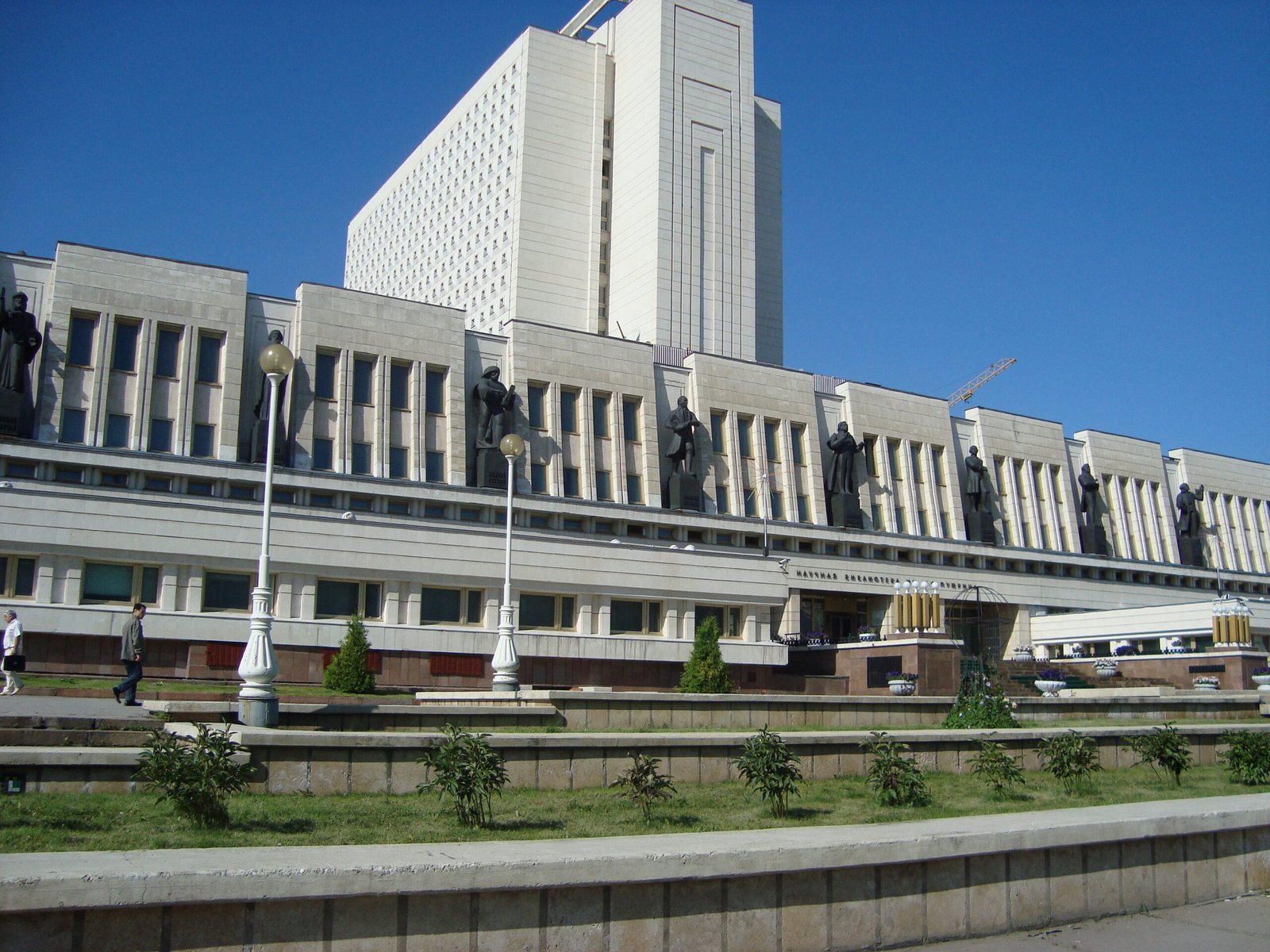
Founded to mark a poet’s centenary, Omsk’s oldest public library now occupies a 1995 building watched over by eight copper figures from Russian history.
At a glance
The Omsk State Regional Research Library is the principal research library of the Omsk region and the city’s oldest surviving public library. It traces its origin to a decision of the Omsk Municipal Duma in 1899, taken to honour the hundredth anniversary of Alexander Pushkin’s birth. The institution has moved once in its history, from cramped municipal offices to a purpose-built home designed by architect Vasily Trokhimchuk.
History
The library opened in January 1907, housed in an extension to the Municipal Duma building. Two adjoining rooms served as reading hall and lending desk. It began small: 4,160 books and magazines, and 370 readers in its first year. From 1940 the library gained the right to receive a copy of every book published in the country, turning a modest municipal collection into a genuine archive of Soviet print culture. During the Great Patriotic War its work was redirected almost entirely toward wartime needs, answering technical queries from factories, theatres and institutions evacuated to Omsk from the front. In 1923 the people’s commissar of education, Anatoly Lunacharsky, visited the central library, a sign of its growing standing. On April 28, 1995, the collection moved into a new building, and the library was granted status as the Central State Library of the Omsk Region.
What you see
Vasily Trokhimchuk began designing the current building in 1982, more than a decade before it opened. Its most distinctive feature is sculptural rather than structural. Eight figures, each 3.5 metres tall, stand in niches along the principal front. They are worked in hammered, blued copper, and together they represent notable figures spanning a thousand years of Russian history. Seen from the street, the facade reads almost as a timeline in metal.
Cultural significance
The library’s significance runs deeper than its collections. It embodies a civic gesture: a Siberian city naming its first public library after Pushkin, then building it out over a century of upheaval. Its wartime role, serving displaced specialists and institutions, ties it directly into the region’s experience of the Great Patriotic War. As a legal deposit library since 1940, it also functions as a record of the country’s publishing output, not merely a reading room.
Key facts
- Location: Omsk, Russia
- Opened: January 1907
- Founding occasion: Centenary of Alexander Pushkin
- Current building: Completed 1995, architect Vasily Trokhimchuk
- Facade sculptures: Eight 3.5m figures in hammered blued copper
- Status: Central State Library of the Omsk Region
Practical information & getting there
The library stands in central Omsk, at coordinates roughly 54.99°N, 73.36°E, within easy reach of the city’s main civic buildings. As a working research library, it serves scholars and the general public. Check the library’s own site before visiting for current opening hours and reading-room access rules.
Sources & resources
Find it on the map
See this place and what’s around it →📷 Become a Cultural Heritage Online photographer
Share your photos of places: they stay published under your name as the author. The more they're seen, the more you get noticed — and soon a contest will reward the most appreciated photos.
Log in or sign up free to add a photoIs this page about you?
This page is read by travellers and heritage enthusiasts who find it on Google. Tell us how you are connected to this place and we will take it from there.