
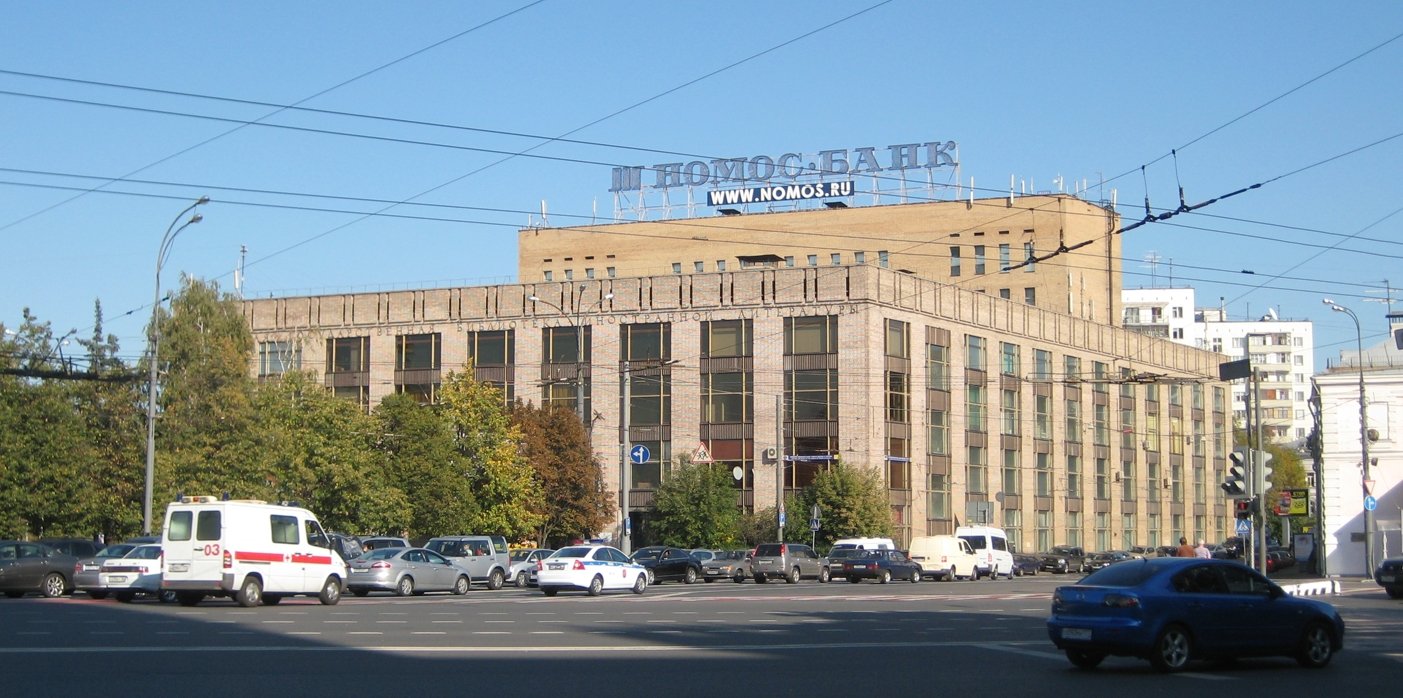
Known to generations of Muscovites simply as “the Foreigner,” this library grew from a hundred borrowed books into one of Russia’s great repositories of world literature.
At a glance
Founded in 1921, the library sits today on the Yauza embankment, facing the Kotelnicheskaya high-rise across the water. It is heritage-listed and remains a working scientific library, not a museum piece. Readers still come for books in 128 languages.
History
Margarita Ivanovna Rudomino founded the institution in 1921 as a small Neophilological Library. Its first collection held only 100 volumes, in German, French and English, shelved on the fifth floor of an old central Moscow building. It was not the Soviet Union’s first special library. Both the Fundamental Library of the Social Libraries and the State Central Scientific Medical Library preceded it. The library moved four times before settling, in 1967, into its present home. In 1948 the Council of Ministers elevated it to “All Union Central Library” status. Rudomino, who had trained in library science in Denmark, directed the institution for over half a century. She retired in 1973, by which point the collection numbered four million publications. Later directors, including Yekaterina Genieva from 1993 to 2015, carried the library through the post-Soviet decades. Since 1975 its collecting profile has widened to fiction, humanities scholarship, and reference works on foreign countries.
What you see
The building stands on the Yauza’s bank, opposite the looming Stalin-era tower on Kotelnicheskaya. Inside, the arrangement reflects the collection’s origins rather than a single architectural statement. Books are catalogued according to the classification systems of their countries of origin, so a French novel and a Japanese one may sit under quite different logics. Language-learning facilities let readers work directly with texts in their original tongue. A children’s room serves younger visitors aged five to sixteen, separate from the main reading halls reserved for those sixteen and over.
Cultural significance
The library hosts roughly 250 lectures and meetings and 200 exhibitions each year. That is a heavy cultural calendar for an institution built on foreign-language holdings. Compared with the Russian State Library or the State Public Historical Library, retrieval from the depository here is notably fast, some 15 to 20 minutes. Observers have called it among the world’s most important libraries. Its identity as “the Foreigner” captures both its collection and its role as a window onto literatures beyond Russia’s borders.
Key facts
- Founded in 1921 by Margarita Ivanovna Rudomino
- Moved to its current Yauza embankment site in 1967
- Held four million publications in 128 languages by 1973
- Heritage-listed institution in Moscow, Russia
- Directors have included Vyacheslav Ivanov and Yekaterina Genieva
Practical information & getting there
The library stands on the Yauza River bank, across from the Kotelnicheskaya Embankment high-rise, a well-known Moscow landmark you can use to orient yourself. It welcomes readers from age sixteen, with a dedicated room for those between five and sixteen. Check the official website before visiting, since access rules and hours for specific reading rooms can vary.
Sources & resources
Find it on the map
See this place and what’s around it →📷 Become a Cultural Heritage Online photographer
Share your photos of places: they stay published under your name as the author. The more they're seen, the more you get noticed — and soon a contest will reward the most appreciated photos.
Log in or sign up free to add a photoIs this page about you?
This page is read by travellers and heritage enthusiasts who find it on Google. Tell us how you are connected to this place and we will take it from there.