
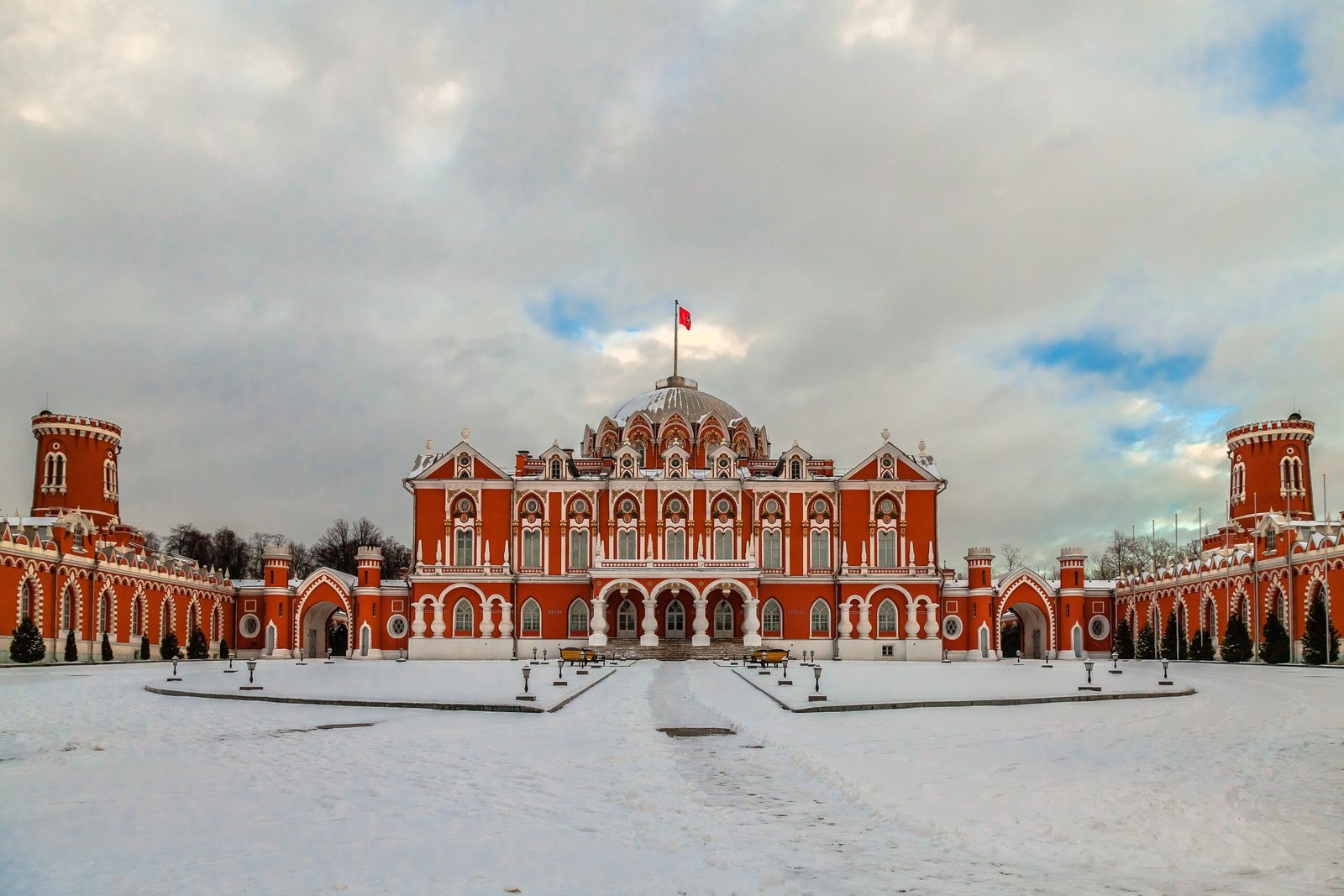
A crenellated red-brick retreat built for a stopping empress, its Gothic Revival turrets still mark the old road into Moscow.
At a glance
Petrovsky Palace stands on Leningradsky Prospect, once the last approach road before the Kremlin. Catherine the Great commissioned it in the 1770s as a rest stop between St Petersburg and Moscow. Matvey Kazakov designed the finished building, working in a Gothic Revival idiom rare for its time and place. Today it houses a hotel and a small museum, and serves as the Moscow government’s official reception house.
History
The commission carried more than practical weight. Its founding coincided with Russia’s victory in the Russian-Turkish War and the Treaty of Kucuk-Kainarji, giving the project a celebratory undertone. Vasily Bazhenov initially led construction before the work passed to Kazakov. Under Kazakov the pace quickened. Main construction wrapped up by 1779; interior decoration followed by 1783. Surviving project drawings show a more elaborate scheme than what was actually built, though the core composition changed little from plan to completion.
Catherine herself used the palace sparingly, stopping there for four days in 1785 and ten days in 1787. After Paul I, it became a traditional final halt for Russian monarchs travelling to their Kremlin coronations.
What you see
Kazakov’s design mixes castle-like massing with classical planning, an unusual pairing for 1780s Moscow. Much of the original interior did not survive twentieth-century reuse. The main halls of the first floor retain partial decoration; the upper floors were completely redesigned during the Soviet period. What remains is concentrated and specific: the Round Hall, four vestibules, the main staircase, and scattered furniture pieces. These fragments are the clearest link to Kazakov’s original scheme still visible inside.
Cultural significance
In 1920, Anatoly Lunacharsky pushed for the palace’s transfer to the Soviet Air Forces, arguing aviation’s future justified the move and citing the building’s poor condition. By 1923 the Zhukovsky Air Fleet Academy had moved in, renaming it the Palace of “Red Aviation.” Renovations for institutional use were extensive: a ventilation pipe was run through the facade, ceilings were replaced, a fuel tank and coal pit were installed in the right wing. In autumn 1941, it briefly housed the headquarters of Long Range Aviation and the Air Defense Forces. The building’s 1998 renaming, ordered by Mayor Yury Luzhkov, restored its historical identity after decades as a functional aviation facility.
Key facts
- Location: Leningradsky Prospect, Moscow, Russia
- Commissioned: 1770s, under Catherine the Great; inception dated 1776
- Architects: Vasily Bazhenov (initial), Matvey Kazakov (completed design)
- Style: Gothic Revival
- Construction completed: 1779 (main structure), 1783 (interiors)
- Heritage status: listed monument
- Current use: hotel, museum, official Moscow government reception house
Practical information & getting there
The nearest metro station is Dynamo, a short walk from the palace grounds. You’ll find the ground floor given over to museum displays, while the upper floors and wings operate as a hotel. Renovation work has continued since 1998, so check current visiting arrangements before travelling. The building sits within Moscow’s city limits, easily reached from central districts by metro or road.
Sources & resources
Find it on the map
See this place and what’s around it →📷 Become a Cultural Heritage Online photographer
Share your photos of places: they stay published under your name as the author. The more they're seen, the more you get noticed — and soon a contest will reward the most appreciated photos.
Log in or sign up free to add a photoIs this page about you?
This page is read by travellers and heritage enthusiasts who find it on Google. Tell us how you are connected to this place and we will take it from there.