
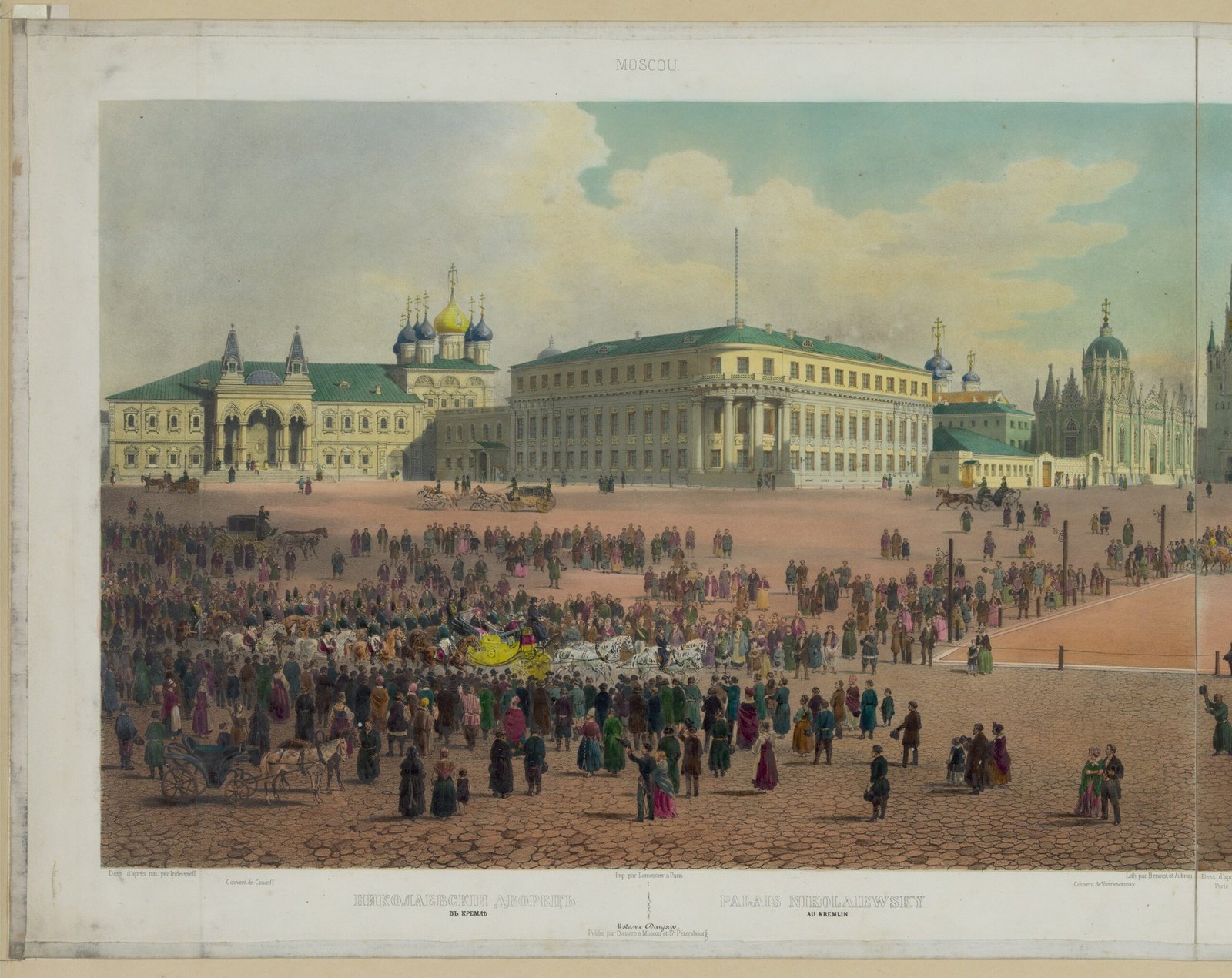
A neoclassical bishop’s residence turned imperial Moscow home, the Small Nicholas Palace once stood at the corner of Ivanovskaya Square inside the Kremlin. It survived fire, war and remodelling, then vanished under Soviet rule.
At a glance
Built in 1775 by Matvey Kazakov for the head of the Moscow Eparchy, the three-storey building later became the personal Moscow residence of Grand Duke Nicholas Pavlovich, the future Nicholas I. Until the Grand Kremlin Palace rose in the 1840s, it was the principal Kremlin lodging for visiting monarchs. Demolished in 1929, nothing remains above ground today.
History
The plot had a long and violent past. A fourteenth-century Golden Horde ambassador’s residence, princely palaces under Ivan III and Ivan the Terrible, and the estate of boyar Ivan Sheremetev all preceded it. In 1744 a Bishop’s Palace rose here; in 1771, during a plague epidemic, a mob enraged by Archbishop Ambrose’s handling of a venerated icon destroyed the building and killed him. Catherine the Great funded its replacement in 1775, entrusting Matvey Kazakov, who had already built Platon Levshin an episcopal residence in Tver. Napoleon used the finished palace as his headquarters during the 1812 occupation. After restoration, Alexander I gave it to his brother Nicholas Pavlovich in 1817. The future Alexander II was born there in 1818. A third storey was added in 1824. Nicholas I met the exiled Alexander Pushkin in the palace in 1826, a meeting historians call decisive for the poet’s career. Late in his reign Nicholas commissioned Konstantin Thon to redesign the building in Russian Revival style; only a porch and stone passageways were built before Alexander II halted the work, preferring the old palace unaltered. Restorers Nikolai Shokhin and others continued careful repairs into the 1870s. The Bolsheviks demolished the palace with its neighbouring monasteries in 1929; the Kremlin Presidium replaced it from 1932 to 1934, itself dismantled in 2016.
What you see
Kazakov’s design centred on a semi-rotunda fronted by four Tuscan columns, topped by a belvedere marked with the archbishop’s monogram. Storage filled the low-vaulted ground floor. The piano nobile held the metropolitan’s apartments, and a private Church of Saints Peter and Paul occupied the eastern corner, its iconostasis also by Kazakov. The 1824 additions brought silk-upholstered rooms in artificial marble and a corner chamber decorated in Pompeian style by Giuseppe Artari, its glazed niches allowing the imperial family to greet crowds below. Today only excavated foundations mark where the building once stood.
Cultural significance
The palace linked three regimes of Russian power: ecclesiastical, imperial, Soviet. It sheltered a future tsar’s birth and a foreign conqueror’s command post within decades of each other. Its 1826 meeting between Nicholas I and Pushkin remains a touchstone moment in Russian literary history. Later, as the Kremlin Presidium, its successor building housed the Supreme Soviet and, until 2011, the Presidential Administration.
Key facts
- Location: corner of Ivanovskaya Square, Moscow Kremlin, Russia
- Built: 1775, architect Matvey Kazakov
- Style: neoclassical, with later Russian Revival additions
- Third storey added: 1824 by Ivan Mironovsky
- Demolished: 1929, together with the Chudov and Ascension monasteries
- Site later occupied by the Kremlin Presidium (1932–1934), dismantled in 2016
Practical information & getting there
No building survives to visit. The former site lies within the Moscow Kremlin, near Ivanovskaya Square, an area under continued state administration with restricted public access. If exploring the Kremlin grounds through official routes, you can note the general location among the palace and monastery ensemble that once stood there, now marked only by archaeological traces.
Sources & resources
Find it on the map
See this place and what’s around it →📷 Become a Cultural Heritage Online photographer
Share your photos of places: they stay published under your name as the author. The more they're seen, the more you get noticed — and soon a contest will reward the most appreciated photos.
Log in or sign up free to add a photoIs this page about you?
This page is read by travellers and heritage enthusiasts who find it on Google. Tell us how you are connected to this place and we will take it from there.