
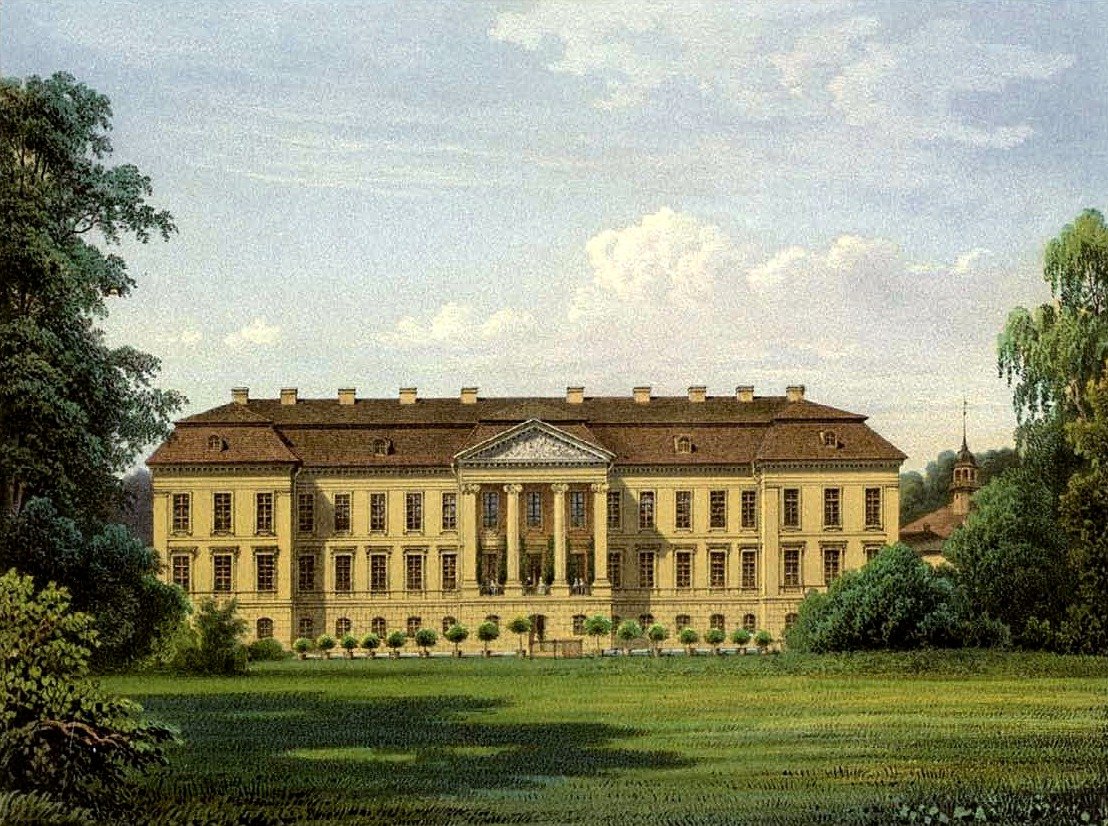
A vanished baroque seat in the Pregolya valley, once judged among the finest stately homes in Prussia, and the birthplace of journalist Marion Dönhoff.
At a glance
Friedrichstein Palace stood near Königsberg, East Prussia, in what is now the village of Kamenka, Kaliningrad Oblast. Built between 1709 and 1714 to designs attributed to Jean de Bodt, with construction supervised by John von Collas, it served as the principal residence of the counts von Dönhoff for nearly two and a half centuries. Soviet troops burned the palace in January 1945. Today only foundation traces, ancillary buildings and the park survive.
History
The site’s estate origins reach back to the 16th century, when Count Bar first built a residential house and granary here. Financial troubles passed the property to Friedrich von Waldburg, who erected the earliest manor and lent it his name. In 1666 the Elector of Brandenburg approved its sale to Count Friedrich von Dönhoff, beginning eight generations of Dönhoff ownership. A fire destroyed the old manor house in the winter of 1709. Otto Magnus von Dönhoff, by then a lieutenant general under Frederick I, responded by commissioning an entirely new baroque palace, reportedly using 100 soldiers from his own regiment as labour. Successive heirs held the estate through the Prussian War Ministry and diplomatic service. August von Dönhoff filled the rooms with instruments, weaponry and carpets. His daughter Marion, born here in 1909, later joined the resistance against Hitler and survived Gestapo questioning after the 1944 assassination plot. She fled on horseback in January 1945 as Soviet forces advanced; the palace was looted and set alight soon after. She went on to edit, then publish, Die Zeit. When she revisited in 1989, only foundations remained.
What you see
Little of the built palace remains standing. Historical accounts describe a two-storey building of nineteen axes, its façade stretching nearly 100 metres and enclosing over 110 rooms above a high basement, beneath a mansard roof. A portico with Ionic columns faced the courtyard. Interiors were reworked in Rococo taste between 1750 and 1770. Soviet soldiers reportedly targeted decorative statues and bas-reliefs, dynamiting figures they associated with the old aristocracy. Visitors today find the baroque park intact, along with scattered outbuildings, but the great house itself has left only its footprint in the ground.
Cultural significance
Friedrichstein belonged to a distinct class of East Prussian “royal palaces,” built by noble families after Prussia’s elevation to a kingdom in 1701, so the new monarch would have grand residences to use while travelling. Alongside Dönhoffstädt, Schlobitten, Finckenstein and Capustigall, it represented a coordinated display of aristocratic ambition and royal loyalty. Its later fame rests as much on memory as on architecture. Marion Dönhoff’s writing carried the lost house into postwar German consciousness, tying its destruction to the wider reckoning over East Prussia’s history.
Key facts
- Location: Kamenka (formerly Löwenhagen), Guryevsky District, Kaliningrad Oblast, Russia
- Construction: 1709–1714, baroque style
- Design attributed to Jean de Bodt; building supervised by John von Collas
- Owned by the counts von Dönhoff, 1666–1945
- Destroyed by fire set by Soviet troops, January 1945
- Birthplace of journalist and Die Zeit publisher Marion Dönhoff
Practical information & getting there
The site lies roughly twenty kilometres east of Kaliningrad, near the village of Kamenka in the Pregolya valley. No palace building remains to visit; you can walk the surviving park grounds and see a few outbuildings from the former estate. There is no official visitor infrastructure, and travel in this border region requires standard Russian entry documentation. Anyone planning a visit should check current access conditions before setting out.
Sources & resources
Find it on the map
See this place and what’s around it →📷 Become a Cultural Heritage Online photographer
Share your photos of places: they stay published under your name as the author. The more they're seen, the more you get noticed — and soon a contest will reward the most appreciated photos.
Log in or sign up free to add a photoIs this page about you?
This page is read by travellers and heritage enthusiasts who find it on Google. Tell us how you are connected to this place and we will take it from there.