
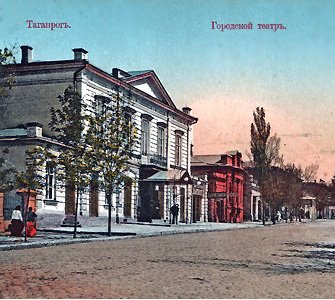
A provincial playhouse on the Sea of Azov where a merchant town once heard Italian opera, and where a local boy named Anton Chekhov learned to love the stage.
At a glance
Built in 1827 to a design attributed to architect Nikolai Trusov, the theater is one of Russia’s oldest surviving provincial stages still in continuous use. It carries the Order of the Badge of Honour, awarded in 1977, and is officially heritage-listed. Since 1944 it has borne the name of Taganrog’s most famous son, Anton Pavlovich Chekhov.
History
Governor Alexander Dunaev founded the theater in 1827, giving Taganrog, then a thriving southern port, a stage to match its ambitions. Italian opera companies began touring through from 1861, filling the hall with a repertoire far removed from Russia’s northern capitals. In 1874 the municipality bought out the building’s shareholders, bringing it fully under city control. The young Chekhov, born in Taganrog in 1860, attended regularly as a teenager. Vaudevilles, operas and comedies here shaped a sensibility he later carried into his own plays. The 20th century brought further firsts: in 1901 the theater screened the city’s first film onstage. Soviet authorities renamed it for Chekhov in 1944, cementing the bond between playwright and playhouse.
What you see
The building presents the restrained civic classicism typical of early 19th-century Russian provincial theaters. Inside, the auditorium retains the intimate scale of its original design. Decades of renovation have not erased the sense of a working 19th-century house. Visitors often note how compact the hall feels, a space built for a market town, not an imperial capital.
Cultural significance
For Russian theater history, the building matters chiefly as a formative space for Chekhov himself. Its stage helped shape the sensibility of a writer who would redefine modern drama. Since 1980 it has hosted the international festival “In the Birthplace of Anton Chekhov,” drawing companies from across Europe, Japan and Australia. The theater has toured its Chekhov productions abroad, including performances in Badenweiler, Germany, the town where the playwright died. In 2010, President Dmitri Medvedev visited during Chekhov’s 150th birth anniversary, watching a rehearsal dedicated to the writer’s life. Actors and artists associated with the house, from Sergei Bondarchuk to Vatslav Dvorzhetsky, went on to national and Soviet-era prominence.
Key facts
- Founded: 1827, by governor Alexander Dunaev
- Architect: Nikolai Trusov (attributed)
- Renamed for Anton Chekhov: 1944
- Order of the Badge of Honour: awarded 1977
- Heritage-listed building
- Hosts the “In the Birthplace of Anton Chekhov” festival since 1980
Practical information & getting there
The theater stands in central Taganrog, a coastal city on the Sea of Azov in Rostov Oblast. You can reach Taganrog by train or bus from Rostov-on-Don, a short regional journey. Check the official website for the current repertoire and festival dates before planning a visit, since touring schedules and seasonal programming vary.
Sources & resources
Find it on the map
See this place and what’s around it →📷 Become a Cultural Heritage Online photographer
Share your photos of places: they stay published under your name as the author. The more they're seen, the more you get noticed — and soon a contest will reward the most appreciated photos.
Log in or sign up free to add a photoIs this page about you?
This page is read by travellers and heritage enthusiasts who find it on Google. Tell us how you are connected to this place and we will take it from there.