
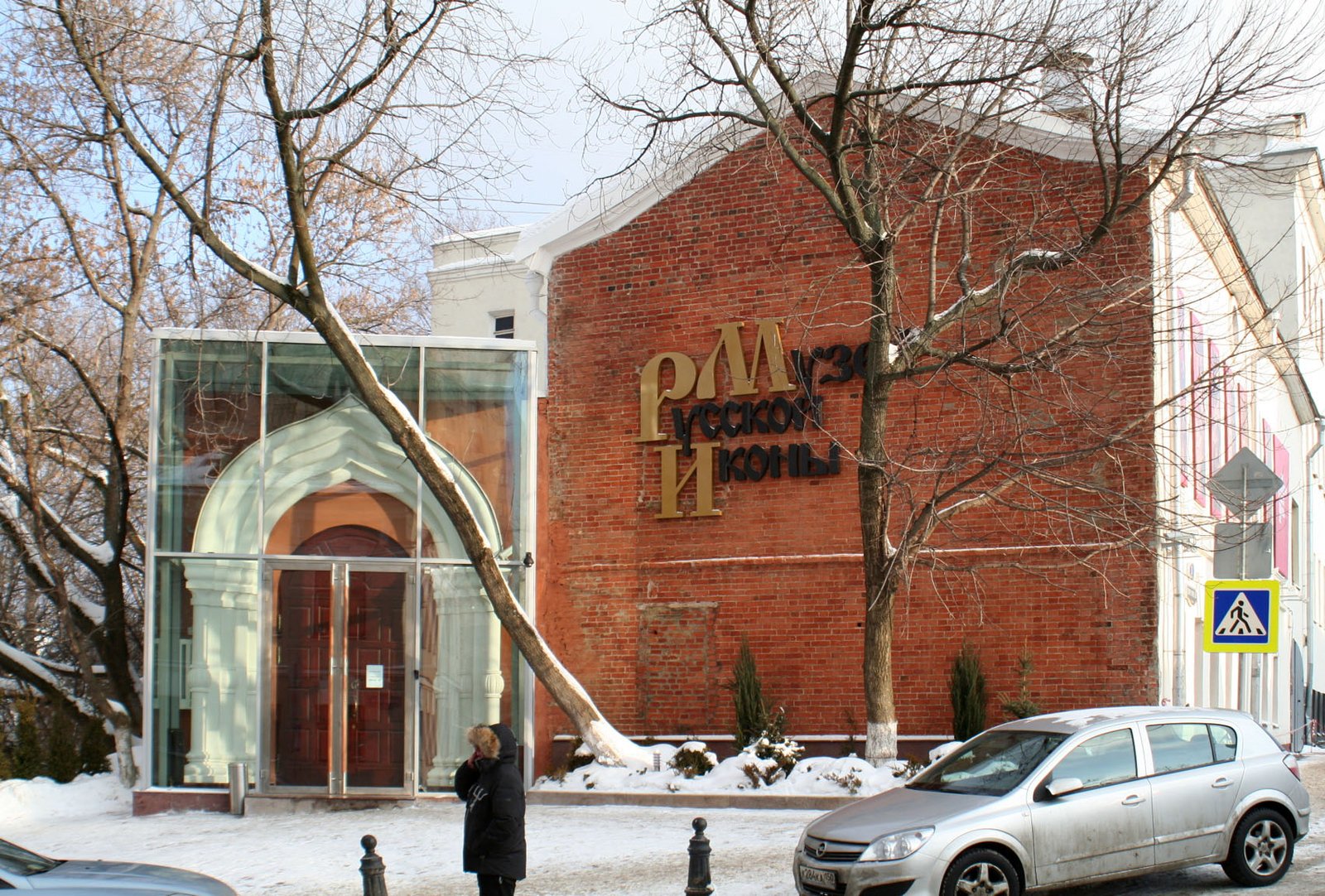
Behind an unassuming building on Goncharnaya Street sits Russia’s only private collection of Byzantine and Old Russian sacred art, assembled by one man’s obsession and now recognised by museums worldwide.
At a glance
The Museum of Russian Icons holds roughly 4,000 to 5,000 objects, among them hundreds of icons spanning the 14th to the 20th centuries. It is a member of ICOM, the International Council of Museums, and of the Union of Museums of Russia. Admission costs nothing. The museum sits close to the historic core of Moscow, a short walk from the river.
History
Mikhail Abramov, an insurance executive at Rosgosstrakh, began collecting icons in 2003. What started as a private passion opened to the public on 26 May 2006, occupying a single hall inside the Vereyskaya Plaza business center. The collection grew quickly. In 2010 it moved to purpose-built premises on Goncharnaya Street in downtown Moscow, where it remains. Abramov also founded a charitable foundation bearing the museum’s name. Its holdings have since been shown at the State Tretyakov Gallery in 2008 and at the Pushkin State Museum of Fine Arts in 2009, exhibitions that brought wider scholarly attention to icons long kept in private hands.
What you see
Inside are rows of painted wooden panels, gold ground catching low gallery light. Many icons date from the 14th to 16th centuries, the classical period of Russian iconography. Others extend into the 19th and 20th centuries, tracing how the tradition persisted and changed. The display is dense but ordered, grouped to let visitors compare workshops and eras side by side. This is not a grand palace conversion. It is a working gallery built around the objects themselves.
Cultural significance
The museum fills a gap left by state institutions, which hold vast icon collections but rarely one curated with such singular focus. Its inclusion in ICOM confirmed a private venture had become a recognised cultural institution. The 2008 and 2009 loan exhibitions, titled “The Returned Treasure” and “Masterpieces of Russian Iconography of the XIV-XVI centuries”, placed pieces from private collections alongside national holdings for the first time. The museum also carried controversy. In 2012 its director was briefly detained after acquiring an icon later found to have been stolen, worth around one million dollars, a reminder of the murky market surrounding religious antiquities.
Key facts
- Founded: 2006, by collector Mikhail Abramov
- Location: Goncharnaya Street, central Moscow (since 2010)
- Collection: approximately 4,000–5,000 works, including hundreds of icons, 14th–20th centuries
- Status: member of ICOM and the Union of Museums of Russia
- Admission: free
Practical information & getting there
The museum is open daily except Wednesday, from 11:00 to 19:00. It stands in downtown Moscow, reachable by metro and a short walk along Goncharnaya Street. Check the official website before visiting, as exhibition schedules and access can change.
Sources & resources
Find it on the map
See this place and what’s around it →📷 Become a Cultural Heritage Online photographer
Share your photos of places: they stay published under your name as the author. The more they're seen, the more you get noticed — and soon a contest will reward the most appreciated photos.
Log in or sign up free to add a photoIs this page about you?
This page is read by travellers and heritage enthusiasts who find it on Google. Tell us how you are connected to this place and we will take it from there.