
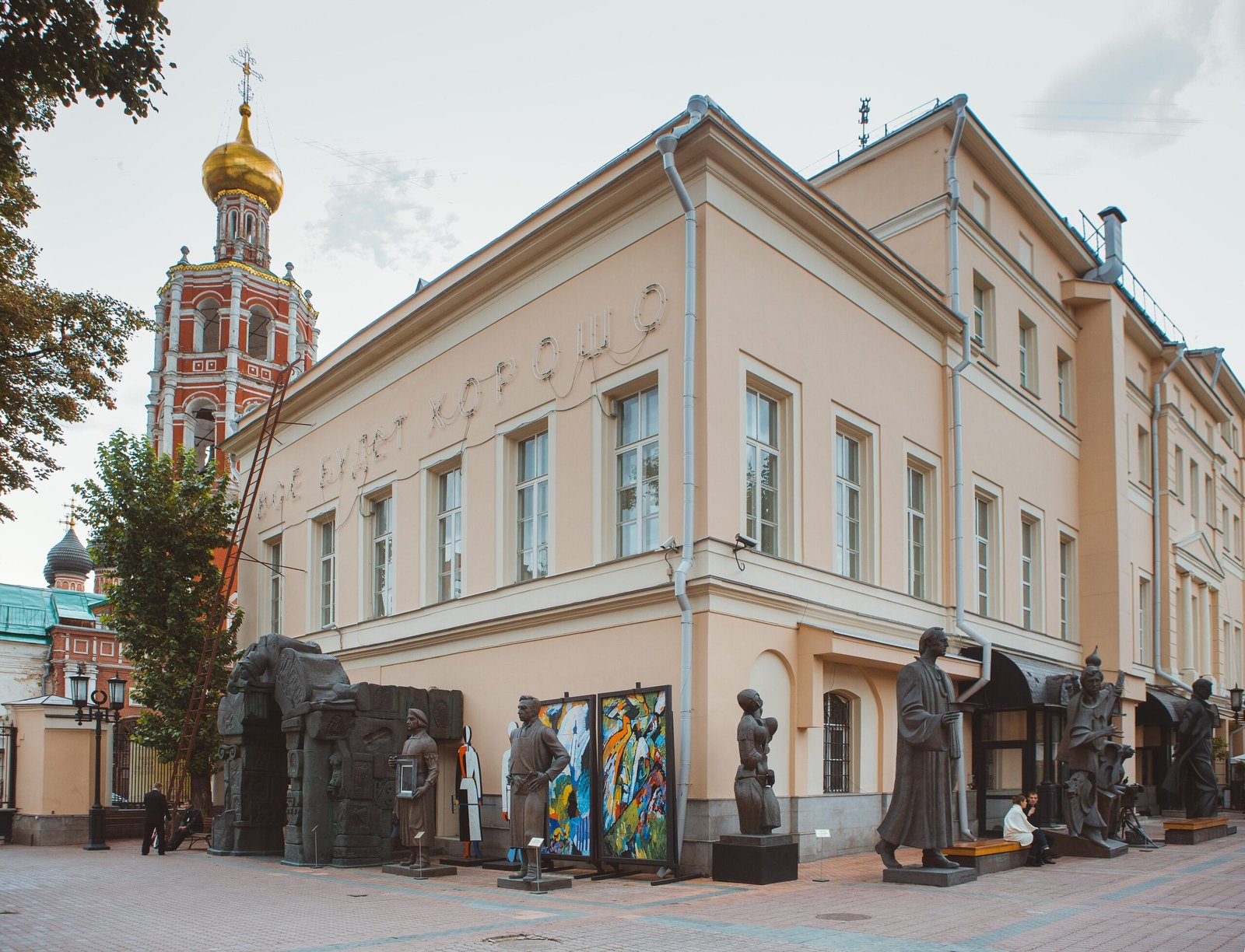
Behind the neoclassical façade of a Kazakov-designed mansion on Petrovka Street, Russia’s first state museum devoted to modern art gathers avant-garde canvases and Soviet-era dissent into one collection.
At a glance
Opened in December 1999, the museum was founded and driven forward by Zurab Tsereteli, president of the Russian Academy of Arts. Its main building occupies the former Gubin mansion. Over two decades it has grown into a network of galleries spread across the city.
History
The museum’s story begins not with the building but with a private collection. Tsereteli’s own holdings formed its founding core. Since 1999 the institution has expanded steadily: a second venue opened in the Patriarshiye Ponds area in December 2003, and a third followed at Tverskoy Boulevard in February 2007. In 2018, the Vadim Sidur Museum and the Museum-Studio of Dmitry Nalbandyan joined as branches, folding two artists’ personal legacies into the wider institution. For its twentieth anniversary, the museum invited an unusual mix of guest curators, from a footballer to a novelist to a voice-assistant program, to reframe its own history.
What you see
The flagship building at 25 Petrovka Street is the former Gubin mansion, designed by Matvei Kazakov, one of Moscow’s most consequential neoclassical architects. Kazakov is also credited with the museum’s Gogolevsky Boulevard building, raised in the late eighteenth century. A further venue on Bolshaya Gruzinskaya occupies a house built at the end of the nineteenth century, now given over to Tsereteli’s own work. Inside, the historic shells give way to white-walled gallery space built for shifting exhibitions rather than permanent display. The contrast is deliberate. Old stone rooms hold very new art.
Cultural significance
The collection’s weight falls on Russian avant-garde and on the nonconformist artists of the 1950s to 1970s, whose work stood outside official Soviet ideology. Names in the holdings include Vladimir Nemukhin, Eduard Steinberg, Vitaly Komar, Alexander Melamid, Anatoli Zverev and Dmitri Krasnopevtsev, among others. Their inclusion gives the museum a role beyond aesthetics. It preserves a record of artistic dissent that had no institutional home under Soviet rule. Alongside its galleries, the museum runs the Free Studios school, a two-year program pairing studio practice with study of the contemporary art market, and maintains a research library of Russian and international art publications.
Key facts
- Opened to the public in December 1999
- Founded and led by Zurab Tsereteli, president of the Russian Academy of Arts
- Main building: the former Gubin mansion, designed by Matvei Kazakov
- Additional venues at Ermolayevsky Pereulok, Tverskoy Boulevard, Gogolevsky Boulevard and Bolshaya Gruzinskaya
- Branches since 2018: Vadim Sidur Museum and Museum-Studio of Dmitry Nalbandyan
- Collection focus: Russian avant-garde and Soviet-era nonconformist art
Practical information & getting there
The main Petrovka building sits near Petrovsky Boulevard in central Moscow, within easy reach of several metro lines depending on which venue you’re visiting. Gogolevskiy is closest to Kropotkinskaya station, Ermolaevskiy to Mayakovskaya, and the Tverskoy gallery to both Chekhovskaya and Pushkinskaya. Because the museum operates across multiple addresses, it’s worth checking which building holds the exhibition you want before setting out. Each site keeps its own rhythm of shows, so a single visit rarely covers the whole institution.
Sources & resources
Find it on the map
See this place and what’s around it →📷 Become a Cultural Heritage Online photographer
Share your photos of places: they stay published under your name as the author. The more they're seen, the more you get noticed — and soon a contest will reward the most appreciated photos.
Log in or sign up free to add a photoIs this page about you?
This page is read by travellers and heritage enthusiasts who find it on Google. Tell us how you are connected to this place and we will take it from there.