
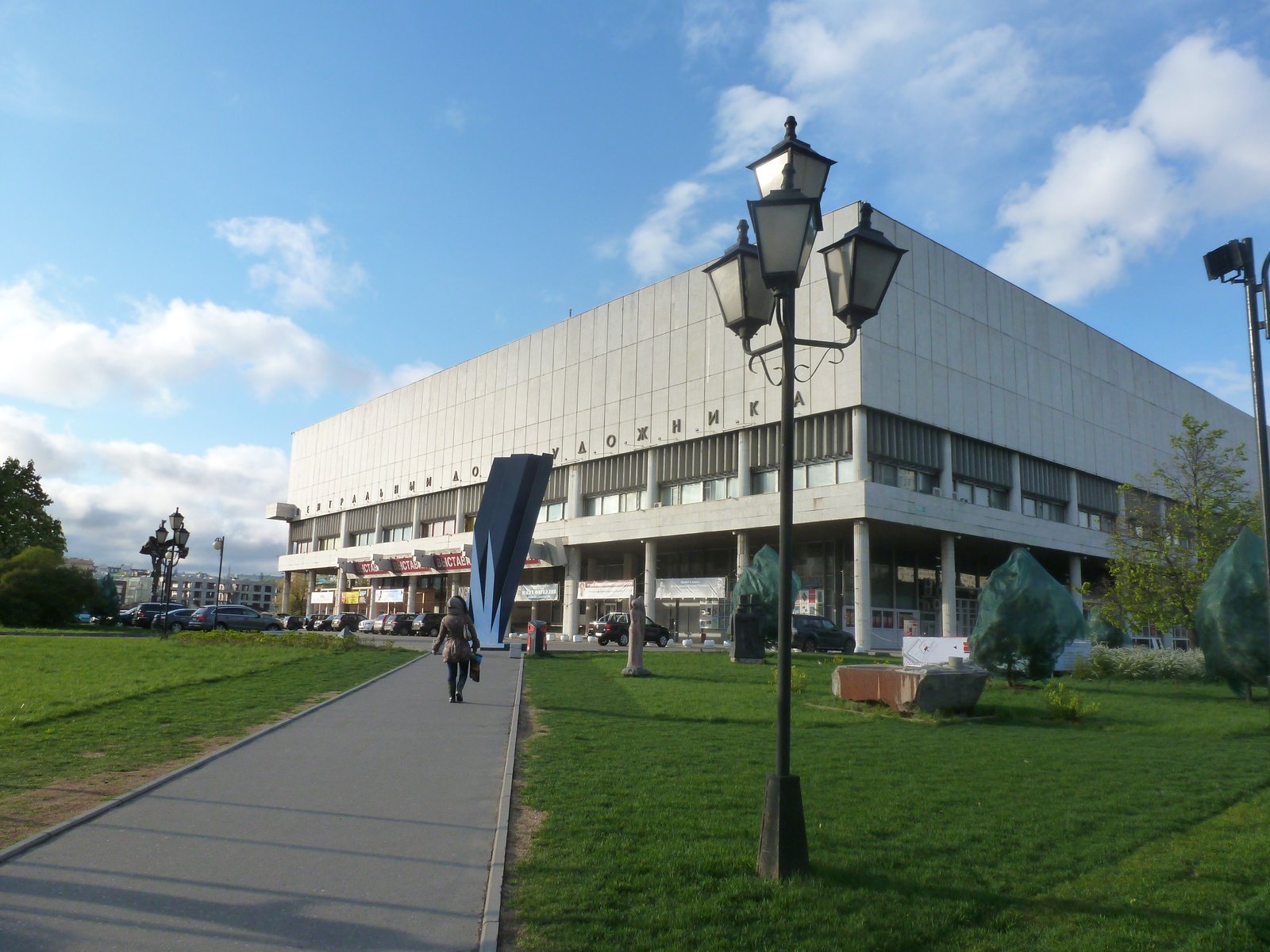
A four-storey exhibition complex on Krymsky Val that for forty years shared its walls with the Tretyakov Gallery, hosting Soviet artists and international names alike before folding entirely into the museum in 2019.
At a glance
The Central House of Artists stood as one of Russia’s best-known exhibition venues, built for the Artists’ Union of the USSR and opened in November 1979. It occupied the same building as the New Tretyakov Gallery, on the edge of Muzeon Park of Arts. The institution existed for four decades before its exhibition space passed fully to the Tretyakov in 2019.
History
The building’s origins trace to September 1956, when the Council of Ministers of the USSR resolved to build separate structures for the Tretyakov Gallery and the Union of Artists. Planners later merged the two projects into a single building. Design work ran through 1962–1963, gaining construction approval in March 1964. Ground broke in 1965. Architects Nikolai Sukoyan and Yuri Sheverdyaev led the project, with support from several research institutes. The complex finally opened in November 1979, after roughly fourteen years from resolution to completion. It closed as an independent institution in April 2019, when the entire building came under New Tretyakov Gallery management.
What you see
The structure rises four storeys, built to hold two distinct institutions under one roof. Large exhibition halls were designed for flexibility, able to absorb painting, sculpture, architecture and design shows alike. Outside, the Muzeon Park of Arts wraps the building with an open-air sculpture museum, recreation areas and children’s playgrounds. The park setting softens what is otherwise a functional, late-Soviet exhibition volume.
Cultural significance
Inside, the Tretyakov’s Krymsky Val wing gathers Russian and Soviet art from the 1920s–1960s: Malevich, Kandinsky, Chagall, Larionov, Falk, Deyneka, Mukhina and the “severe style” painters among them. The Central House of Artists side ran a separate, restless program. In the 1980s it brought Western figures rarely seen in Moscow — Yves Saint Laurent, Francis Bacon, Salvador Dalí, Robert Rauschenberg, Jean Tinguely — into Soviet view. It later hosted the Non/fiction literary fair from 1999, plus Art Moscow, Arch Moscow and antique salons. Few venues did as much to connect late-Soviet and post-Soviet Moscow to international contemporary art.
Key facts
- Location: Krymsky Val, 10, Moscow, Russia, 119049
- Opened: November 1979
- Architects: Nikolai Sukoyan and Yuri Sheverdyaev
- Construction: planned from 1956, approved 1964, built 1965–1979
- Shared building with the Tretyakov Gallery (New Tretyakov Gallery)
- Ceased to exist as separate institution: April 2019
- Successor: Central House of Artists Online, a virtual platform
Practical information & getting there
The building now operates as part of the New Tretyakov Gallery, so you should check that institution’s current hours and ticketing before visiting. It sits within Muzeon Park of Arts, easily reached on foot from central Moscow along the Moskva River embankment. The surrounding sculpture park is open-air and free to walk through, making it a natural approach route to the gallery entrance.
Sources & resources
Find it on the map
See this place and what’s around it →📷 Become a Cultural Heritage Online photographer
Share your photos of places: they stay published under your name as the author. The more they're seen, the more you get noticed — and soon a contest will reward the most appreciated photos.
Log in or sign up free to add a photoIs this page about you?
This page is read by travellers and heritage enthusiasts who find it on Google. Tell us how you are connected to this place and we will take it from there.