
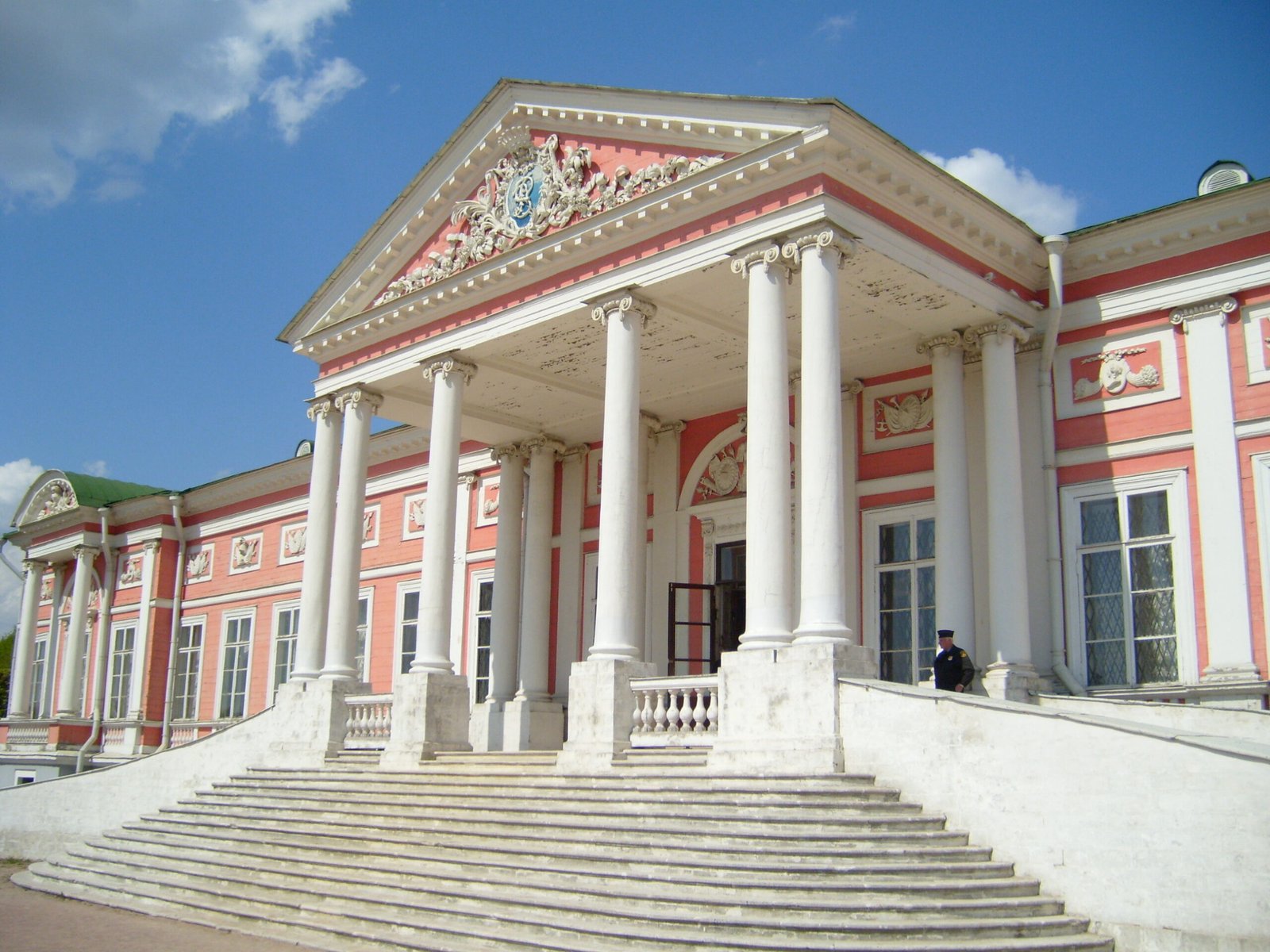
A wooden palace painted to look like stone, built by one of Russia’s richest men purely for entertainment, ceremony and show.
At a glance
Kuskovo was the summer estate of the Sheremetev family, laid out east of Moscow from the mid-18th century onward. Count Petr Borisovich Sheremetev wanted it grander than any noble residence and equal to a Czar’s palace. It was never meant for overnight guests or farming. Its sole purpose was festivity. Today the grounds hold the Russian State Museum of Ceramics, and the park remains a popular escape for Muscovites.
History
The land belonged in the 17th century to Field Marshal Boris Petrovich Sheremetev, victor at Poltava under Peter the Great. A wooden church, house and ponds already stood there. His son Petr Borisovich transformed the property, building it alongside his St. Petersburg palace on the Fontanka. Construction proceeded architect by architect: Y.I. Kologrivov shaped the lake and park until his death in 1754, Fiodor Argunov took over the palace and grotto, then moved to St. Petersburg work, leaving Karl Blank to finish the house. Catherine II visited in 1775, an event still marked by an obelisk. Decline followed by century’s end. The 1812 French invasion caused damage. Serfdom’s abolition in 1861 broke up the estate’s land. After 1917 the palace was nationalized, becoming a natural history museum in 1919, then home to the porcelain collections that formed the State Museum of Ceramics by 1932.
What you see
The palace is built in the neoclassical style, then fashionable in both Russian capitals. Its walls are wooden planks, plastered and painted in soft pastels to mimic masonry. A six-column portico fronts the house, its ramp designed for carriages drawn by up to eight horses. Servants once rushed out to hold the horses as guests descended. The formal French-style park, laid out between 1750 and 1780, is ornamented with clipped hedges, statues and trees trimmed into spheres and cones. Eight alleys converge at the circular Hermitage pavilion, built 1764–77, where Sheremetev preferred to spend his days. Nearby stand the brick Dutch House, its kitchen lined floor to ceiling in Delft tiles, and Argunov’s grotto, conceived as a palace for the King of the Seas.
Cultural significance
Kuskovo ranks among the first great summer estates of Russian nobility near Moscow, and one of the few to survive intact. It once hosted outdoor entertainments drawing twenty-five thousand guests, complete with a serf theater and orchestra. That theater was demolished in the 1830s. The Orangerie now houses the State Museum of Ceramics, whose holdings include Meissen, Wedgwood, Sèvres and Russian porcelain. Its centerpiece is the Egyptian service, commissioned by Napoleon in 1798 and given to Czar Alexander I at Tilsit in 1807. The museum also preserves an extensive collection of early Soviet revolutionary-themed porcelain.
Key facts
- Location: East District, Moscow, Russia
- Style: Neoclassical, with a French formal park
- Inception: 1737, with palace construction through the 1750s–1760s
- Architects: Y.I. Kologrivov, Fiodor I. Argunov, Karl Blank
- Current use: Russian State Museum of Ceramics
- Heritage status: Officially protected
Practical information & getting there
Kuskovo lies within Moscow’s East District, reachable from the city center. You can wander the park freely and step into the Orangerie for the ceramics museum. Wooden-plank pastel facades photograph best in low sun. Check the official museum site before visiting, as opening hours and exhibitions change seasonally.
Sources & resources
Find it on the map
See this place and what’s around it →📷 Become a Cultural Heritage Online photographer
Share your photos of places: they stay published under your name as the author. The more they're seen, the more you get noticed — and soon a contest will reward the most appreciated photos.
Log in or sign up free to add a photoIs this page about you?
This page is read by travellers and heritage enthusiasts who find it on Google. Tell us how you are connected to this place and we will take it from there.