
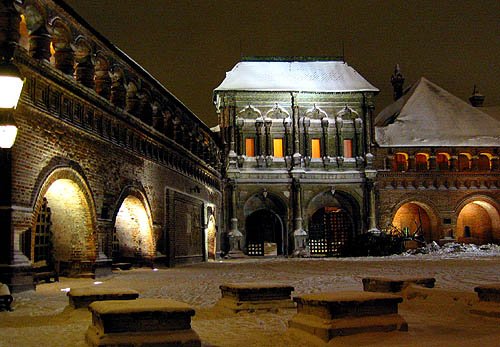
A cluster of tiled towers and low churches on the steep banks east of the Yauza, Krutitsy grew from a Mongol-era diocese into one of Moscow’s most decorated ecclesiastical compounds, then spent two centuries as an army warehouse before returning to the Church.
At a glance
Krutitsy Metochion sits in Tagansky District, about three kilometers southeast of the Kremlin. Its name comes from the old Russian word for steep river banks. Today it functions as the personal metochion of the Patriarch of Moscow, though its grounds feel more like a quiet park than a working monastery.
History
The site’s origins trace to 1261, when Orthodox clergy established the Diocese of Sarai inside the Golden Horde’s capital, hoping to serve captive and voluntary Slavic communities there. Prince Daniel of Moscow donated land here, on the river route to Sarai, and the diocese built its first church in 1272. When the Golden Horde fragmented, the diocese relocated to Moscow in 1454; its bishop kept the old title but gained a new one, Bishop of Krutitsy. By 1589 the see’s leaders held the grander style of Metropolitans of Krutitsy, Bishops of Sarai and Don. During the Time of Troubles, Krutitsy’s Dormition Cathedral briefly served as Muscovy’s main cathedral while the Kremlin was occupied. The 1650s brought disputes between Patriarch Nikon and the Old Believers, some of whom were later jailed on site. Metropolitan Paul II’s rule, 1664–1676, was the golden age: he rebuilt the Dormition Cathedral, raised the Metropolitan’s Chamber, and planted a garden with Moscow’s first fountain. Decline followed swiftly. Peter I abolished the patriarchy in 1711 and downgraded Krutitsy’s metropolitans to bishops. Fire struck in 1737. The seminary closed after a brief run in the 1740s, and in 1785 the state shut the diocese entirely. The military moved in. Fire again, in 1812, gutted the cathedral so badly that demolition was ordered and then, at the last moment, halted. Restoration under Grand Duke Alexander, later Alexander II, ran from the 1830s to 1868, led by architects Konstantin Thon and Yevgraph Tyurin. Yet the army kept most of the land, ringing the old abbey with barracks that doubled as a jail. After 1917 the cathedral closed again; frescoes vanished under oil paint, and a former cemetery became a football pitch.
What you see
The Dormition Cathedral is really two churches stacked together. The lower, unheated winter church of St. Peter and Paul was finished between 1667 and 1689; the upper summer church of the Dormition followed in 1700. Five domes crown the ensemble, rising 29 meters to the base of its cross. Locally it was once nicknamed the Little Dormition Cathedral, second only to its namesake in the Kremlin. Nearby stands the Resurrection Church, completed in the 1650s atop early 16th-century foundations. The Metropolitan’s Chamber, built 1655–1670, connects to the cathedral via a gallery added in 1693–1694 by architects Osip Startsev and Illarion Kovalyov. Above its gates rises the Teremok tower, decorated with tiles by Stepan Ivanov. A Riverside Dormitory from 1719 remains under restoration. A row of modest 19th-century wooden houses lines one edge of the grounds.
Cultural significance
Krutitsy embodies an unusual chapter of Russian church history, born from missionary ambitions inside the Mongol court rather than from Moscow itself. Its tiled Teremok and gallery count among the finest surviving examples of 17th-century Russian decorative architecture. Petr Baranovsky’s postwar restoration work here helped establish Krutitsy as a training ground for Soviet-era conservation. The site now belongs to the State Historical Museum as a branch, bridging its museum status with active church use.
Key facts
- Location: Tagansky District, Moscow, Russia
- Founded: diocese established 1261; first church 1272
- Dormition Cathedral: lower church 1667–1689, upper church completed 1700
- Height: 29 meters to the base of the cross
- Gallery and Teremok tower: 1693–1694, architects Osip Startsev and Illarion Kovalyov
- Restoration: led by Petr Baranovsky from 1947; state heritage listing from 1966
- Returned to the Russian Orthodox Church: 1991–1996
Practical information & getting there
You can reach Krutitsy on foot from Proletarskaya metro station, near the Novospassky Monastery. Two public gates open onto Krutitskaya Street and the First Krutitsky Lane. This is not a monastery in the strict sense, more a churchyard park managed by clergy. Visitors are asked to leave at the end of evening mass, avoid photography without prior consent, and refrain from smoking anywhere within the gates.
Sources & resources
Find it on the map
See this place and what’s around it →📷 Become a Cultural Heritage Online photographer
Share your photos of places: they stay published under your name as the author. The more they're seen, the more you get noticed — and soon a contest will reward the most appreciated photos.
Log in or sign up free to add a photoIs this page about you?
This page is read by travellers and heritage enthusiasts who find it on Google. Tell us how you are connected to this place and we will take it from there.