
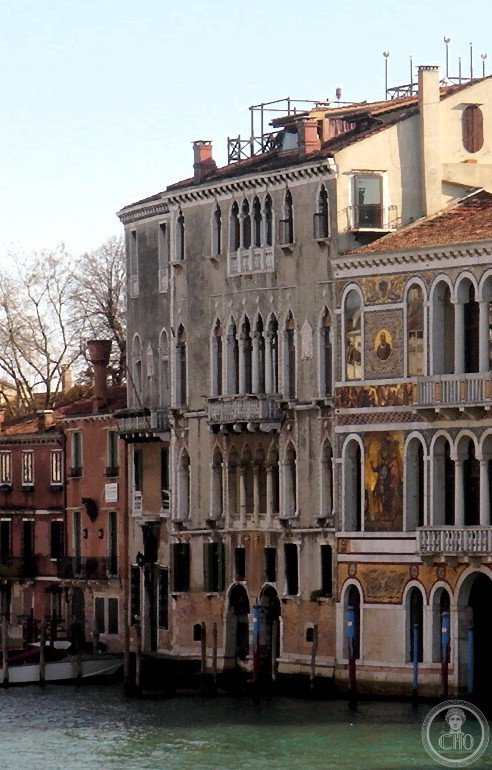
Palazzo da Mula Morosini
Palazzo da Mula is a Venetian Gothic villa on the island of Murano in the Venice Lagoon, standing on the south bank of the Canale degli Angeli near the Ponte Vivarini bridge on the sub-island of San Pietro Martire. It is one of the few surviving examples of 15th-century residential architecture on Murano, an island historically renowned as the centre of Venetian glass production. The palace’s Gothic arcade facing the canal makes it one of Murano’s most photographed landmarks.
At a glance
- Type
- Venetian Gothic palazzo / villa
- Period
- 15th century; associated with the da Mula and Morosini noble families
- Style
- Venetian Gothic
- Location
- San Pietro Martire, Murano, Venice Lagoon, Italy
- Coordinates
- 45.4649° N, 12.1827° E
- Current use
- Government offices (Municipality of Venice)
Overview
Palazzo da Mula stands as a rare survivor of the aristocratic residential culture that once flourished on Murano, when Venetian noble families maintained villas on the island both to oversee their glass-manufacturing interests and to enjoy its gardens and relative quiet. The building’s water-facing arcade of pointed Gothic arches, set above a stone base, is characteristic of the Venetian Gothic style at its most refined. Today the building serves administrative functions for the municipality and is not open to the public interior, though its canal facade is freely visible and much admired.
History
The palace takes its name from the da Mula family, a Venetian patrician house that held significant interests in Murano’s glass industry and maintained the property through the late medieval and early Renaissance periods. It subsequently passed to the Morosini family, another powerful Venetian noble house, giving rise to the compound name by which it is sometimes known. Over the centuries the building underwent modifications that partially altered its original Gothic configuration, but the canal facade retains much of its 15th-century character. The Municipality of Venice eventually acquired the property and adapted it for civic use.
What you see
The principal feature is the multi-bay Gothic arcade on the canal elevation, where slender columns support pointed arches with carved capitals — a formal vocabulary that mirrors the great Venetian palaces on the Grand Canal in miniature. The building is set directly on the water, its base of Istrian stone rising from the canal edge in the traditional Venetian manner. The surrounding neighbourhood of San Pietro Martire, with the adjacent Dominican church of the same name and the glass-furnace district, provides rich context for understanding the building’s original social environment.
Cultural significance
Palazzo da Mula is an important document of the aristocratic culture that made Murano a prestigious address as well as an industrial centre during the height of the Venetian Republic. Its survival alongside the glass furnaces and the church of San Pietro Martire illustrates the coexistence of craft production, religious life, and patrician residence that defined Murano’s social geography for centuries. The building is listed among the architectural heritage of the Venice Lagoon.
Practical information
- Address
- Fondamenta Cavour, Murano, 30141 Venice, Italy
- Access
- Exterior freely visible from the Canale degli Angeli; interior houses municipal offices (restricted access)
- Nearby
- Museo del Vetro di Murano (Murano Glass Museum) — open to the public, 5 minutes walk
Getting there
Take vaporetto Line 4.1 or 4.2 from Fondamente Nove (mainland Venice) to Murano Colonna or Murano Venier stops; the palace is a short walk from either stop along the Canale degli Angeli. From the Piazzale Roma or Ferrovia (Santa Lucia station) take a direct vaporetto to Murano. The island is approximately 1.5 kilometres north-east of Venice proper.
Sources & resources
See the place
Find it on the map
See this place and what’s around it →📷 Become a Cultural Heritage Online photographer
Share your photos of places: they stay published under your name as the author. The more they're seen, the more you get noticed — and soon a contest will reward the most appreciated photos.
Log in or sign up free to add a photoIs this page about you?
This page is read by travellers and heritage enthusiasts who find it on Google. Tell us how you are connected to this place and we will take it from there.