

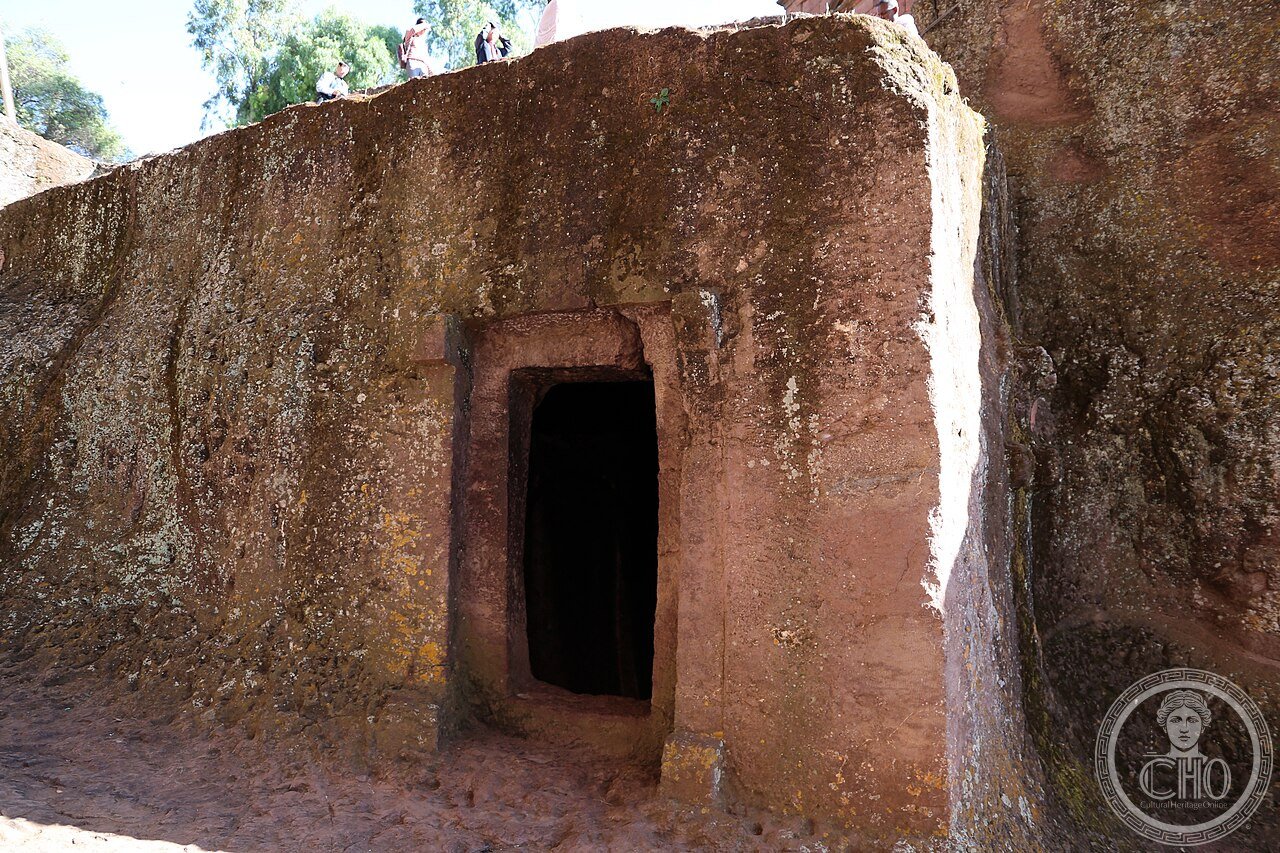
At Lalibela, in Ethiopia, the church of Bete Denagel belongs to the north-western group of the rock-hewn churches, along with Bete Medhane Alem, Bete Maryam, Bete Golgotha and Bete Meskel. They are linked to one another by a system of tunnels and trenches, north of the symbolic trench known as the «river Jordan». Like the other ten churches, it is attributed to the reign of King Lalibela, of the Zagwe dynasty, datable between the 12th and the 13th century. It is held to be one of the smallest in the whole complex, about five metres by five, and a little over three and a half metres high. The name «Denagel» means «virgins» in Ge’ez, and the church is popularly known as the «House of Virgins». Tradition — reported consistently by several Ethiopian guides, but not verifiable through primary academic sources — says the church commemorates fifty virgin nuns martyred in the 4th century at Edessa, on the orders of the Roman emperor Julian the Apostate, in the course of his campaign to restore Neoplatonic paganism against Christianity. Unlike the larger churches of the complex, Bete Denagel is only partly cut from the rock. Its west-facing entrance has a double arch on a single pillar, leading to a cell of minimal size. Since 1978 the church has been part of the UNESCO World Heritage Site «Rock-Hewn Churches, Lalibela».
About Bete Denagel
Bete Denagel, in Lalibela, Ethiopia, belongs to the northwestern cluster of the town’s rock-hewn churches, alongside Bete Medhane Alem, Bete Maryam, Bete Golgotha and Bete Meskel, connected by a system of tunnels and trenches north of the symbolic trench known as the “River Jordan.” Like the other ten churches, it is attributed to the reign of King Lalibela of the Zagwe dynasty, dated broadly to the 12th or 13th century, and is considered one of the smallest structures in the entire complex, measuring roughly five by five metres with a height of just over three and a half metres. The name “Denagel” means “virgins” in Ge’ez, and the church is popularly known as the “House of Virgins.” According to tradition, consistently reported across several Ethiopian guide sources though not independently verifiable against primary academic sources, the church commemorates fifty virgin nuns martyred in the 4th century at Edessa on the orders of the Roman Emperor Julian the Apostate, as part of his campaign to restore Neoplatonic paganism against Christianity. Unlike the complex’s larger churches, Bete Denagel is only partially carved from the rock, its west-facing entrance marked by a double arch on a single pillar leading to a minimally sized cell. Since 1978, the church has formed part of the UNESCO World Heritage Site “Rock-Hewn Churches, Lalibela.”
Key facts
- 12th-13th century: attributed to the reign of King Lalibela, Zagwe dynasty.
- ~5 x 5 metres, one of the smallest of the eleven churches.
- “Denagel” means “virgins” in Ge’ez; popularly “House of Virgins”
- Tradition: commemorates fifty nuns martyred at Edessa under Julian the Apostate.
- Northwestern cluster, alongside Bete Medhane Alem, Bete Maryam and Bete Golgotha.
- 1978: becomes part of the UNESCO World Heritage Site “Rock-Hewn Churches, Lalibela”
History
Bete Denagel’s modest scale, among the smallest of Lalibela’s eleven churches, stands in deliberate contrast to its weighty dedication, commemorating a tradition of Christian martyrdom that connects the highland Ethiopian complex to the wider early Christian world of 4th-century Roman Syria. Its place within the tightly linked northwestern cluster, threaded together by tunnels and trenches alongside Bete Medhane Alem, Bete Maryam and Bete Golgotha, reflects the deliberate architectural unity King Lalibela’s builders achieved across even the complex’s smallest structures.
What you see
The church’s modest, partly rock-cut structure opens through a west-facing entrance marked by a double arch resting on a single pillar, leading into a small interior cell barely large enough for a couple of benches. Its scale and simplicity set it apart from the monumental churches nearby, offering a quieter counterpoint within the tunnel-connected northwestern cluster.
Practical information
- Opening hours: generally open daily with seasonal variation; admission fee applies; check current hours before visiting.
- Address: Lalibela, Amhara Region, Ethiopia.
Getting there
Bete Denagel stands within the northwestern cluster of Lalibela’s rock-hewn churches, reachable on foot within the town. GPS: 12.0325° N, 39.0433° E (approximate, Lalibela complex).
Nearby
- Bete Maryam — the oldest of Lalibela’s churches, nearby.
- Bete Golgotha — connected within the same northwestern cluster.
- Lalibela town — the surrounding highland town, source of the church complex’s name.
Sources
- Wikipedia — “Rock-Hewn Churches, Lalibela” (en.wikipedia.org).
- UNESCO World Heritage Centre — “Rock-Hewn Churches, Lalibela” (whc.unesco.org).
- My Ethiopia Tours — “Bete Danaghel Church, Lalibela” (myethiopiatours.com).
Find it on the map
See this place and what’s around it →📷 Become a Cultural Heritage Online photographer
Share your photos of places: they stay published under your name as the author. The more they're seen, the more you get noticed — and soon a contest will reward the most appreciated photos.
Log in or sign up free to add a photo