
La devozione a Nostra Signora di Mariazell risale al 1157, quando il monaco Magnus, appartenente al monastero benedettino di San Lambrecht, decise di ritirarsi come eremita in un angolo remoto della foresta stiriana. Durante il viaggio, il suo cammino fu sbarrato da un enorme masso: Magnus vi posò sopra una piccola statua della Madonna in legno di tiglio che portava con sé, pregando per trovare una via. La roccia, secondo la tradizione, si spaccò in due, aprendogli il passaggio. In segno di gratitudine, Magnus costruì lì una piccola cella (“Zell” in tedesco, da cui il nome Mariazell) per vivere e pregare, custodendo la statua che sarebbe diventata nota come Magna Mater Austriae, la Grande Madre d’Austria. Dal 1330 in poi, un tribunale secolare iniziò a imporre la “Zellfahrt” — il pellegrinaggio a Mariazell — come pena espiatoria per i criminali, contribuendo a farne il santuario mariano più importante di tutta l’Austria. Papa Pio X elevò il santuario a basilica minore nel 1907 e ne incoronò l’immagine sacra nel 1908.
About Mariazell Basilica
The tradition of devotion at Mariazell traces its origin to 1157, when a monk named Magnus, a member of the Benedictine monastery of St Lambrecht, resolved to become a hermit and settled in a remote corner of the Styrian wilderness. According to the founding legend, as Magnus travelled through the forest, his path was suddenly blocked by a vast boulder; faced with this obstacle, he placed a small statue of the Virgin Mary, carved from linden wood and carried with him on his journey, upon the rock and prayed for guidance. To his astonishment, the boulder split cleanly in two, allowing him to pass through. In gratitude, Magnus built a small cell — “Zell” in German, giving the settlement its name, Mariazell — in which to live and pray, keeping the small statue with him. That same statue became venerated over the following centuries as the Magna Mater Austriae, the “Great Mother of Austria,” and remains today the central object of devotion at the site, enshrined within the basilica’s Gnadenkapelle, or Grace Chapel. Over time, Magnus’s simple hermitage grew into a full monastery and church, developing into one of the most significant pilgrimage destinations anywhere in Central Europe. Documented pilgrim numbers grew substantially from around 1330 onward, when a secular court began formally imposing the “Zellfahrt” — a mandatory pilgrimage journey to Mariazell — as a form of judicial penance for convicted criminals, embedding the site within both religious devotion and criminal justice practice of the period. The sanctuary’s status was formally elevated when Pope Pius X raised it to the rank of minor basilica by a Motu proprio issued on 10 November 1907, and the following year, on 8 September 1908, he further authorised the formal coronation of the venerated Marian image, cementing Mariazell’s position as Austria’s foremost national Marian shrine.
Key facts
- 1157: monk Magnus founds the hermitage, following the legend of the split boulder
- Statue: a linden-wood Madonna, venerated as the Magna Mater Austriae
- From 1330: pilgrimage to Mariazell (Zellfahrt) imposed as judicial penance for criminals
- 10 November 1907: Pope Pius X elevates the sanctuary to Minor Basilica
- 8 September 1908: formal coronation of the Marian image authorised
- Status: Austria’s most important Marian pilgrimage site
History
Mariazell’s origin legend, centred on a hermit monk’s miraculous passage through a split boulder, situates the site within a well-established medieval pattern of Marian shrines founded upon a single reported miraculous encounter with a devotional statue, a pattern echoing similar traditions across Catholic Europe though rarely with such lasting national significance. The 14th-century practice of imposing pilgrimage to Mariazell as formal judicial penance for criminals represents a distinctive fusion of secular legal punishment and religious devotion characteristic of medieval Central European justice, directly contributing to the site’s transformation from a remote hermitage into a major pan-regional pilgrimage destination.
Pope Pius X’s early 20th-century elevation of Mariazell to basilica status and his authorisation of the Marian image’s formal coronation reflect the site’s consolidated status by that period as the preeminent national shrine of Austria-Hungary, a role Mariazell has retained within the specifically Austrian national and Catholic religious identity down to the present day.
What you see
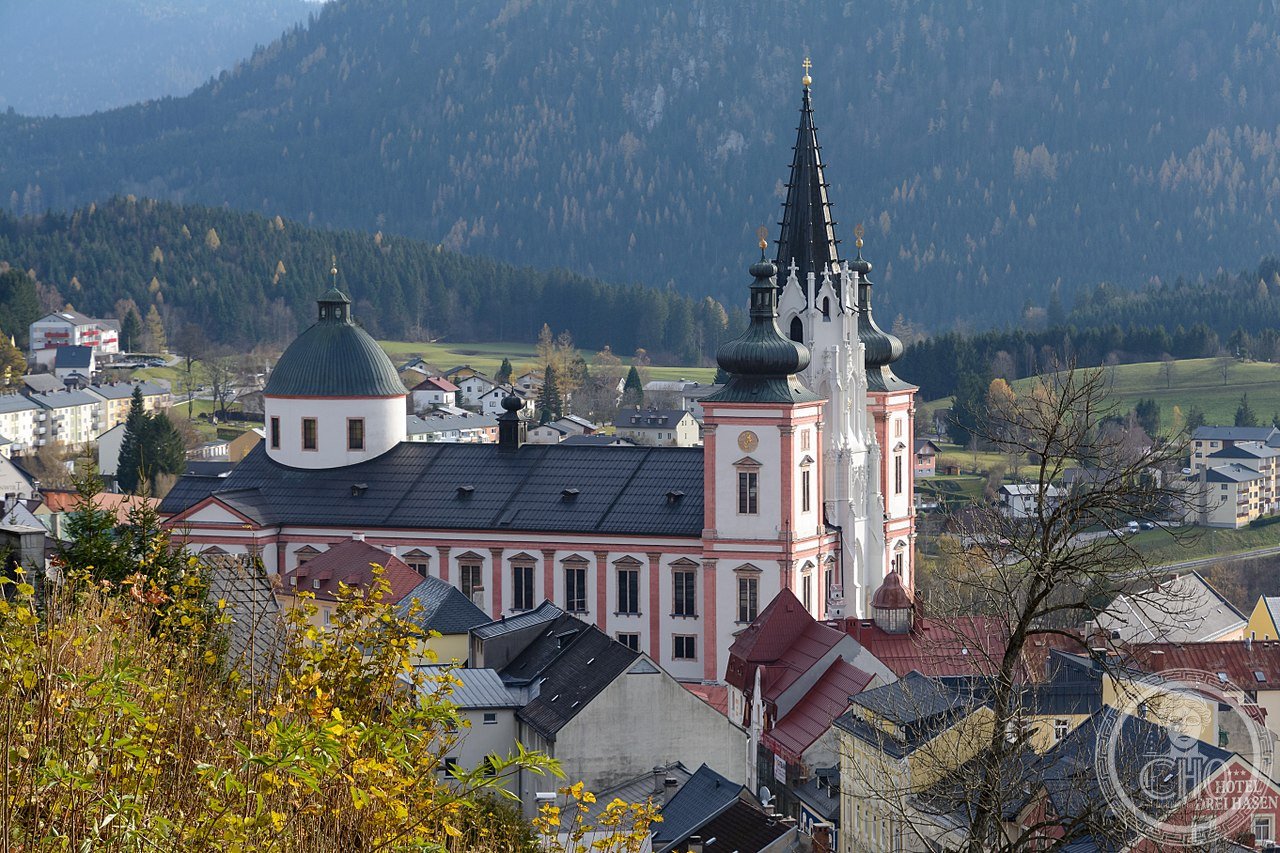
The basilica’s twin-towered facade dominates the town of Mariazell, its architecture layered across centuries of expansion from Magnus’s original modest cell into a major pilgrimage church. Inside, the Gnadenkapelle houses the venerated linden-wood statue of the Magna Mater Austriae, the focal point for the pilgrims who continue to visit the shrine in substantial numbers each year, following a tradition of devotion now stretching back nearly nine centuries.
Practical information
- Opening hours: generally open daily with seasonal variation; free admission; check current hours before visiting
- Address: Wiener Neustädter Straße 1, 8630 Mariazell, Austria
Getting there
Mariazell Basilica stands in the town of Mariazell, in the Styrian mountains of central Austria, reachable by narrow-gauge railway from St Pölten or by car. GPS: 47.7728° N, 15.3189° E.
Nearby
- Mariazell town centre — the pilgrimage town surrounding the basilica
- Bürgeralpe — nearby mountain accessible by cable car, overlooking the town
- St Pölten — regional city, connected to Mariazell by the historic Mariazellerbahn railway
Sources
- Wikipedia — “Mariazell Basilica” (en.wikipedia.org)
- National Shrine of the Immaculate Conception — “A Prayer for Marian Provision: the Miracle of Mariazell” (nationalshrine.org)
- Sacred Destinations — “Mariazell Shrine” (sacred-destinations.com)
Find it on the map
See this place and what’s around it →📷 Become a Cultural Heritage Online photographer
Share your photos of places: they stay published under your name as the author. The more they're seen, the more you get noticed — and soon a contest will reward the most appreciated photos.
Log in or sign up free to add a photo