
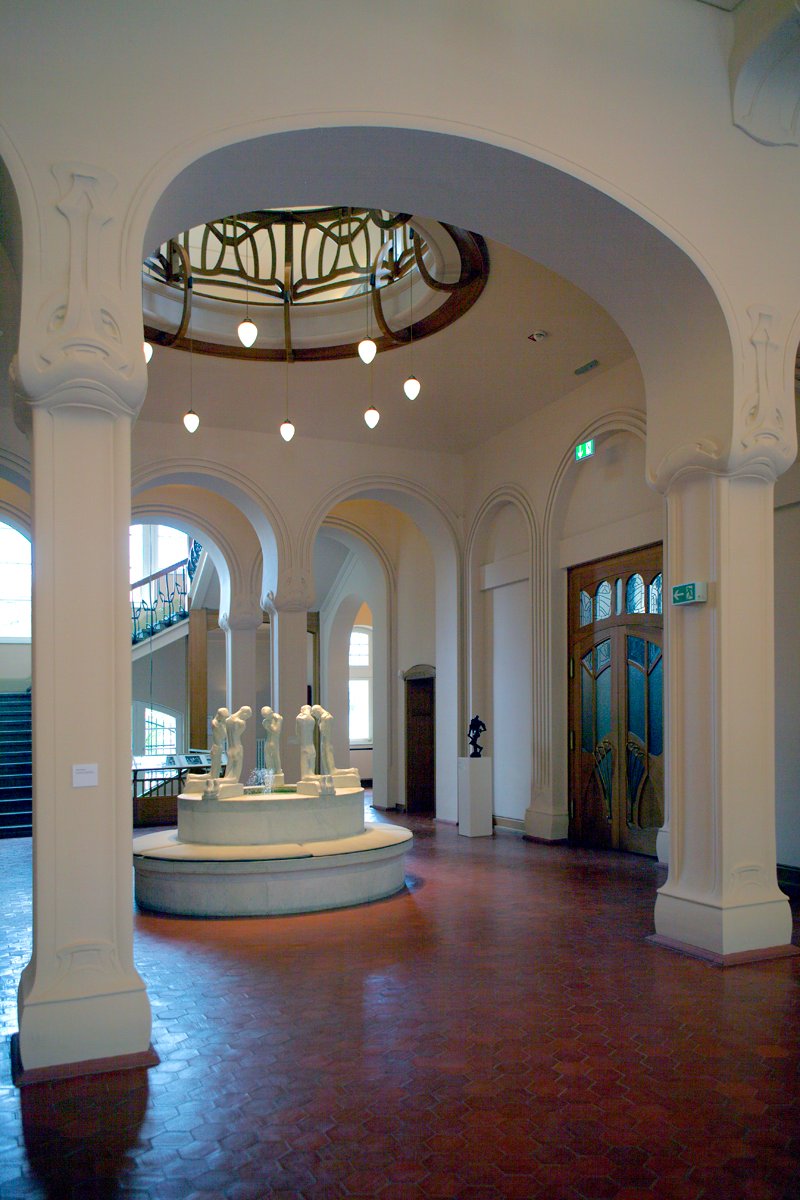
Karl Ernst Osthaus-Museum
A modernist art museum shaped by loss and recovery, housing one of Germany’s finest collections of Art Nouveau and expressionist works in a building designed by Henry van de Velde.
At a glance
The Osthaus-Museum occupies the former Folkwang building, whose interiors were designed by the influential Belgian architect and designer Henry van de Velde. Originally created to display Karl Ernst Osthaus’ pioneering art collection, the museum tells a story of absence and reconstruction. Today it holds major works by Christian Rohlfs and Emil Schumacher, alongside environmental installations and the German branch of the Museum of Jurassic Technology.
History
Karl Ernst Osthaus commissioned Henry van de Velde to design an interior for his private collection, which opened to the public as the Museum Folkwang. When Osthaus’ heirs sold the entire collection to Essen, Hagen was left with an empty building that served as offices for the local electric company.
After World War II, director Herta Hesse led the restoration of the Folkwang building into a new home for the city’s art museum. Though original interiors were lost to reconstruction and bombing, subsequent restorations have approximated Osthaus’ vision. Under later director Michael Fehr, the museum adopted a more experimental approach, commissioning installations that engage critically with Hagen’s artistic legacy.
What you see
The building’s architecture reflects Henry van de Velde’s modernist principles, though the original interior design is not fully preserved. The reinstated spaces provide context for paintings, sculptures, and contemporary installations. Environmental art by Herman de Vries and large-scale works dominate gallery spaces, while the archive occupies dedicated areas for research access.
Cultural significance
The museum represents a uniquely German narrative of cultural loss and recovery. It houses one of the main collections of Christian Rohlfs and the most important collection of Emil Schumacher, both regarded as Hagen artists. The accompanying Karl Ernst Osthaus-Archive preserves crucial documentation on the Folkwang Museum and early 20th-century avant-garde movements, making it an essential resource for art historical research.
Key facts
- Location: Hagen, North Rhine-Westphalia, Germany (51.356°N, 7.473°E)
- Interior design: Henry van de Velde
- Collection focus: Art Nouveau, expressionism, contemporary installations
- Notable holdings: Works by Christian Rohlfs, Emil Schumacher, Herman de Vries
- Archive: Karl Ernst Osthaus-Archive documenting early 20th-century avant-garde art and architecture
Practical information & getting there
The museum is located in Hagen, accessible by rail and road via North Rhine-Westphalia. Consult the museum’s website for current hours, admission fees, and exhibition schedules. The archive operates by appointment for serious researchers.
Sources & resources
- Osthaus-Museum Hagen — Wikipedia
- Cultural Heritage Online
Find it on the map
See this place and what’s around it →📷 Diventa un fotografo di Cultural Heritage Online
Condividi le tue foto dei luoghi: restano pubblicate con la tua firma come autore. Più vengono viste, più ti fai conoscere — e presto un concorso premierà le foto più apprezzate.
Accedi o registrati gratis per aggiungere una fotoDo you manage this place?
This page is read by travellers and heritage enthusiasts who find it on Google. Keep it accurate — and make it work for you. Free for non-profit heritage institutions.