
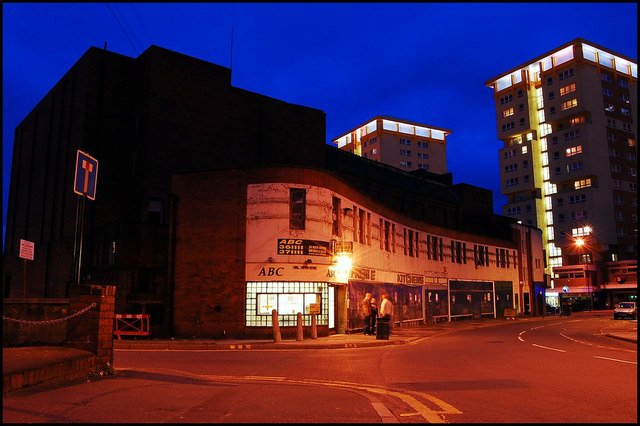
An Art Deco cinema that opened as the Regal in 1935 and became a cultural hub for mid-twentieth-century entertainment, hosting The Beatles in 1963 before closure in 1997.
At a glance
Designed by Associated British Cinemas’ in-house architect William R. Glen, this 1,594-seat cinema occupied the corner of Kirkgate and Sun Lane. Its streamlined Art Deco interiors featured concealed lighting and a full theatrical stage, though the planned organ was never installed. The building was retrofitted into a three-screen multiplex in 1976 before eventual closure and demolition.
History
The cinema opened as the Regal on 9 December 1935, serving Wakefield’s entertainment needs throughout the mid-twentieth century. It was renamed ABC in 1962 when Associated British Cinemas rebranded their estate. In 1976, the single auditorium was divided into three screens to compete with emerging multiplex cinemas, reopening on 11 November that year.
The cinema’s cultural significance peaked in the 1950s and 1960s when it hosted major touring shows. The Beatles performed here on 7 February 1963, during the Helen Shapiro Winter Tour—just four days before recording the majority of their debut album Please Please Me. At that point, they had released only one single, “Love Me Do,” which had reached number 17 in the UK charts.
Following the opening of a Cineworld multiplex in Wakefield in December 1996, the ABC closed in 1997. Multiple redevelopment proposals followed—including conversion to apartments (2007–2009) and demolition schemes (2013–2019)—but none were realized. Wakefield Council purchased the site in 2020 and commissioned its demolition, which began internally in March 2022 and was completed externally by May 2023.
What you see
The building exemplified the Art Deco style favored by cinema architects of the 1930s. Its interior was notably plainer than many of Glen’s other designs, relying on concealed lighting beneath the balcony and rear ceiling, with upward-casting pendant fittings. The original proscenium measured 43 feet wide, backing a stage 26 feet deep—generous proportions for theatrical presentations and variety shows.
Architectural provision was made for a pipe organ with side and overhead chambers, yet this amenity was never installed, leaving those spaces dormant throughout the building’s operational life.
Cultural significance
The ABC Cinema holds particular resonance in British rock history as the venue where The Beatles performed in early 1963, during their rise to national prominence. The cinema was also representative of a distinctive era in British leisure architecture—the purpose-built suburban cinema that served as a social and cultural anchor for local communities from the 1930s through the 1990s.
Key facts
- Country: United Kingdom
- City: Wakefield, West Yorkshire
- Designed by: William R. Glen (Associated British Cinemas)
- Opened: 9 December 1935 (as the Regal Cinema)
- Original capacity: 1,594 seats
- Renamed: ABC Cinema (1962)
- Converted to three screens: 11 November 1976
- Closed: 1997
- Coordinates: 53.68°N, 1.49°W
Practical information & getting there
The cinema no longer stands. The site has been cleared and is planned for temporary green space pending future development. Wakefield town centre is served by rail and bus connections, and the former cinema’s location on Kirkgate remains a notable point of reference in the city’s commercial district.
Sources & resources
Find it on the map
See this place and what’s around it →📷 Become a Cultural Heritage Online photographer
Share your photos of places: they stay published under your name as the author. The more they're seen, the more you get noticed — and soon a contest will reward the most appreciated photos.
Log in or sign up free to add a photoIs this page about you?
This page is read by travellers and heritage enthusiasts who find it on Google. Tell us how you are connected to this place and we will take it from there.