
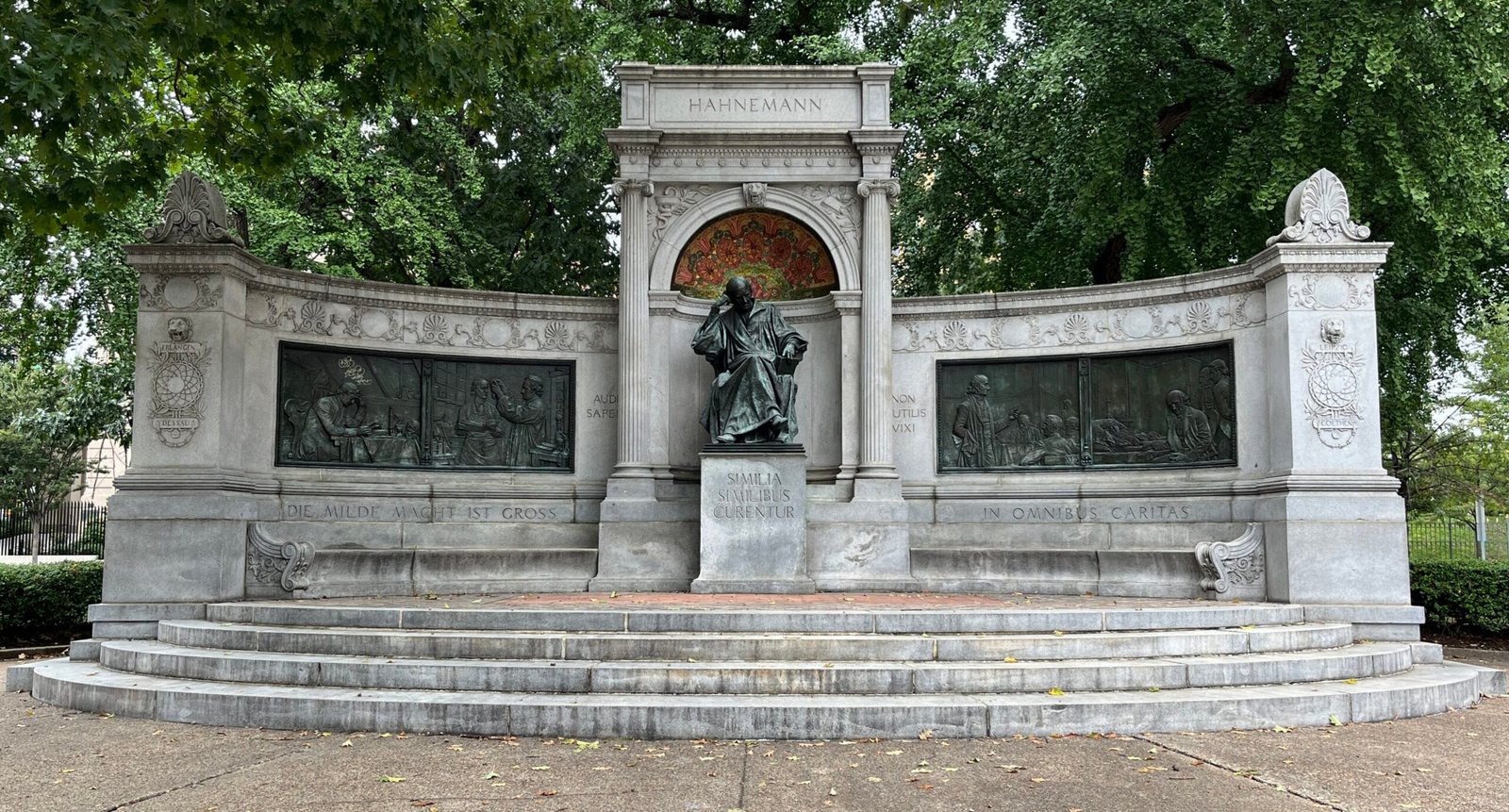
A Classical Revival monument honoring the German physician who founded homeopathy, distinguished as the first sculpture in Washington, D.C. dedicated to a foreigner unconnected to the American Revolution.
At a glance
The monument occupies the east side of Scott Circle in northwest Washington, D.C. Its exedra was designed by architect Julius Harder; sculptor Charles Henry Niehaus created the statue. The bronze figure honors Samuel Hahnemann (1755–1843), whose medical philosophy reshaped global healthcare practice.
History
The American Institute of Homeopathy spearheaded a lengthy fundraising campaign to erect this public sculpture. Dedication ceremonies took place in 1900, drawing thousands of attendees including President William McKinsey, Attorney General John W. Griggs, and General John Moulder Wilson. The monument underwent rededication in 2000 and restoration in 2011, later earning National Register of Historic Places designation in 2007.
What you see
The Classical Revival composition pairs Harder’s exedra—an open semicircular structure—with Niehaus’s sculptural portrait. Niehaus brought considerable experience to the commission; his other Washington, D.C. works include the John Paul Jones Memorial and multiple statues in the National Statuary Hall Collection.
Cultural significance
This monument marks a pivotal moment in Washington’s public sculpture tradition. Hahnemann’s honor broke precedent: no foreigner outside the Revolutionary circle had previously received such commemoration in the capital. The dedication reflects 19th-century American esteem for homeopathic medicine and its pioneer founder.
Key facts
- Location: Scott Circle, northwest Washington, D.C.
- Dedicated: 1900
- Architect: Julius Harder (exedra)
- Sculptor: Charles Henry Niehaus (statue)
- Designation: National Register of Historic Places (2007)
- Coordinates: 38.907256, -77.035725
- Ownership & maintenance: National Park Service
Practical information & getting there
The monument and its surrounding grounds are maintained by the National Park Service. Scott Circle is accessible by public transportation; visit during daylight hours for optimal viewing. The site is free and open to the public year-round.
Sources & resources
Find it on the map
See this place and what’s around it →📷 Become a Cultural Heritage Online photographer
Share your photos of places: they stay published under your name as the author. The more they're seen, the more you get noticed — and soon a contest will reward the most appreciated photos.
Log in or sign up free to add a photoIs this page about you?
This page is read by travellers and heritage enthusiasts who find it on Google. Tell us how you are connected to this place and we will take it from there.