

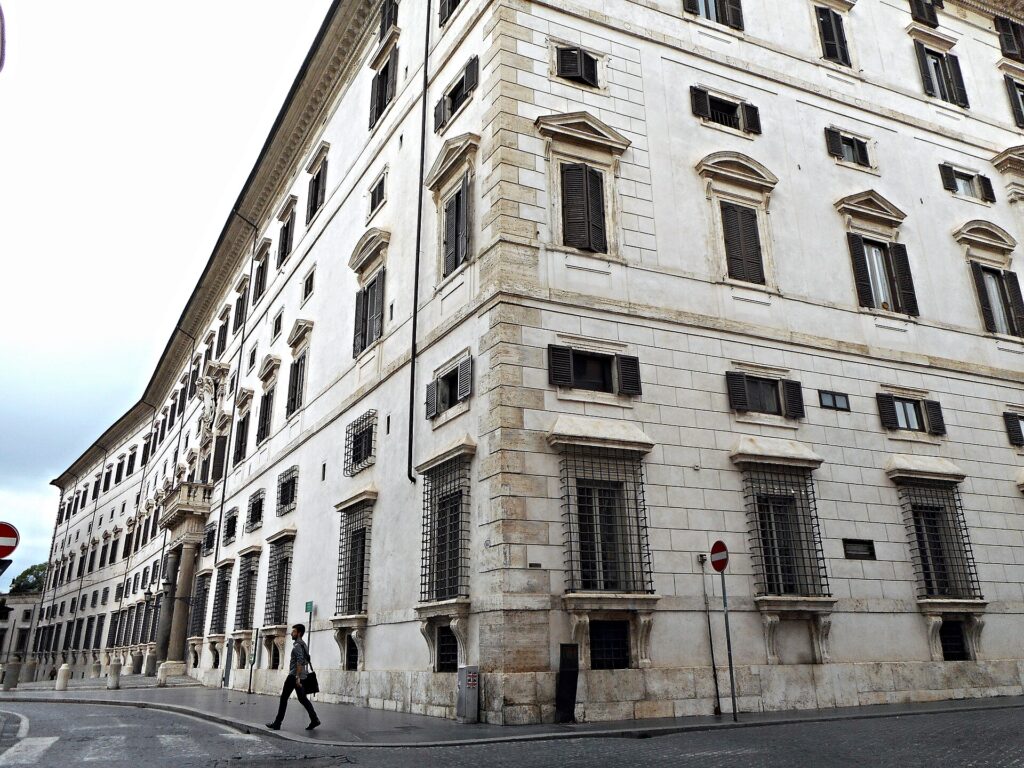
Fondazione Memmo is a private foundation created in Rome in 1990 by Roberto Memmo to bring the public closer to art. Since 2012 it has run a programme of contemporary exhibitions, first in Palazzo Ruspoli on via del Corso and now in the former stables of the same palace, with the entrance at via Fontanella Borghese 56/b; admission is free.
At a glance
- Type
- Private art foundation with temporary exhibitions
- Founded
- 1990, by Roberto Memmo
- Seat
- Former stables of Palazzo Ruspoli, via Fontanella Borghese 56/b, 00186 Rome
- Discipline
- Contemporary art, with a historic programme on ancient art from 1991 to 2009
- Admission
- Free
- Coordinates
- 41.9043° N, 12.4787° E
Overview
The foundation occupies the stables of Palazzo Ruspoli, in the Campo Marzio, with an independent entrance on via della Fontanella di Borghese. The rooms are those of a service building of the palace, adapted as gallery spaces, and the exhibitions are conceived in dialogue with their proportions rather than in a neutral white cube. The programme consists of temporary shows, one at a time, with free entry: the foundation has no permanent collection of its own on display.
History
Roberto Memmo, a lawyer and property developer with a lifelong interest in ancient art, founded the institution in 1990 as a private foundation and became its first president, with three vice-presidents including the then superintendent of cultural heritage Claudio Strinati. The first season opened in Palazzo Ruspoli in December 1991 with Canova all’Ermitage, which drew 130,000 visitors. There followed a series of exhibitions on the great civilisations of the ancient world: Nefertari, luce d’Egitto in 1994, seen by 380,000 people, and Cleopatra, regina d’Egitto in 2000. In under twenty years the foundation’s exhibitions were visited by more than three million people.
In 2012 the foundation turned to contemporary art, with a site-specific project by Sara VanDerBeek, followed by Sterling Ruby in 2013 and Shannon Ebner in 2014, the exhibition that inaugurated the new space of the stables. Since 2015 the annual group exhibition Conversation Piece, curated by Marcello Smarrelli, has taken stock of the artists working in Rome, especially those hosted by the foreign academies and cultural institutes in the city; it reached its eleventh edition in 2026. Roberto Memmo died in 2021.
What you see
The foundation’s rooms are the former stables of Palazzo Ruspoli, adapted as exhibition spaces with an independent entrance on via della Fontanella di Borghese. The palace was begun in the mid-sixteenth century for the Jacobilli, sold in 1583 to the Rucellai, and completed by Bartolomeo Ammannati, who built the façade on via del Corso and the loggia overlooking the garden, with frescoes by Jacopo Zucchi; it passed to the Caetani and, from 1776, to the Ruspoli, who gave it their name. Inside, the monumental staircase is the work of Martino Longhi the Younger.
Cultural significance
Fondazione Memmo belongs to the small group of private Roman institutions that have kept a contemporary art programme alive in the historic centre, alongside the public museums. Its history runs in two halves: the great archaeological and art-historical exhibitions of the 1990s, which set attendance records in Italy, and the contemporary programme begun in 2012, built on site-specific commissions and on residencies with Gasworks in London. The Conversation Piece cycle has become a recurring survey of the international artists working in Rome.
Practical information
- Address
- Via Fontanella Borghese 56/b, 00186 Rome (Campo Marzio)
- Hours
- 11:00–18:00, closed on Tuesdays; check the programme before visiting, since the space closes between exhibitions
- Admission
- Free
- Telephone
- +39 06 68136598
Getting there
The foundation is in the heart of Rome, a few minutes on foot from Piazza di Spagna and the Metro A station of Spagna, and from Largo Goldoni at the northern end of via del Corso. Several bus lines run along via del Corso and the nearby Tiber embankments. The area is closed to most private traffic, so the last part of the visit is on foot.
Sources & resources
Find it on the map
See this place and what’s around it →📷 Become a Cultural Heritage Online photographer
Share your photos of places: they stay published under your name as the author. The more they're seen, the more you get noticed — and soon a contest will reward the most appreciated photos.
Log in or sign up free to add a photo