
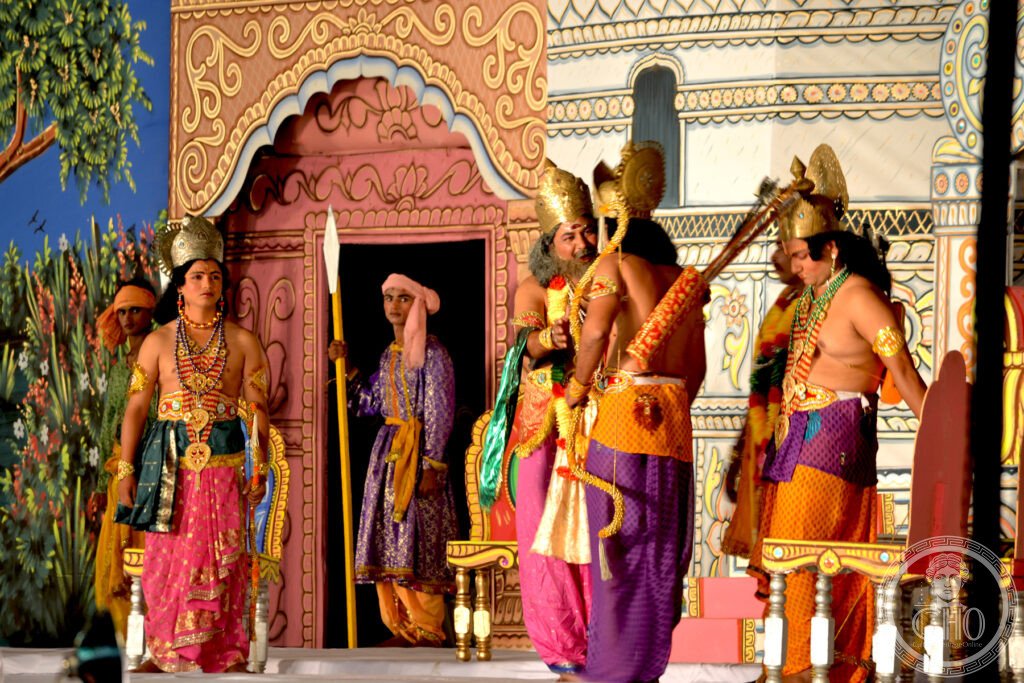
A dramatic folk re-enactment of the life of Rama from the ancient Hindu epic Ramayana, staged annually during Navaratri by local communities across India and the global diaspora.
At a glance
Ramlila—literally “Rama’s play”—transforms the sacred Ramayana into open-air theatre performed by villagers and urban neighbourhood committees. During the autumn festival of Navaratri, thousands of dramatic adaptations unfold across India, culminating in Vijayadashami (Dussehra) when effigies of the demon Ravana are burnt in night festivities. Performers and audience members together animate stories driven by ethical values and devotion.
Origins & history
Rama, the seventh avatar of the god Vishnu, anchors the Ramayana—a Sanskrit epic dating to the 1st millennium BCE that merges performance arts with moral teaching. Most North Indian Ramlilas draw from the Ramcharitmanas, a 16th-century verse composition in Awadhi by the poet Tulsidas, whose lines serve as dialogue in traditional stagings. The form migrated into Southeast Asia during the 1st millennium CE, becoming part of performance culture in Bali, Myanmar, Cambodia and Thailand. With Indian migration in the 19th and 20th centuries, Ramlila spread to Fiji, Mauritius, Trinidad and Tobago, South Africa, and communities in North America, Europe and Oceania.
The practice
Local Ramlila committees (Samitis) stage open-air productions funded entirely by villagers or neighbourhoods. A trained core team of performance artists enact the legendary war between good and evil, yet the actual staging attracts impromptu participants from the crowd—blurring the boundary between performer and spectator. Dialogues emerge from Tulsidas’s verses recited and adapted in real time. The celebration climaxes on Vijayadashami night with the burning of giant grotesque effigies of Ravana, typically accompanied by fireworks, marking the triumph of good over evil.
Cultural significance
Ramlila is a cornerstone of Hindu cultural life, part of a broader tradition of dramatic worship that includes Durga Puja and Rasalila (Krishna performances). The practice binds communities through shared storytelling and ritual; it transmits sacred narrative and ethical wisdom to new generations while allowing each locality to shape the tale to its own voice. The form demonstrates how ancient texts remain living, participatory arts—renewed each year by the devotion and creativity of ordinary people.
Key facts
- Countries: India, with diaspora communities worldwide
- Anchor heartland: Varanasi, Uttar Pradesh (25.32131°N, 83.01379°E)
- Notable centres: Ayodhya, Vrindavan, Almora, Chamba, Solan, Satna, Madhubani
- Annual festival: Navaratri (autumn)
- Climax celebration: Vijayadashami (Dussehra)
- Source text: Ramcharitmanas (16th century, Tulsidas)
- UNESCO inscription: 2008 (Reference 00110)
Where to experience it
Varanasi remains the heartland of Ramlila, where the tradition unfolds with particular spiritual depth during Navaratri each autumn. Ramlila performances occur in historically significant Hindu cities including Ayodhya, Vrindavan, Almora, and across Uttar Pradesh, Uttarakhand, Himachal Pradesh, Bihar and Madhya Pradesh. Communities worldwide—from Mauritius to Trinidad and Tobago, from London to Vancouver—stage local adaptations during the festival season.
Sources & resources
Find it on the map
See this place and what’s around it →📷 Become a Cultural Heritage Online photographer
Share your photos of places: they stay published under your name as the author. The more they're seen, the more you get noticed — and soon a contest will reward the most appreciated photos.
Log in or sign up free to add a photo