
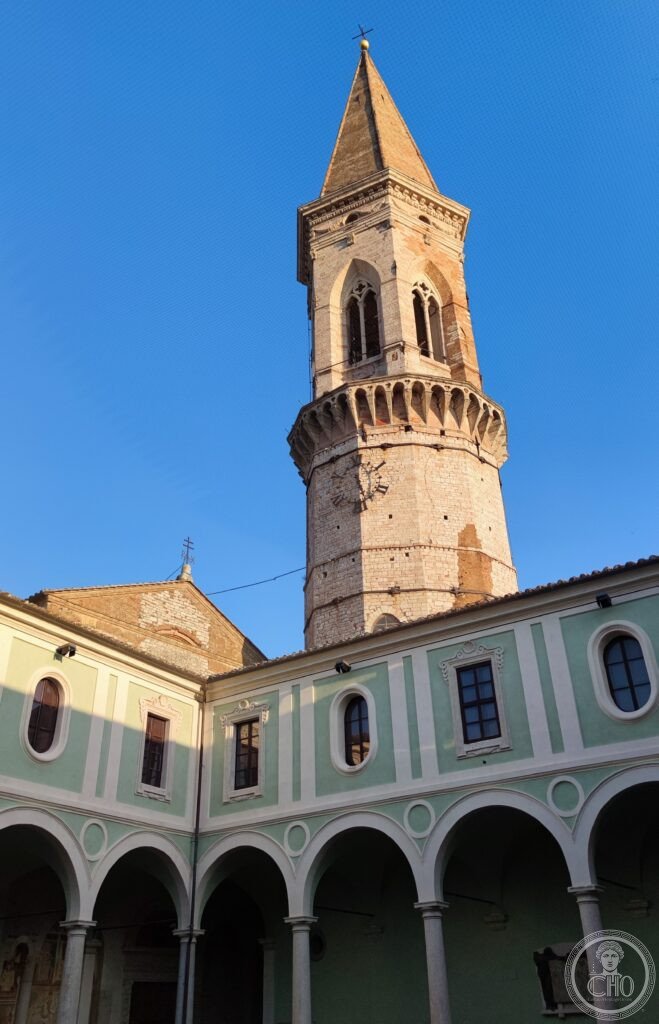
The Abbazia di San Pietro is a Catholic basilica and Benedictine abbey in Perugia, Umbria, one of the most important monastic complexes in central Italy and an Italian national monument. Founded in the late 10th century on the site of the ancient church of San Pietro Apostolo, it is celebrated for its remarkable bell tower, at 70 metres the tallest structure in Perugia and one of the city’s defining landmarks. The abbey church preserves an exceptional collection of Renaissance and Baroque art, including intarsia choir stalls by Bernardino Antonibi and a painting cycle in the sacristy representing the history of the Benedictine order.
At a glance
- Type
- Benedictine abbey and minor basilica
- Period
- Founded late 10th century; present church substantially rebuilt 14th–17th century
- Style
- Romanesque origins; Gothic and Baroque modifications
- Location
- Borgo XX Giugno, Perugia, Province of Perugia, Umbria, Italy
- Coordinates
- 43.1014° N, 12.3934° E
- Status
- Italian national monument; active Benedictine community
Overview
The Basilica di San Pietro is a Catholic basilica and abbey in Perugia, acknowledged as a national monument of Italy. Its bell tower, standing at 70 metres, is the tallest structure in Perugia and one of the city’s most recognisable symbols visible from across the surrounding Umbrian plain. The complex combines an active religious community with one of the richest accumulations of Renaissance and Baroque art in Umbria, making it both a living monastery and a major cultural heritage site.
History
The abbey was founded at the end of the 10th century by a Benedictine monk named Pietro Vincioli, on the site of an earlier church dedicated to Saint Peter the Apostle, which may itself have been built over a Roman temple. The present basilica was rebuilt and enlarged from the 14th century onwards, with significant work carried out in the 15th and 16th centuries under the patronage of the Baglioni family and other Perugian noble houses. The Benedictine community has maintained an unbroken presence at the site since the foundation, making San Pietro one of the oldest continuously inhabited monasteries in Umbria.
What you see
The basilica interior is a three-aisled space lined with ancient columns, many brought from earlier Roman buildings, supporting arches that frame side chapels rich with paintings by Perugino, Sassoferrato, Guido Reni, and other masters. The wooden choir stalls (1525–1535) are among the finest examples of Italian intarsia work, with perspectival architectural scenes of exceptional technical mastery. The sacristy contains a celebrated cycle of 29 paintings on the life of Saint Benedict by Francesco Appiani and others, while the atrium preserves Roman sarcophagi and medieval stonework.
Cultural significance
San Pietro represents one of the most complete examples of a medieval Benedictine monastic complex in central Italy, combining architectural heritage, fine art, liturgical furniture, and continuous monastic life within a single well-preserved site. Its national monument status reflects its importance as a document of Umbrian religious culture from the early medieval period to the present.
Practical information
- Address
- Borgo XX Giugno 74, 06121 Perugia PG, Italy
- Opening hours
- Check official website for current visiting times; the church is an active monastery
- Admission
- Usually free for the basilica; guided visits to the sacristy and choir may have a fee
Getting there
Perugia is connected to Rome (approximately 2 hours) and Florence by rail via the FCU regional line, with the main station at Fontivegge. A minimetro (automated funicular railway) links Fontivegge to the city centre. From the city centre, San Pietro is located in Borgo XX Giugno, accessible on foot (approximately 15 minutes from Piazza IV Novembre) or by local bus. By car, take the E45 (Perugia-Cesena road) and exit at Perugia Sud.
Sources & resources
Find it on the map
See this place and what’s around it →📷 Become a Cultural Heritage Online photographer
Share your photos of places: they stay published under your name as the author. The more they're seen, the more you get noticed — and soon a contest will reward the most appreciated photos.
Log in or sign up free to add a photo