
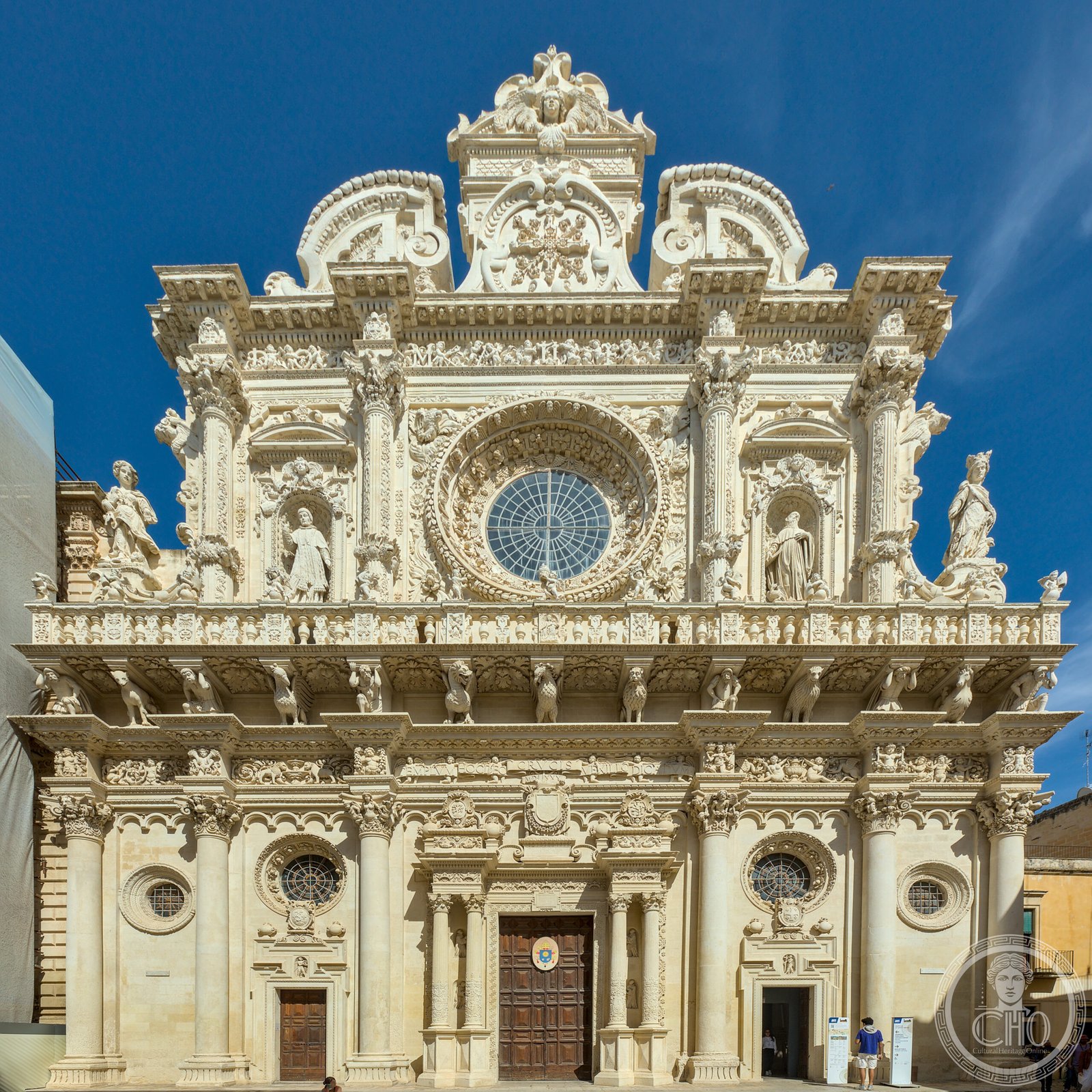
The Basilica of Santa Croce is Lecce’s most celebrated Baroque monument, a church whose facade is considered the supreme masterpiece of the regional style known as barocco leccese. Construction stretched from 1548 to 1695, engaging successive generations of local architects and stonemasons who covered its facade with an extraordinary profusion of carved figures, grotesques, garlands, and symbolic animals rendered in the soft local limestone. The adjacent Palazzo del Governo (former Celestine convent), now the Prefettura, completes one of southern Italy’s most theatrically Baroque urban compositions.
At a glance
- Type
- Basilica minor (Catholic)
- Period
- 1548–1695
- Style
- Barocco leccese (Lecce Baroque)
- Location
- Via Umberto I, 73100 Lecce LE, Italy
- Coordinates
- 40.3538° N, 18.1736° E
Overview
Santa Croce stands as the finest achievement of the barocco leccese tradition, in which the characteristic soft limestone of the Salento peninsula is carved with a richness and delicacy unmatched elsewhere in Italy. Completed in 1695 after nearly 150 years of intermittent construction, the church is today a basilica minor and one of the most photographed monuments in Apulia. It sits in the heart of Lecce’s historic centre, whose density of Baroque architecture has earned the city the informal epithet Florence of the South.
History
Work on Santa Croce began in 1548 on the site of a Celestine monastery, with successive architects including Gabriele Riccardi, who designed the lower facade, and Francesco Antonio Zimbalo, known as lo Zingarello, who completed the upper facade and rose window in the 17th century. The project also involved Cesare Penna and Giuseppe Zimbalo at various stages, making it a collective achievement of the Leccese school over more than a century. The Celestine convent adjoining the church was transformed into the Palazzo del Governo after the suppression of religious orders in the early 19th century. The basilica has undergone multiple restoration campaigns in the 20th and 21st centuries to preserve its elaborate stone carvings from weathering.
What you see
The two-storey facade is divided by a bold cornice and features a profusion of carved decoration: telamones (supporting figures), grotesque masks, tobacco leaves, artichokes, cherubs, and allegorical figures of virtues fill every surface. The upper storey is dominated by a large rose window framed by carved foliage and flanked by niches containing saints. The interior is comparatively restrained — a Latin-cross plan with a single nave, side chapels, and a coffered ceiling — allowing the eye to rest after the exuberance of the facade. The attached Palazzo del Governo retains its original Baroque courtyard, visible from the adjacent street.
Cultural significance
Santa Croce is the defining symbol of Lecce’s identity and has appeared on Italian postage stamps and in countless architectural histories as the canonical example of barocco leccese. The church is protected under Italian cultural heritage law and is part of the historic centre under discussion for UNESCO World Heritage listing. Its construction history, spanning nearly 150 years and multiple master builders, makes it an invaluable document of the evolution of regional Baroque taste.
Practical information
- Address
- Via Umberto I, 73100 Lecce LE
- Opening hours
- Generally open daily for visits and Mass; check local listings for seasonal hours
- Admission
- Free (place of worship)
Getting there
Lecce railway station is connected to Bari by frequent regional trains (approximately 90 minutes) and to Naples and Rome via Taranto. The basilica is about 15 minutes on foot from the station through the pedestrianised historic centre. From Piazza Sant’Oronzo, Santa Croce is a five-minute walk north along Via Umberto I.
Sources & resources
See the place
Find it on the map
See this place and what’s around it →📷 Become a Cultural Heritage Online photographer
Share your photos of places: they stay published under your name as the author. The more they're seen, the more you get noticed — and soon a contest will reward the most appreciated photos.
Log in or sign up free to add a photoIs this page about you?
This page is read by travellers and heritage enthusiasts who find it on Google. Tell us how you are connected to this place and we will take it from there.