
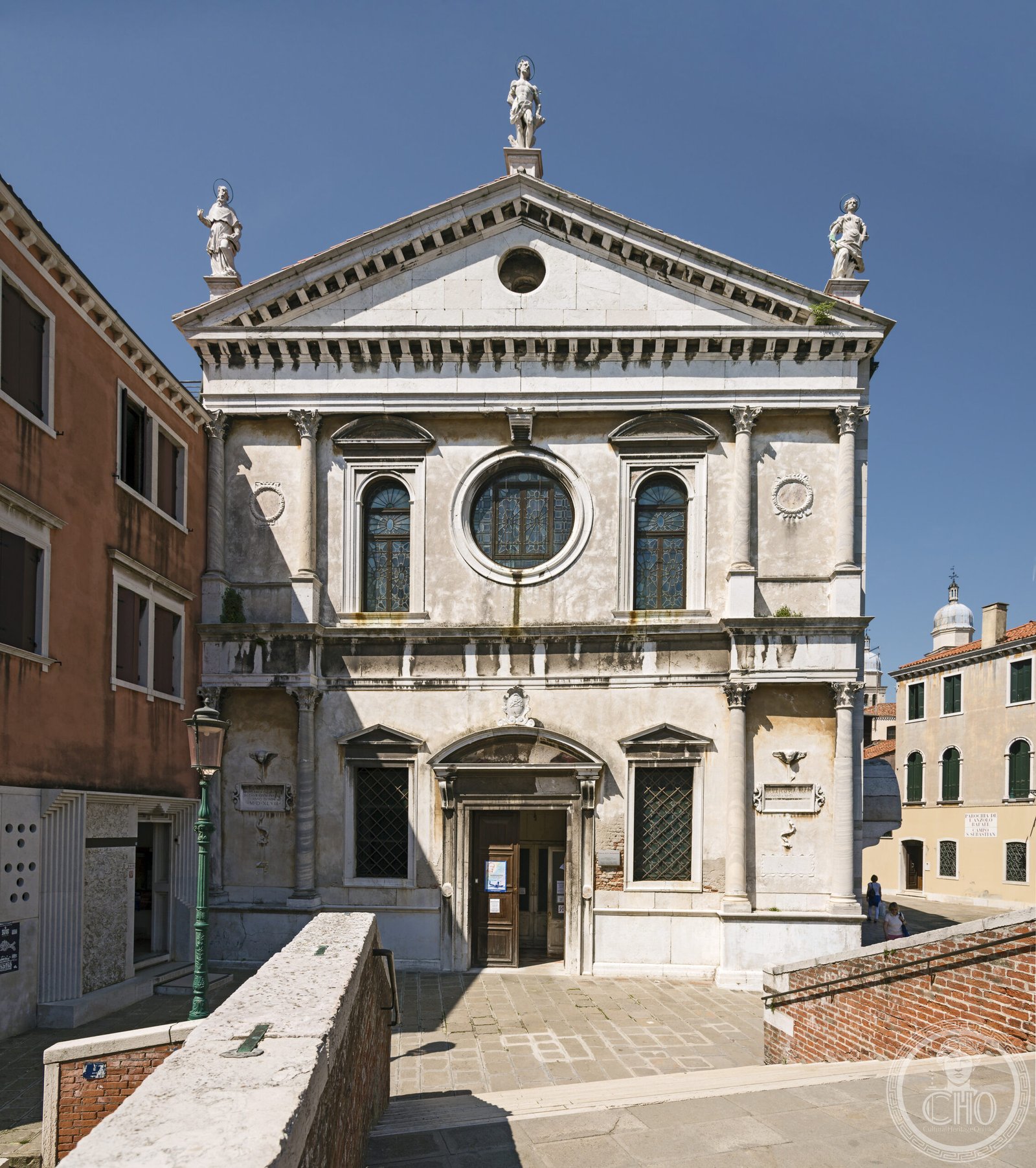
San Sebastiano is a Roman Catholic church in the Dorsoduro sestiere of Venice, renowned as the principal artistic monument to Paolo Veronese, who spent much of his career decorating its interior and was buried within its walls. Built between 1505 and 1548 to designs attributed to Antonio Scarpagnino, the church contains an exceptional cycle of ceiling paintings, organ shutters, and frescoes by Veronese executed between 1555 and 1570, making it one of the most coherent Renaissance decorative programmes in the Veneto.
At a glance
- Type
- Roman Catholic parish church
- Period
- Built 1505-1548; decorated by Veronese 1555-1570
- Style
- Venetian Renaissance
- Location
- Dorsoduro, Venice, Veneto, Italy
- Coordinates
- 45.4320 N, 12.3178 E
Overview
San Sebastiano stands in the quieter southern reaches of the Dorsoduro sestiere, a short walk from the Squero di San Trovaso. The church is dedicated to Saint Sebastian, the Roman martyr, and belongs to the Patriarchate of Venice. It is often described as Veronese church, since the painter returned here repeatedly across fifteen years to create an interior of rare visual unity.
The building follows a single-nave plan with side chapels and a deep chancel. Its exterior is relatively plain, which makes the opulence of the interior all the more striking upon entry. The church forms part of the Chorus Venice circuit of historic Venetian churches open to the public.
History
The church was erected on the site of a 15th-century oratory belonging to the Hieronymites. Construction began in 1505 under the patronage of the Venetian Republic, with the building largely completed by 1548 under the direction of Antonio Scarpagnino. Paolo Veronese arrived in Venice from Verona around 1553 and almost immediately began working at San Sebastiano, securing his Venetian reputation through the commission.
Veronese painted the sacristy ceiling first, then the nave ceiling with scenes from the Book of Esther, and later the organ shutters and the high altarpiece. He was buried in the church in 1588, and a commemorative bust marks his tomb near the organ.
What you see
The nave ceiling carries three large canvases depicting the Story of Esther set in elaborate trompe-loeil frames. The organ shutters, when open, reveal scenes of the Presentation of Jesus at the Temple and the Pool of Bethesda. The high altarpiece shows the Madonna and Child with Saints Sebastian, Peter, Catherine, and Francis.
The sacristy retains an earlier Veronese ceiling with the Coronation of the Virgin and four Evangelists. Side chapels contain works by other Venetian masters and marble funerary monuments. The coffered chancel arch and gilded detailing reinforce the lavish chromatic effect of the entire decorative scheme.
Cultural significance
San Sebastiano is one of the most intact expressions of mid-16th-century Venetian decorative painting, with its Veronese cycle recognized as a national monument of Italy. The church serves as a touchstone for understanding Veronese mature style his mastery of illusionistic architecture, saturated colour, and festive compositional energy. Its inclusion in the Chorus Venice circuit ensures ongoing conservation funding and public access.
Practical information
- Address
- Campo San Sebastiano, Dorsoduro 1687, 30123 Venice VE
- Hours
- Check official website or the Chorus Venice circuit (chorusvenezia.org) for current opening times
- Admission
- Chorus Venice combined ticket applies; free for children under 11
Getting there
From Venice Santa Lucia station, take vaporetto line 1 or 2 to Ferrovia, then line 5.1 or 5.2 toward San Basilio. Alternatively, walk south through Dorsoduro from the Accademia stop approximately 15 minutes on foot. The church is not far from the Ca Rezzonico water-bus stop.
Sources and resources
See the place
Find it on the map
See this place and what’s around it →📷 Become a Cultural Heritage Online photographer
Share your photos of places: they stay published under your name as the author. The more they're seen, the more you get noticed — and soon a contest will reward the most appreciated photos.
Log in or sign up free to add a photo