
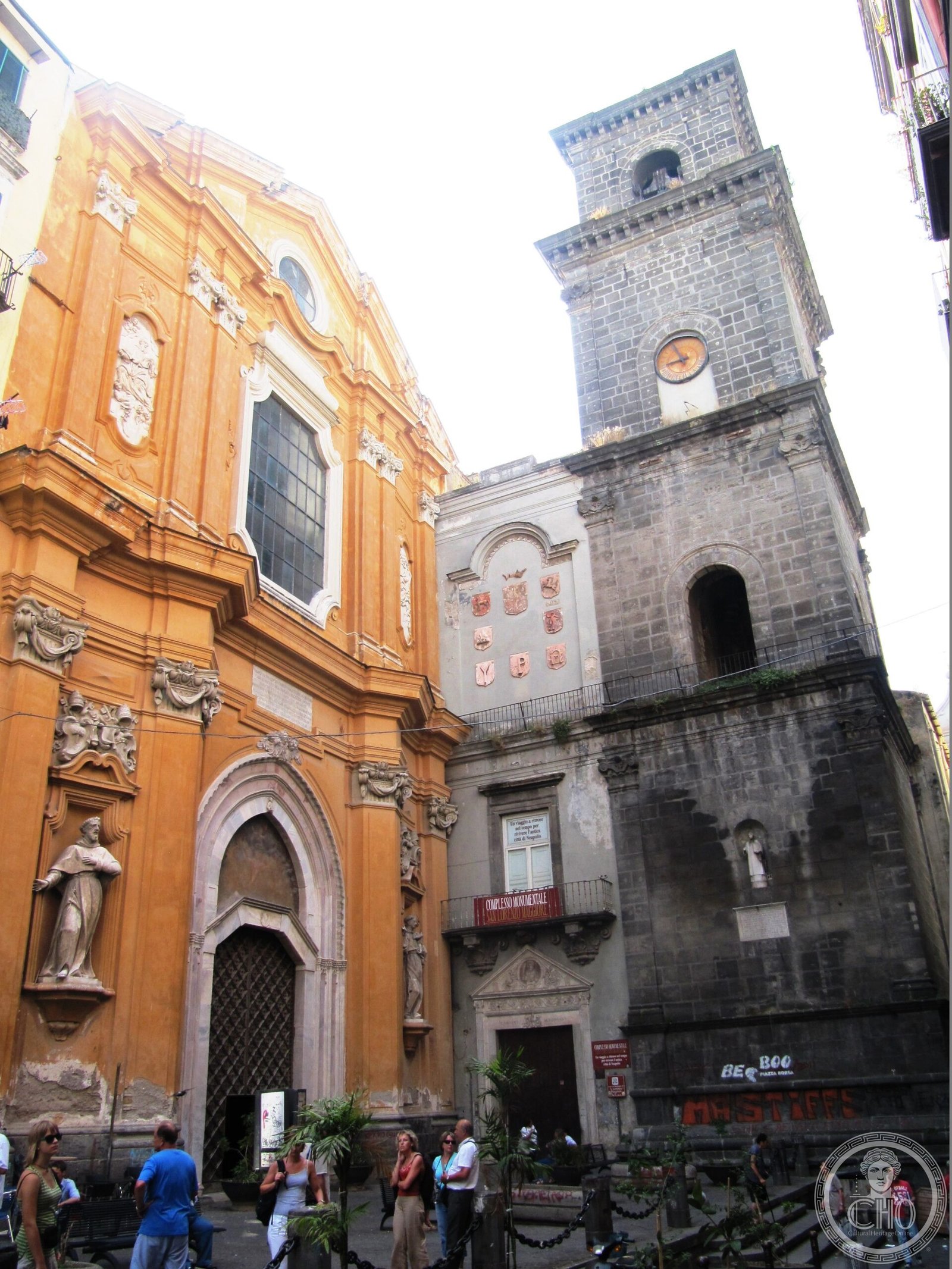
San Lorenzo Maggiore in Naples is a Gothic Franciscan basilica built from the 13th century over the ancient Greek agora and Roman macellum of Neapolis, whose remains are preserved in an extraordinary subterranean archaeological site beneath the church. Located at the exact geographic centre of the ancient city, at the intersection of via San Gregorio Armeno and via dei Tribunali, the complex spans two millennia of urban stratification and is one of the most complete examples of Greek-Roman-medieval continuity in southern Italy.
At a glance
- Type
- Gothic Franciscan basilica with subterranean Roman and Greek archaeological site
- Period
- Underground: 4th century BCE–4th century CE; basilica: 13th–14th century; Museum: contemporary
- Style
- French Gothic (basilica); Roman Imperial (underground macellum)
- Location
- Via dei Tribunali 316, Naples, Campania — 40.8507° N, 14.2579° E
Overview
San Lorenzo Maggiore occupies the precise geographic centre of ancient Neapolis, the Greek colony founded around 470 BCE whose street grid still underlies the modern historic centre. The name San Lorenzo refers simultaneously to the medieval basilica above ground, the archaeological museum opened in recent decades on the premises, and the Roman market — the Macellum of Naples — preserved intact beneath the church. Giovanni Boccaccio, who lived in Naples in the 1330s, is said to have first glimpsed Fiammetta in this church, making it a literary landmark as well as an architectural one.
History
The site’s documented history begins with the Greek public spaces of Neapolis, succeeded by the Roman-era macellum (a covered market with a central tholos fountain), which functioned through late antiquity. After the fall of the western Roman Empire the buildings fell into disuse and were progressively buried. The Normans and Angevins promoted religious construction in Naples, and the Franciscan order received the site in the 13th century; the basilica was built under Angevin patronage in the French Gothic style introduced to Naples by Charles I of Anjou, with work continuing through the 14th century. Baroque-era modifications overlaid the medieval interior, partly reversed in modern restoration campaigns that also uncovered the underground layers.
What you see
The basilica interior features a tall single nave with a polygonal apse of French inspiration and remains of medieval funerary monuments and frescoes. Descending to the archaeological site beneath the church, visitors walk through a labyrinth of Roman-era shops (tabernae), a treasure room, a laundry (fullonica), a bakery, and civic spaces — all preserved up to several metres in height and still displaying original plaster finishes and architectural details. The tholos fountain of the macellum, a circular structure with marble column stumps, stands at the centre of the underground circuit as the most evocative single element of ancient Neapolis accessible to the public.
Cultural significance
San Lorenzo Maggiore offers one of Europe’s most legible urban stratigraphies: a single site where Greek, Roman, early Christian, medieval, and early modern layers are all physically accessible within a few vertical metres. For historians of Naples and of ancient urbanism, the macellum underground is an irreplaceable document of daily commercial life in a prosperous Roman port city. The complex stands at the heart of the Spaccanapoli cultural itinerary that defines historic Naples as a UNESCO World Heritage Site.
Practical information
- Address
- Via dei Tribunali 316, 80138 Napoli NA
- Admission
- Paid admission to the archaeological underground and museum; the basilica itself may be visited free during non-service hours
- Coordinates
- 40.8507° N, 14.2579° E
Getting there
The church is located on via dei Tribunali in the heart of Naples’ historic centre (Centro Storico UNESCO). The nearest Metro station is Dante (Line 1) or Cavour (Line 1), both a short walk away. Buses on via Tribunali stop directly in front. The historic centre is best explored on foot; limited traffic zone rules apply.
Sources & resources
See the place
Find it on the map
See this place and what’s around it →📷 Become a Cultural Heritage Online photographer
Share your photos of places: they stay published under your name as the author. The more they're seen, the more you get noticed — and soon a contest will reward the most appreciated photos.
Log in or sign up free to add a photo