
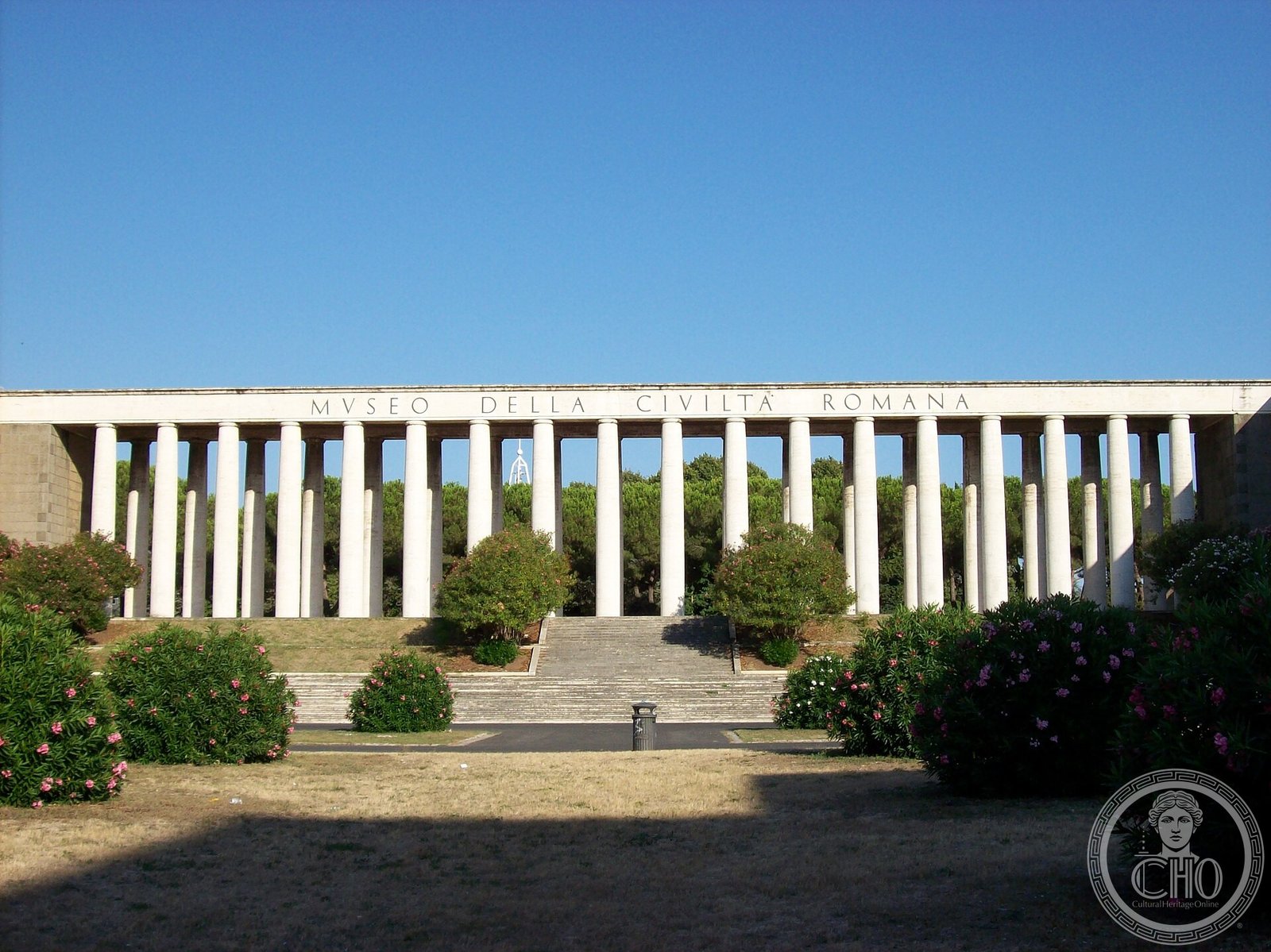
The Museum of Roman Civilization (Museo della Civiltà Romana) is a large-scale exhibition complex in the EUR district of Rome devoted entirely to the civilisation of ancient Rome, from its origins to the late empire. Founded in 1940 in the rationalist-monumental buildings erected for the 1942 World’s Fair that was never held, the museum is best known for a 1:250 scale plaster model of Rome as it appeared in the 4th century AD — the Plastico di Roma Antica — covering more than 200 square metres and representing every known structure of the imperial city.
At a glance
- Type
- Municipal archaeological and civilisation museum
- Period
- Opened 1940; exhibits span 8th century BC – 4th century AD
- Style
- Italian Rationalist (E42 / EUR complex)
- Location
- Piazza Giovanni Agnelli, EUR district, Rome, Italy
- Coordinates
- 41.8327° N, 12.4721° E
Overview
The Museum of Roman Civilization occupies a pair of symmetrical rationalist buildings in the EUR quarter, the planned expansion district south of Rome that Mussolini commissioned for an international exposition in 1942. The museum’s collection spans 59 rooms and focuses not on original ancient artefacts but on casts, scale models, reproductions, and reconstructions that make ancient Roman material culture legible to a broad audience. It was closed for renovation for many years and has partially reopened; the 360° virtual tour extends access while restoration continues.
History
The museum was originally established by Mussolini in 1940 to celebrate the two-thousandth anniversary of Augustus and to propagandise Roman heritage as the foundation of the Fascist state. The building complex was designed as part of the E42 (EUR) exhibition district and survived the cancellation of the 1942 expo and World War II. After the war the museum was reorganised under Rome’s municipal administration, expanded, and eventually became one of the largest museums of ancient Roman civilisation in the world.
What you see
The museum’s principal attraction is the Plastico di Roma Antica, a 1:250 scale model reconstructing the entire city of Rome as it appeared under Constantine I in the 4th century AD — created between 1933 and 1955 by architect Italo Gismondi. Other highlights include full-scale plaster casts of the reliefs from Trajan’s Column, a reconstruction of the Ara Pacis (before the Meier pavilion was built), scale models of Roman buildings across the empire, and reconstructed Roman interiors illustrating daily life from domestic spaces to public baths.
Cultural significance
As the world’s most comprehensive single-institution survey of Roman civilisation through reproductions and models, the museum serves a crucial educational function and holds irreplaceable documentary value — several of its casts record sculptural details that have since deteriorated on the originals. The EUR building that houses it is itself a significant example of Italian Rationalist architecture of the 1930s–40s.
Practical information
- Address
- Piazza Giovanni Agnelli 10, 00144 Roma RM, Italy
- Status
- Partially closed for renovation; check the Musei in Comune Roma website for current opening status
- Hours
- Check official website — hours vary by wing; some sections accessible via timed entry
Getting there
Take Rome Metro Line B to EUR Fermi or EUR Palasport station; the museum is a short walk from either stop in the EUR district. Buses 30, 170, and 671 also serve the EUR area from central Rome.
Sources & resources
See the place
Find it on the map
See this place and what’s around it →Historical events at this place (1)
- 2021 Qhapaq Ñan
📷 Become a Cultural Heritage Online photographer
Share your photos of places: they stay published under your name as the author. The more they're seen, the more you get noticed — and soon a contest will reward the most appreciated photos.
Log in or sign up free to add a photoIs this page about you?
This page is read by travellers and heritage enthusiasts who find it on Google. Tell us how you are connected to this place and we will take it from there.