
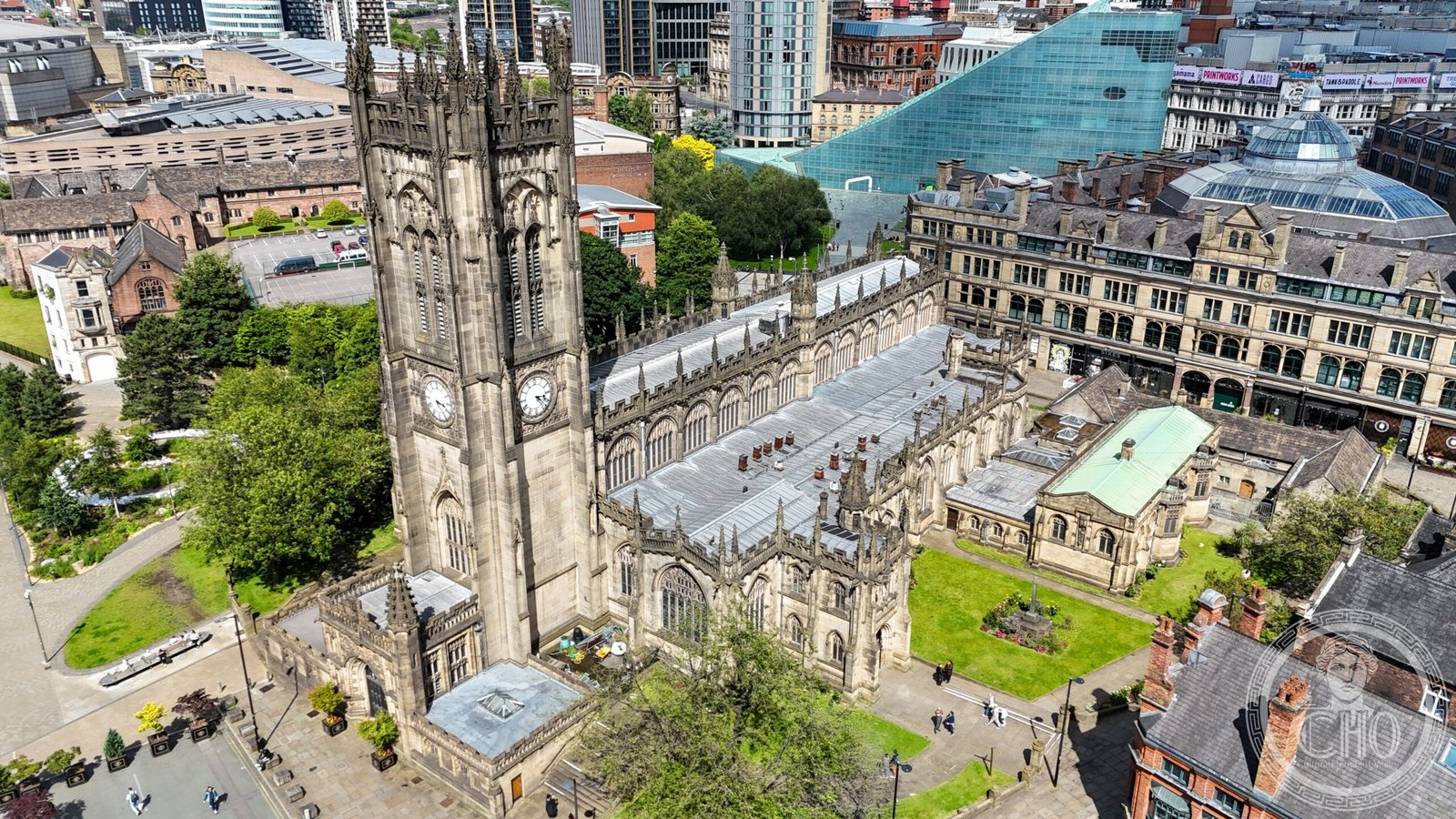
The mother church of the Anglican Diocese of Manchester, this late-medieval collegiate church evolved from a parish foundation into one of northern England’s finest examples of Perpendicular Gothic architecture.
At a glance
Manchester Cathedral stands on Victoria Street in the city centre as a Grade I listed building and the seat of the Bishop of Manchester. Built in Perpendicular Gothic style and substantially reshaped over five centuries, it remains the spiritual heart of the diocese and parish.
History
The collegiate body was founded in 1421, and the former parish church underwent reconstruction in Perpendicular Gothic style in the decades that followed. Between 1485 and 1506, James Stanley II—warden of the college and later Bishop of Ely—oversaw major rebuilding of the nave and collegiate choir, introducing soaring clerestory windows that flooded the interior with light. Stanley’s era also saw the commission of exceptional late-medieval wooden furnishings that remain defining features of the interior. When the Diocese of Manchester was established in 1847, the collegiate church assumed cathedral status. The Victorian period brought extensive refacing, restoration and structural extension. World War II bomb damage prompted further significant restoration work, returning the building to its former grandeur.
What you see
The cathedral’s Perpendicular Gothic framework displays the characteristic pointed arches, vertical emphasis and intricate tracery of the late medieval period. The nave features exceptional height and light, enhanced by James Stanley’s high clerestory windows. Most striking are the interior wooden furnishings—an intact ensemble of late-medieval craftsmanship. The pulpitum, choir stalls and elaborately carved nave roof survive in remarkable condition; the roof is a particular marvel, its internal structure supported by gilded angels bearing musical instruments. Victorian and post-war interventions modernised the building without erasing its medieval character.
Cultural significance
Manchester Cathedral represents a rare survival of comprehensive late-medieval church furnishings in England. The wooden roof and choir fittings document the artistic ambitions of the pre-Reformation Church and the patronage of influential regional figures like James Stanley. As the mother church of its diocese and Manchester’s parish church, it remains central to the city’s religious and civic identity.
Key facts
- Location: Victoria Street, Manchester, United Kingdom
- Coordinates: 53.48527778, -2.24472222
- Architectural style: Perpendicular Gothic (15th century onwards)
- Grade I listed building
- Cathedral status: Established 1847
- Significant patron: James Stanley II (warden 1485–1506)
Practical information & getting there
The cathedral is located in Manchester city centre on Victoria Street, accessible by public transport and on foot from major stations. As an active place of worship and cathedral, opening hours and visitor facilities vary; you are advised to check ahead before visiting.
Sources & resources
Find it on the map
See this place and what’s around it →📷 Become a Cultural Heritage Online photographer
Share your photos of places: they stay published under your name as the author. The more they're seen, the more you get noticed — and soon a contest will reward the most appreciated photos.
Log in or sign up free to add a photoIs this page about you?
This page is read by travellers and heritage enthusiasts who find it on Google. Tell us how you are connected to this place and we will take it from there.