
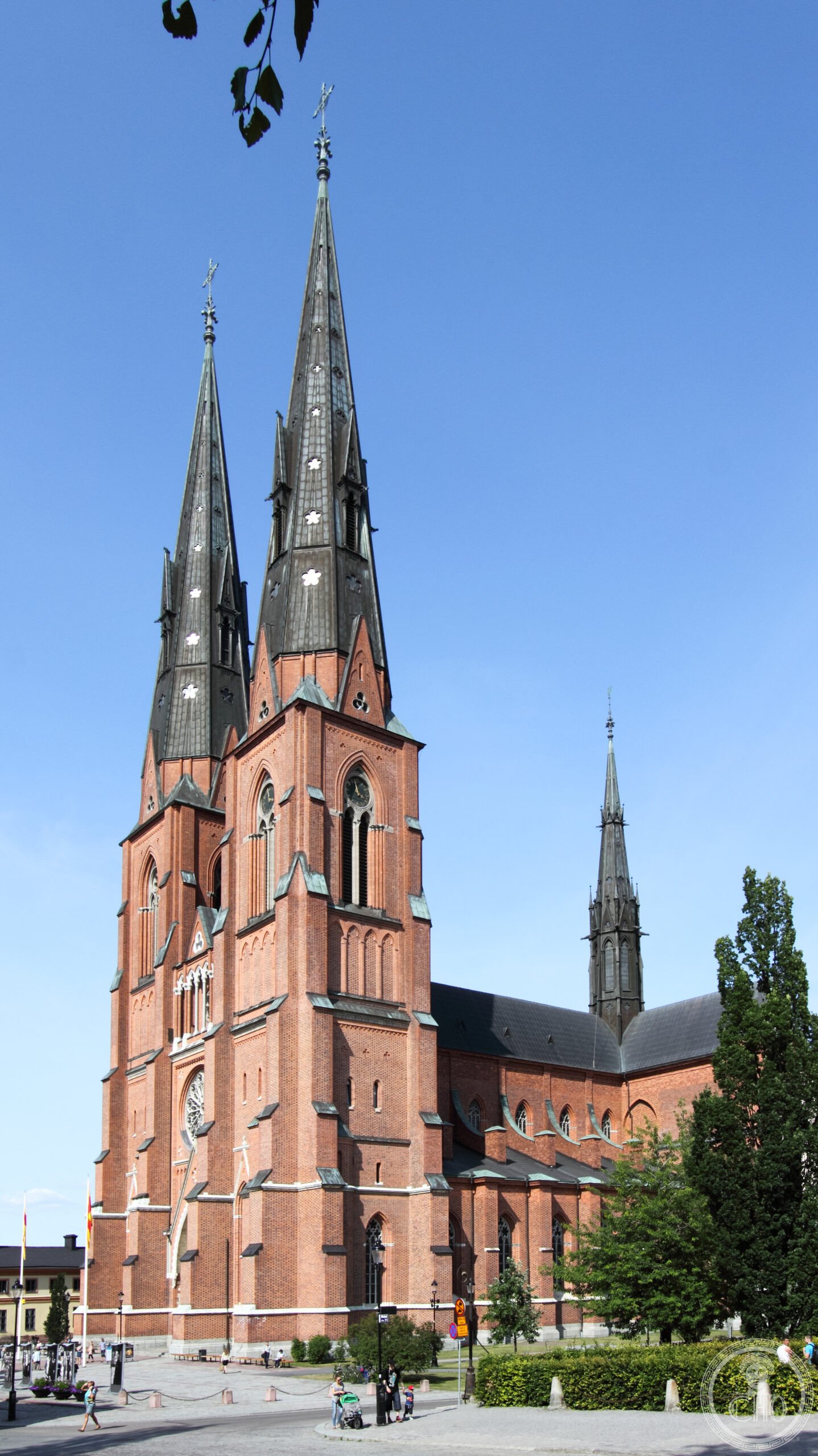
At 118.7 metres, Scandinavia’s tallest church rises between the university and the Fyris river. This French Gothic masterpiece served as the coronation site of Swedish kings and holds the remains of Saint Eric IX, Sweden’s patron saint.
At a glance
Uppsala Cathedral is the seat of the Archbishop of Uppsala and the primate of Sweden. Built primarily of brick with Gotland limestone accents, it dominates the city’s skyline and remains the tallest church in the Nordic countries. The cathedral continues its role as a church of the Church of Sweden in the Evangelical-Lutheran tradition.
History
Construction began in the late 13th century under Roman Catholic patronage. Most of the structure rose between 1272 and 1420, with the western end completed by the mid-15th century. Twin towers followed shortly after, topped later with high spires.
The Protestant Reformation transformed its purpose. Rather than losing significance, the cathedral became the traditional coronation site for Swedish monarchs and expanded to house royal tombs, including those of Gustav Vasa and John III. A devastating fire in 1702 destroyed many features, prompting Carl Hårleman to redesign the spires with low helms in 1735. Helgo Zetterwall undertook substantial reconstruction in the 1880s. Restoration work in the 1970s uncovered and restored medieval frescoes that had been whitewashed following the Reformation.
What you see
French architects including Étienne de Bonneuil designed the cathedral in the French Gothic style, organized as a cross formed by nave and transept. Brick dominates the construction, with limestone reserved for pillars and ornamental details. The vaults follow the original 13th-century plan, some completed as late as around 1440.
Inside, the Treasury Museum displays medieval furnishings and artwork. The funeral chapels contain royal monuments and the remains of notable figures including Carl Linnaeus, Emanuel Swedenborg, and Olaus Rudbeck.
Cultural significance
Uppsala Cathedral embodies Swedish national identity through its role as the burial place of Saint Eric IX (c. 1120–1160), the nation’s patron saint and king. For centuries, it anchored Sweden’s monarchy through coronations and royal interments. The building itself represents a dialogue between Catholic origins and Protestant transformation, visible in its preserved medieval art and expanded royal chapels.
Key facts
- Country: Sweden
- Location: Uppsala, between Uppsala University and the Fyris river
- Coordinates: 59.858°N, 17.633°E
- Height: 118.7 metres (389 ft)
- Construction period: Late 13th–15th centuries (mainly 1272–1420)
- Architects: French Gothic designers including Étienne de Bonneuil
Practical information & getting there
The cathedral sits in central Uppsala, easily reached on foot from the university quarter. You can view the exterior and interior, including the funeral chapels and Treasury Museum. Specific visiting hours and any admission details are available through the cathedral’s official channels.
Sources & resources
Find it on the map
See this place and what’s around it →📷 Become a Cultural Heritage Online photographer
Share your photos of places: they stay published under your name as the author. The more they're seen, the more you get noticed — and soon a contest will reward the most appreciated photos.
Log in or sign up free to add a photoIs this page about you?
This page is read by travellers and heritage enthusiasts who find it on Google. Tell us how you are connected to this place and we will take it from there.