
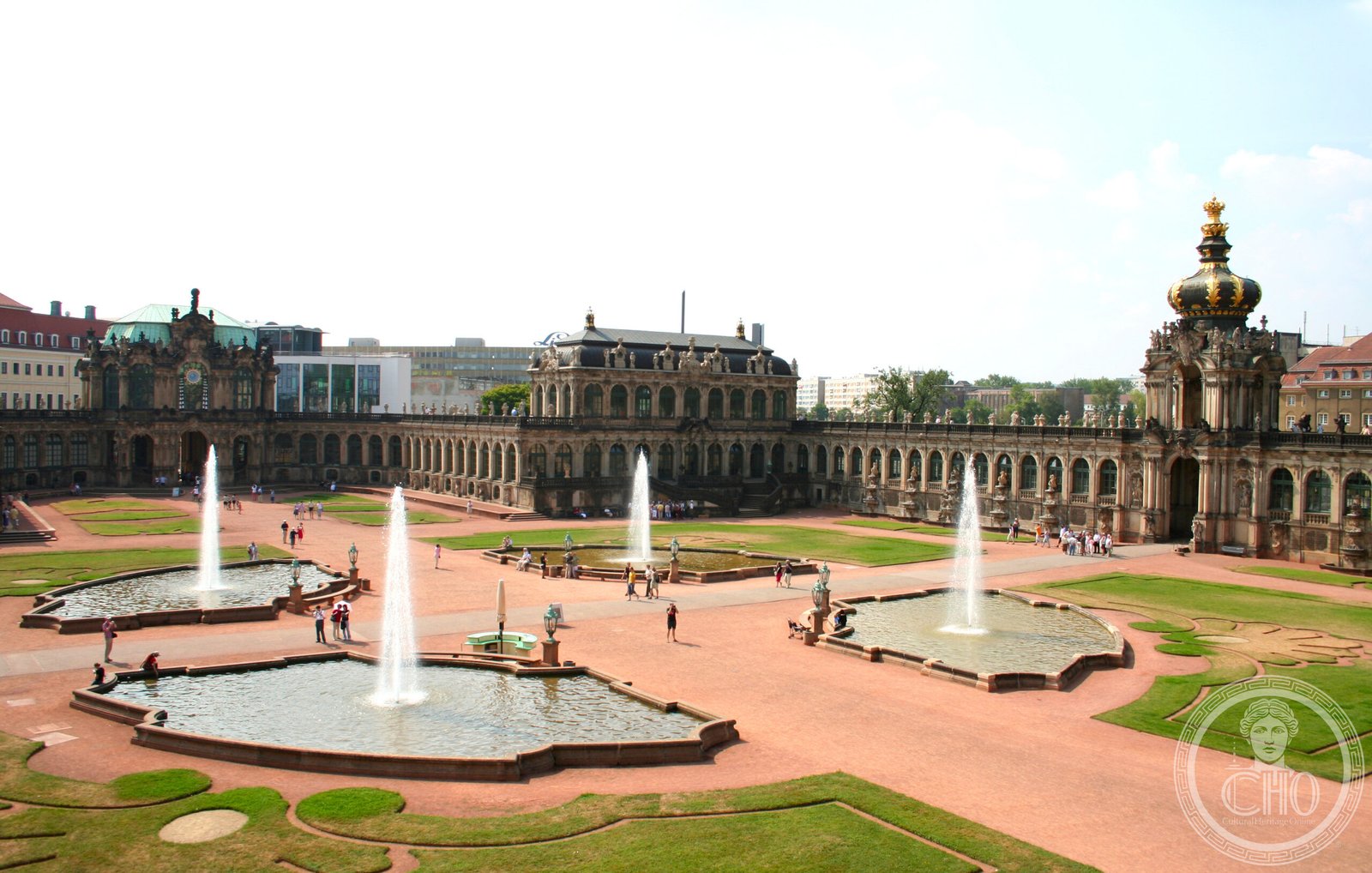
A palatial complex of richly decorated pavilions and galleries, the Zwinger stands as one of Germany’s most significant Baroque monuments and now houses world-class art collections.
At a glance
The Zwinger is a masterwork of Baroque architecture designed by Matthäus Daniel Pöppelmann. Built beginning in 1709, it originally served as an orangery, garden, and ceremonial forecourt for Augustus the Strong, Elector of Saxony and King of Poland. Today it functions as a major museum complex in the heart of Dresden.
History
Construction began in 1709 as part of Augustus the Strong’s ambitious vision. The complex was originally conceived as the forecourt to a grand new palace that would have extended to the Elbe River; those plans were abandoned after the elector’s death. For more than a century the Zwinger remained incomplete on its river side.
In 1855, architect Gottfried Semper closed that gap with the Sempergalerie, a gallery that became one of 19th-century Germany’s most important museum undertakings. The Bombing of Dresden in February 1945 devastated the complex, but reconstruction in the 1950s and 1960s restored it. Three major collections reopened: the Old Masters Picture Gallery, the Dresden Porcelain Collection, and the Royal Cabinet of Mathematical and Physical Instruments.
What you see
Pöppelmann’s design showcases the opulence of the Baroque through elaborately ornamented pavilions and galleries bordered by balustrades, sculptures, and decorative vases. The Sempergalerie, added over a century later, completes the ensemble on the Elbe-facing side. The interconnected courtyards and gardens preserve the original ceremonial character while now housing museum galleries.
Cultural significance
The Zwinger ranks alongside the Frauenkirche as Dresden’s most celebrated architectural monument. It embodies the ambition and artistic patronage of Augustus the Strong’s reign and represents a pinnacle of German Baroque achievement. As a museum, it preserves exceptional collections of European art, ceramics, and scientific instruments, making it central to German cultural heritage.
Key facts
- Country: Germany
- City: Dresden
- Architect: Matthäus Daniel Pöppelmann (original design); Gottfried Semper (Sempergalerie, 1855)
- Built: 1709 onwards
- Coordinates: 51.053, 13.734
- Collections: Old Masters Picture Gallery, Dresden Porcelain Collection, Royal Cabinet of Mathematical and Physical Instruments
Practical information & getting there
The Zwinger is located in central Dresden. Music and theater events continue to use the courtyards and galleries. For current opening hours, admission prices, and event schedules, consult the official Dresden tourism website or museum listings.
Sources & resources
Find it on the map
See this place and what’s around it →📷 Become a Cultural Heritage Online photographer
Share your photos of places: they stay published under your name as the author. The more they're seen, the more you get noticed — and soon a contest will reward the most appreciated photos.
Log in or sign up free to add a photoIs this page about you?
This page is read by travellers and heritage enthusiasts who find it on Google. Tell us how you are connected to this place and we will take it from there.