

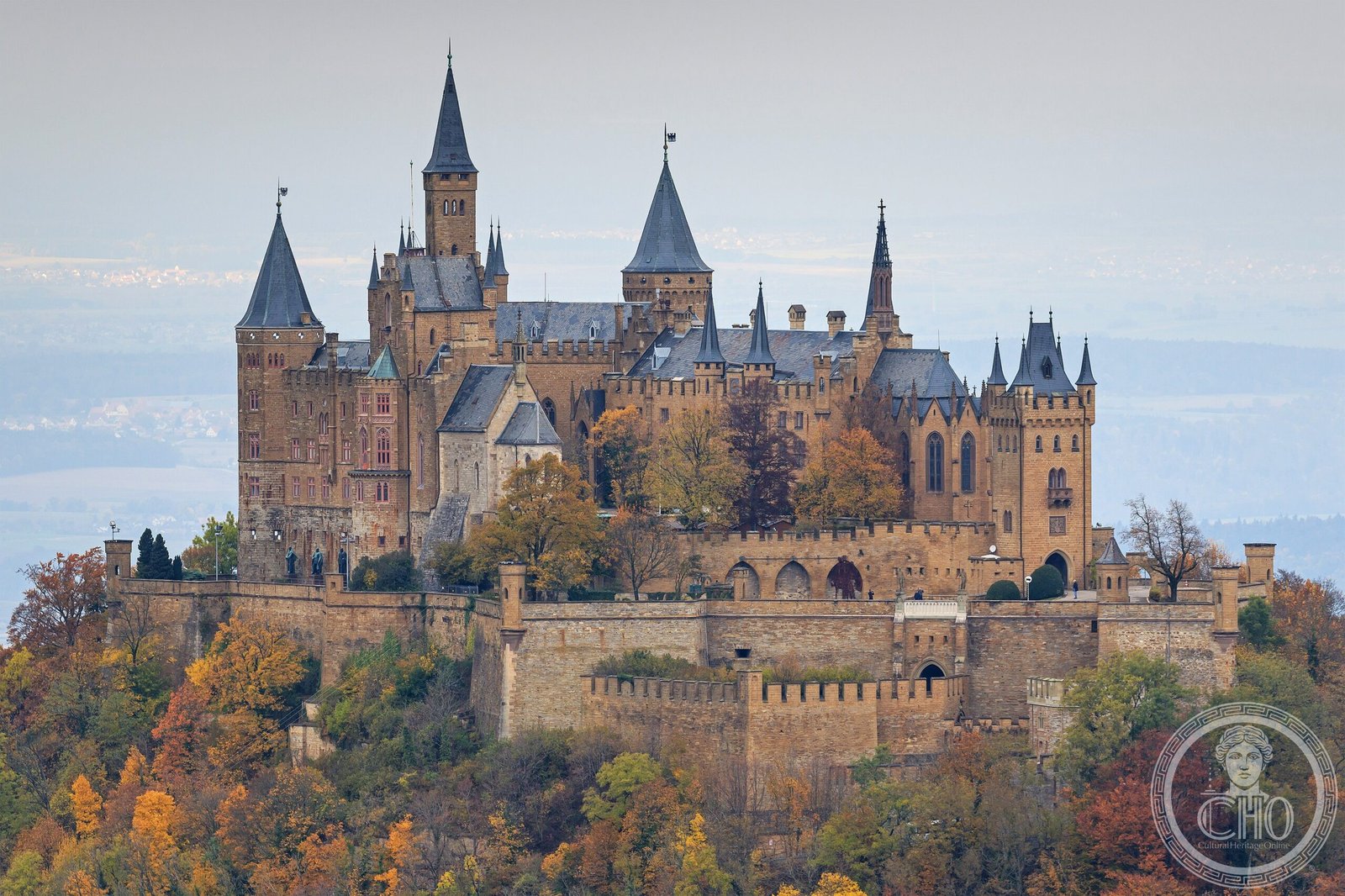
The ancestral stronghold of the House of Hohenzollern crowns Mount Hohenzollern in the Swabian Jura. Built as a dynastic monument between 1846 and 1867, this Gothic Revival castle holds the crown jewels and personal treasures of Prussian royalty.
At a glance
Hohenzollern Castle is the third fortress to occupy this strategic hilltop. Designed by architect Friedrich August Stüler and commissioned by King Frederick William IV of Prussia, it synthesizes English Gothic Revival with Loire Valley château aesthetics. Though built as a family memorial, no German Emperor ever lived here permanently.
History
The first castle rose in the early 11th century, the ancestral seat of a dynasty that would splinter into branches—yet the Swabian line retained the mountain stronghold. In 1423, imperial cities of Swabia destroyed it after a ten-month siege.
A second, more formidable structure followed from 1454 to 1461, sheltering Catholic Hohenzollerns through the Thirty Years’ War. By the late 18th century, strategic value faded and decay set in. King Frederick William IV initiated the current castle’s construction in 1846 as a monument to dynastic glory, completed in 1867 after two decades of work.
In 1945, the castle briefly harbored Crown Prince Wilhelm, son of Kaiser Wilhelm II and last heir to the German throne.
What you see
Stüler’s design fuses English Gothic Revival vocabulary—pointed arches, crenellations, vertical emphasis—with the romantic elegance of French Renaissance châteaux. The castle commands Mount Hohenzollern’s summit, its towers and stone facade rising dramatically above the Swabian landscape south of Hechingen.
Cultural significance
Hohenzollern Castle crystallizes 19th-century dynastic nostalgia and Prussian identity. As keeper of the Crown of Wilhelm II, uniforms and correspondence of Frederick the Great, and Hohenzollern family portraiture, it documents the rise and fall of a German royal house that shaped European history for centuries.
Key facts
- Country: Germany
- Location: Mount Hohenzollern, near Bisingen, Baden-Württemberg
- Coordinates: 48.32°N, 8.97°E
- Built: 1846–1867
- Architect: Friedrich August Stüler
- Commissioned by: King Frederick William IV of Prussia
Practical information & getting there
The castle sits above and south of Hechingen on the edge of the Swabian Jura in central Baden-Württemberg. Visitor details and opening hours should be confirmed before planning your visit.
Sources & resources
Find it on the map
See this place and what’s around it →📷 Become a Cultural Heritage Online photographer
Share your photos of places: they stay published under your name as the author. The more they're seen, the more you get noticed — and soon a contest will reward the most appreciated photos.
Log in or sign up free to add a photoIs this page about you?
This page is read by travellers and heritage enthusiasts who find it on Google. Tell us how you are connected to this place and we will take it from there.