
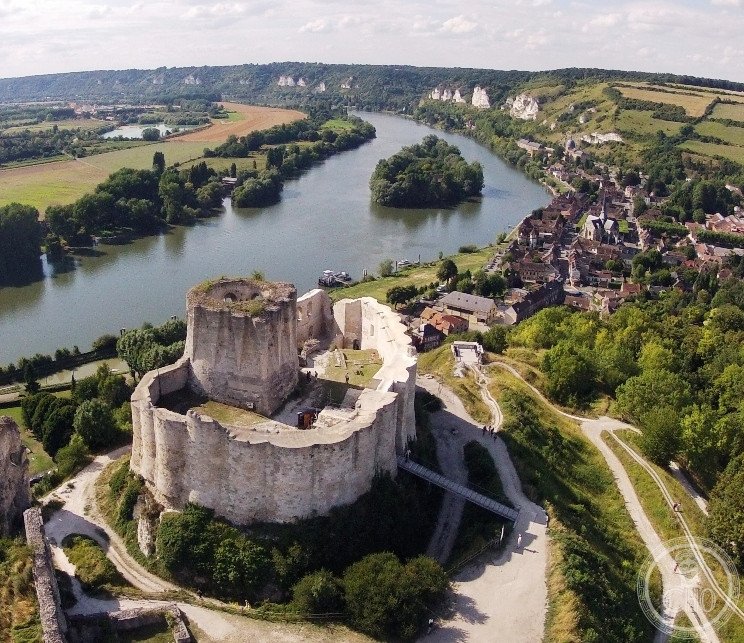
Richard the Lionheart’s formidable fortress above the Seine, built in two years and pioneering early concentric design—now a haunting ruin that witnessed power struggles across four centuries.
At a glance
Château Gaillard rises above Les Andelys in Normandy, 95 kilometres north-west of Paris. Richard the Lionheart ordered its construction in 1196 to defend English holdings in France. The castle’s three concentric enclosures, separated by dry moats, demonstrate advanced military engineering for its era. Though dismantled in 1599, its ruins remain a powerful testament to medieval fortification strategy and dynastic ambition.
History
Richard the Lionheart, simultaneously King of England and feudal Duke of Normandy, initiated construction in 1196. Remarkably, the complex fortress was completed in just two years—an extraordinary achievement for so substantial a work. During the same period, the town of Petit Andely was built to support the castle’s garrison and operations.
In 1204, King Philip II of France besieged and captured the castle after prolonged fighting, a victory that shifted the balance of power in Normandy. The fortress changed hands repeatedly during the Hundred Years’ War until 1449, when the French king claimed it definitively from English control. By 1599, Henry IV of France ordered its demolition as a potential security risk to the region, though it was already ruined. Today it remains a monument historique under French Ministry of Culture protection.
What you see
The castle employs early concentric fortification principles rare for the 1190s. Three separate enclosures, ringed by dry moats, created overlapping defensive zones—attackers could not breach one without coming under fire from the next. A keep dominated the innermost enclosure, serving as both stronghold and residence.
Château Gaillard was among Europe’s first castles to incorporate machicolations—those projecting parapets with floor openings that allowed defenders to drop stones and boiling liquids on assailants below. This architectural innovation became a hallmark of later medieval fortifications. The ruins today reveal the sophistication of 12th-century military design.
Cultural significance
Château Gaillard embodies the ambitions of the Plantagenet dynasty in continental Europe. Richard’s willingness to invest vast resources in a single fortress demonstrates the strategic importance of controlling the Seine valley. The castle’s advanced design influenced fortress-building across northern Europe.
The site also witnessed broader medieval dramas: it housed the exiled Scottish king David II in the mid-14th century. Its final destruction by Henry IV symbolized the consolidation of French royal power and the eclipse of English territorial claims in Normandy.
Key facts
- Location: Les Andelys, Eure, Normandy, France
- Coordinates: 49.238127777778, 1.4027527777778
- Founded: 1196
- Builder: Richard the Lionheart
- Construction period: 2 years (1196–1198)
- Captured: 1204 by Philip II of France
- Demolished: 1599 by order of Henry IV
- Protected status: Monument historique
- Public access: Inner bailey (March–November); outer baileys (year-round)
Practical information & getting there
Château Gaillard overlooks the Seine at Les Andelys, 40 kilometres south-west of Rouen and 95 kilometres north-west of Paris. The ruins are readily accessible from both cities. The inner bailey welcomes visitors from March through November; the outer enclosures remain accessible year-round. As a protected monument, the site maintains strict conservation standards.
Sources & resources
Find it on the map
See this place and what’s around it →📷 Become a Cultural Heritage Online photographer
Share your photos of places: they stay published under your name as the author. The more they're seen, the more you get noticed — and soon a contest will reward the most appreciated photos.
Log in or sign up free to add a photoIs this page about you?
This page is read by travellers and heritage enthusiasts who find it on Google. Tell us how you are connected to this place and we will take it from there.