
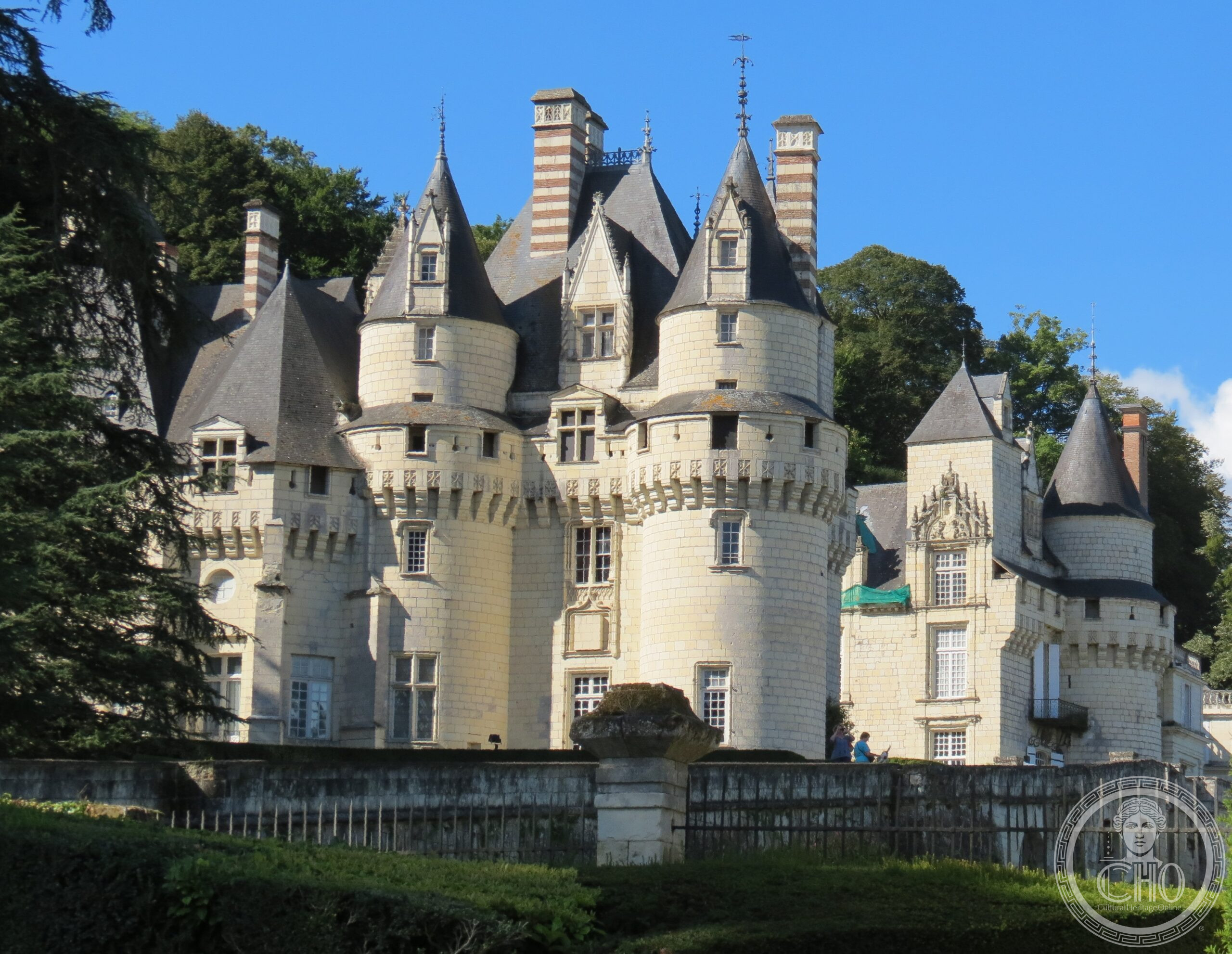
A fortress that inspired Perrault’s “Sleeping Beauty” and later influenced Disney’s iconic castle designs, Ussé rises from the Indre Valley in a series of towers and turrets refined over six centuries.
At a glance
Perched on a high terrace above the Indre Valley at the edge of the Chinon forest, Château d’Ussé began as an eleventh-century stronghold and evolved into a Renaissance showpiece. The castle’s theatrical silhouette—whitewashed walls, slate roofs, decorative turrets—captivated artists and writers for generations.
History
Gueldin de Saumur, a Norman seigneur, first fortified the site in the eleventh century with a palisade. The Comte de Blois subsequently rebuilt it in stone. In 1431, Jean V de Bueil, captain-general to Charles VII, purchased the ruined castle and began reconstruction in the 1440s. His son Antoine married Jeanne de Valois, daughter of Charles VII and Agnès Sorel, in 1462.
By 1455, debt forced Antoine to sell to Jacques d’Espinay, chamberlain to the king. Espinay and his son Charles (chapel completed 1612) transformed the fortress into a château, blending Flamboyant Gothic with Renaissance elements. In the seventeenth century, Louis I de Valentinay, comptroller of the royal household, demolished the north range to open views toward the parterre—a design ascribed to André Le Nôtre.
The castle passed to the House of Rohan, then in 1802 to the duc de Duras. During the Hundred Days of 1813, Bourbon loyalists convened here to explore restoration possibilities. François-René de Chateaubriand later worked on his Mémoires d’Outre-Tombe as a guest of the duchesse. In 1885, the comtesse de la Rochejaquelein bequeathed Ussé to her great-nephew, the comte de Blacas, whose descendants own it today.
What you see
The chapel, completed in 1612, showcases the castle’s architectural transition: pointed arches and ornate tracery coexist with classical proportions and Renaissance detail. The sixteenth- and seventeenth-century ranges display white stone facades punctuated by decorative turrets and slate roofs that create the castle’s distinctive profile.
Valentinay’s demolition of the north range in the seventeenth century unified the interior courtyard and extended sightlines across the formal gardens and terraced grounds below.
Cultural significance
Charles Perrault, author of the definitive French versions of fairy tales including “Sleeping Beauty,” frequently visited Ussé and drew inspiration from its romantic silhouette for his literary creation. The castle became synonymous with the enchanted towers of European imagination.
In the 1920s, the Chemin de Fer de Paris à Orléans featured Ussé in a railroad poster celebrating French heritage. Walt Disney encountered such imagery and incorporated elements of Ussé’s picturesque towers into his castle designs for animation and theme parks, cementing its role in twentieth-century popular culture.
Key facts
- Location: Rigny-Ussé, Indre-et-Loire, France
- Coordinates: 47.24972222°N, 0.29111111°E
- First fortified: Eleventh century
- Major reconstructions: 1440s–1450s (Bueil); 1500s–1600s (Espinay family); seventeenth century (Valentinay)
- Designated monument historique: 1931
Practical information & getting there
Ussé is located in the Loire Valley, approximately 10 kilometres southwest of Chinon. It remains in private ownership and is occasionally open to visitors; current opening hours and admission fees should be verified before visiting. The castle is accessible by road from Tours and other regional centres.
Sources & resources
Find it on the map
See this place and what’s around it →📷 Become a Cultural Heritage Online photographer
Share your photos of places: they stay published under your name as the author. The more they're seen, the more you get noticed — and soon a contest will reward the most appreciated photos.
Log in or sign up free to add a photoIs this page about you?
This page is read by travellers and heritage enthusiasts who find it on Google. Tell us how you are connected to this place and we will take it from there.