

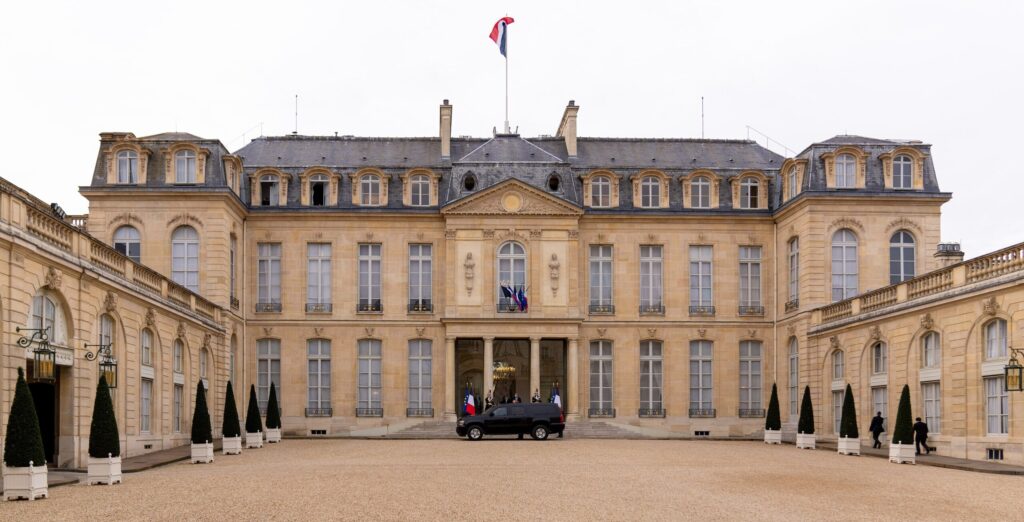
The official residence of the French president, completed in 1722 on the Rue du Faubourg Saint-Honoré. Named for the Elysian Fields of Greek mythology, it has served as both aristocratic mansion and seat of power.
At a glance
A mid-18th-century palace in the 8th arrondissement, steps from the Champs-Élysées, housing the president’s office, private residence, and the meeting place of the French Council of Ministers. The Hôtel de Marigny stands across the street as an adjoining state guest house.
History
Built for Louis Henri de La Tour d’Auvergne, governor of Île-de-France from 1719, the palace was completed in 1722. It passed through illustrious hands: Madame de Pompadour (1721–1764), Nicolas Beaujon (1718–1786), Bathilde d’Orléans (1750–1822), Joachim Murat (1767–1815), and Charles Ferdinand, Duke of Berry (1778–1820) all called it home.
On 12 December 1848, the French Parliament formally designated it the official residence of the president under the Second Republic, establishing its political role that endures today.
What you see
An 18th-century palace of refined French aristocratic design. The interior contains the presidential office and private residence alongside state reception rooms.
Cultural significance
The Élysée Palace embodies French sovereignty and continuity. Its name evokes the Elysian Fields of classical mythology—the blessed realm—a poetic reference to ideals of governance. As seat of the presidency, it symbolizes the Fifth Republic’s executive power and hosts the weekly Council of Ministers, where France’s government convenes.
Key facts
- Country: France
- City: Paris
- Completed: 1722
- Location: Rue du Faubourg Saint-Honoré, 8th arrondissement
- Coordinates: 48.8703°N, 2.3164°E
- Official residence of the president since 1848
Practical information & getting there
The palace is not open to the public. You can view its exterior on the Rue du Faubourg Saint-Honoré, near the Champs-Élysées in central Paris. The nearby Hôtel de Marigny, a state guest house, is similarly restricted to official use.
Sources & resources
Find it on the map
See this place and what’s around it →📷 Become a Cultural Heritage Online photographer
Share your photos of places: they stay published under your name as the author. The more they're seen, the more you get noticed — and soon a contest will reward the most appreciated photos.
Log in or sign up free to add a photoIs this page about you?
This page is read by travellers and heritage enthusiasts who find it on Google. Tell us how you are connected to this place and we will take it from there.