
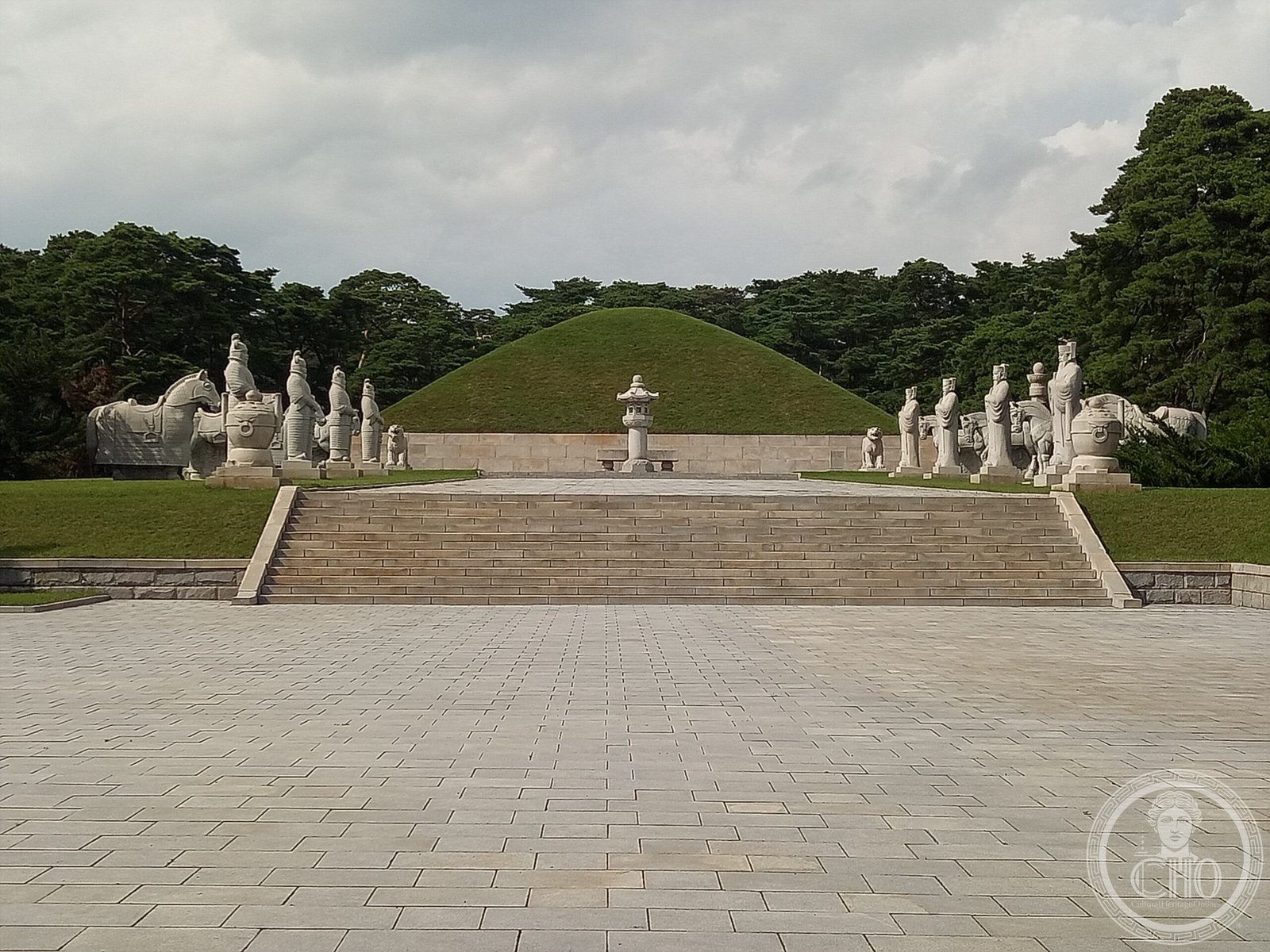
The royal mausoleum of Jumong, founder of Goguryeo, stands as a testament to Korea’s ancient kingdoms and the artistic traditions of its earliest dynasties.
At a glance
This is the principal burial site of King Jumong (58–19 BC), founder of Goguryeo, the northernmost of Korea’s Three Kingdoms. Located near Ryongsan Village in Pyongyang, the tomb anchors a vast necropolis of 63 individual tombs from the Goguryeo period, with at least fifteen additional tombs belonging to vassal lords nearby.
History
Jumong established Goguryeo as one of the peninsula’s dominant powers. After his death, he received the posthumous name King Dongmyeong. The burial complex developed over centuries, accumulating tombs of royal family members and high officials around the founder’s grave—a spatial arrangement reflecting the hierarchies of the ancient kingdom.
The tombs span from roughly 277 BC to 668 AD, capturing the full arc of Goguryeo’s cultural and spiritual evolution.
What you see
The complex comprises multiple earthen and stone structures distributed across 233 hectares. The most distinctive feature is the wall paintings adorning the tombs, which depict blossoming lotuses—powerful symbols indicating the presence of Buddhism in ancient Korea.
Cultural significance
The tomb complex represents a crucial junction of political power and spiritual practice in East Asian history. The lotus imagery reveals Buddhism’s influence on Goguryeo’s elite during the kingdom’s formative centuries. As the burial ground of a founding monarch and his court, the site embodies the values and artistic sophistication of one of Korea’s greatest ancient states.
Key facts
- Country: North Korea
- City: Pyongyang
- Coordinates: 38.895°N, 125.923°E
- UNESCO World Heritage Site: Complex of Goguryeo Tombs (2004)
- Protected area: 233 hectares (580 acres) with 1,701-hectare buffer zone
- Founder commemorated: King Jumong (58–19 BC)
Practical information & getting there
The tomb lies in Pyongyang’s Ryokpo district. Access to North Korea requires special authorization; consult your government’s travel advisory before planning a visit. Local guides are mandatory for all foreign visitors to archaeological sites in the country.
Sources & resources
Find it on the map
See this place and what’s around it →📷 Become a Cultural Heritage Online photographer
Share your photos of places: they stay published under your name as the author. The more they're seen, the more you get noticed — and soon a contest will reward the most appreciated photos.
Log in or sign up free to add a photo