
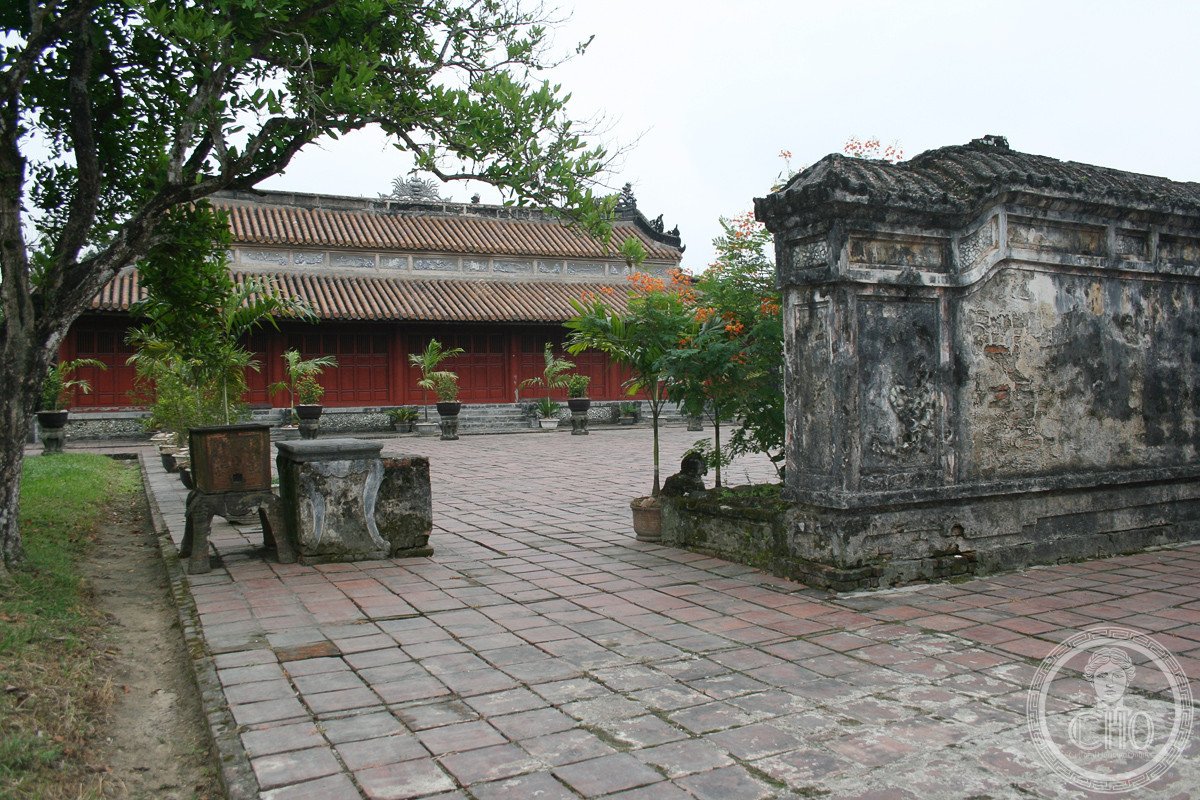
An imperial mausoleum complex housing Vietnam’s last dynasty, where emperors, their families, and royal dependents rest across two ceremonial sections.
At a glance
The An Lăng (An Mausoleum) serves as the final resting place for Emperor Dục Đức, his wife, and successive generations of the Nguyễn dynasty—Vietnam’s last ruling house. The compound accommodates multiple burials spanning emperors, empresses, and royal kin, reflecting the dynastic weight of Vietnamese imperial tradition.
History
Dục Đức was a nineteenth-century emperor of the Nguyễn dynasty. His tomb became a multi-generational burial site, housing not only the emperor himself but also his son Thành Thái, his grandson the child-emperor Duy Tân (interred in 1987), and the queen mother Nguyễn Thị Định, mother of Duy Tân. This layering of burials underscores the tomb’s significance as a dynastic necropolis.
What you see
The mausoleum divides into two distinct sections: the tomb itself and the Long An shrine. This architectural separation reflects Vietnamese imperial burial custom, balancing the resting place with a space for ritual veneration and ancestor worship.
Cultural significance
As a repository of Vietnam’s imperial past, the tomb embodies the legacy of the Nguyễn dynasty during its final decades. The presence of child-emperor Duy Tân—whose burial occurred only in the late twentieth century—links the compound to modern Vietnamese history and the end of the monarchy itself.
Key facts
- Location: Huế, Vietnam
- Coordinates: 16.45°N, 107.59°E
- Structure: Two-part complex (tomb and shrine)
- Primary burials: Emperor Dức Đức, Thành Thái, child-emperor Duy Tân, and royal family members
Practical information & getting there
The tomb is located in Huế, the former imperial capital in central Vietnam. Visit during daylight hours to appreciate both sections of the complex. Local guides offer context on Nguyễn dynasty history and burial customs.
Sources & resources
- Tomb of Dục Đức (Wikipedia)
- Cultural Heritage Online
Find it on the map
See this place and what’s around it →📷 Become a Cultural Heritage Online photographer
Share your photos of places: they stay published under your name as the author. The more they're seen, the more you get noticed — and soon a contest will reward the most appreciated photos.
Log in or sign up free to add a photo