
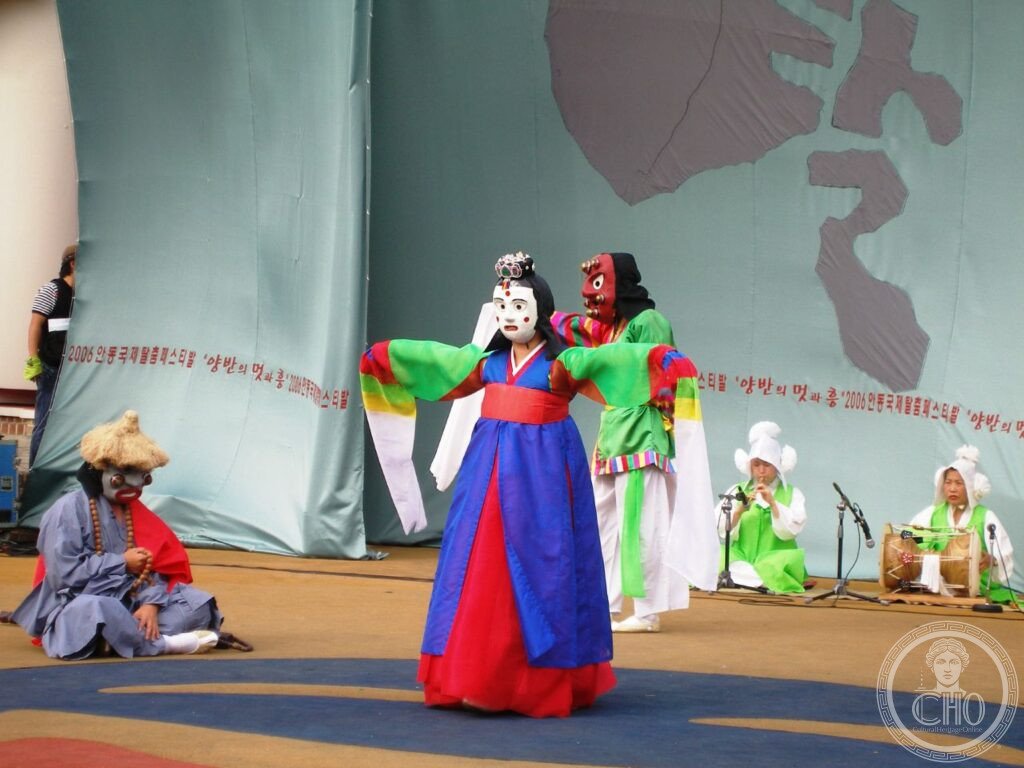
Masked dancers move across the stage in exaggerated gestures, their painted faces embodying social satire. Song and dance flow together as characters—commoners, nobles, animals, spirits—enact the frustrations and humor of everyday life, turning folk drama into a vehicle for wit and rebellion.
At a glance
Talchum, or mask dance drama, is a Korean performance tradition in which dancers wear carved masks while singing, dancing, and acting out dramatic narratives. The practice blends movement, voice, costume, and painted wooden masks into a form that entertains while commenting on social hierarchy and human folly. Though the term talchum originally referred to mask dances of Hwanghae Province in present-day North Korea, it is now accepted as the general term for all Korean mask dance drama, which varies by region—from the sandae noli of the Seoul and Gyeonggi areas to the yayu (field play) and Obangsinjang (dance of five gods) of the southern coast.
Origins & history
Talchum emerged as a folk practice rooted in the lived experiences of Korea’s lower classes, who channeled their grievances toward the yangban elite through masked performance. The form allowed performers and audiences alike to speak truths that direct speech might forbid—a safety valve for social tension expressed through humor, satire, and supernatural fantasy. Regional variations developed over centuries, each area adapting the basic elements of mask, music, and drama to local contexts and sensibilities.
The practice
The essence of talchum lies in the carved wooden mask. Each mask is painted with bold lines and vivid colors, instantly identifying the character—a yangban official, a servant, a monk, a fox spirit, a cow. Dancers move with deliberate exaggeration, their bodies articulating the mask’s expression through posture and gesture. Song accompanies the action, often bawdy or satirical. The performers adopt distinct voices and mannerisms for each character, creating a cast of archetypes who reveal human weakness and social absurdity through slapstick, innuendo, and wordplay. Costumes complement the masks, while percussion and wind instruments provide rhythmic and melodic support.
Cultural significance
Talchum stands as a landmark of Korean folk culture precisely because it gave voice to the voiceless. For centuries, lower-class performers and spectators found in mask drama a rare space to critique power, mock pretension, and celebrate resilience. The practice embodies the resilience and wit of communities, preserving in movement and narrative the social realities and aspirations of ordinary Koreans. Its inscription on UNESCO’s Representative List in 2022 affirmed both its deep roots in Korean life and its continuing relevance as a living art form.
Key facts
- Practice: Talchum (mask dance drama)
- Anchor community: Andong, South Korea
- Countries: South Korea
- UNESCO inscription: 2022 (Reference 01742)
- Regional variants: Sandae noli (Seoul/Gyeonggi), Yayu and Obangsinjang (southern coast)
Where to experience it
Andong, in the North Gyeongsang Province of South Korea, remains the heartland of talchum tradition and a living center for mask-making and performance. The region sustains practitioners, apprentices, and festivals devoted to the art. Visitors are encouraged to seek local performances, mask workshops, and cultural venues that showcase this vibrant practice.
Sources & resources
Find it on the map
See this place and what’s around it →📷 Become a Cultural Heritage Online photographer
Share your photos of places: they stay published under your name as the author. The more they're seen, the more you get noticed — and soon a contest will reward the most appreciated photos.
Log in or sign up free to add a photo