
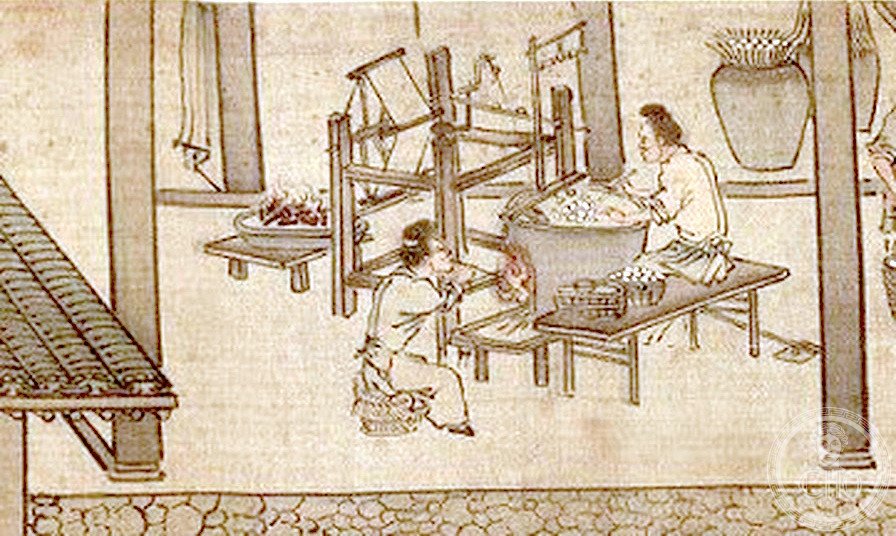
The cultivation of silkworms and transformation of their cocoons into thread represents one of humanity’s oldest textile arts, sustaining communities across Central Asia and the Middle East through knowledge passed down across millennia.
At a glance
Sericulture is the practice of raising silkworms—specifically the caterpillars of the domestic silkmoth—to harvest and process their cocoons into raw silk suitable for weaving. The domestic silkmoth has been so extensively modified through selective breeding that it no longer exists in the wild; most individuals are now flightless and lack natural defenses against predators, rendering them entirely dependent on human care. This intimacy between cultivator and creature defines the practice across seven nations sharing the tradition.
Origins & history
Silk is believed to have been first produced in China as early as the Neolithic period, making sericulture one of the world’s most ancient crafts. The knowledge and techniques gradually spread westward along trade routes, establishing themselves in the mountainous regions and oases of Central Asia and Iran, where the practice took root in local communities and became integral to regional economies and cultural identity.
The practice
Sericulturists feed silkworm caterpillars on mulberry leaves—a labor-intensive daily task requiring careful attention to temperature, humidity, and hygiene. As the worms mature, they spin their cocoons from a continuous filament of raw silk, a single strand that may measure 300 to 900 meters. Cocoons are then processed through heat treatment to kill the pupae and prevent the moth from breaking through, preserving the fiber’s integrity. The cocoons are next soaked in hot water to soften the sericin (the gum binding the filament) before being unwound onto spools—a delicate operation known as sericulture’s final stage. Weavers then transform the raw silk into cloth, employing traditional looms and techniques refined across generations.
Cultural significance
Sericulture and silk weaving sustain communities economically, socially, and culturally across Afghanistan, Azerbaijan, Iran, Turkey, Tajikistan, Turkmenistan, and Uzbekistan. The practice embodies ecological knowledge, technical precision, and aesthetic refinement—connecting cultivators to the natural world while linking families and regions through shared craft traditions. Silk remains both a precious commodity and a marker of cultural identity in societies where the practice has flourished for centuries.
Key facts
- Practiced in: Afghanistan, Azerbaijan, Iran, Turkey, Tajikistan, Turkmenistan, Uzbekistan
- Anchor community: Herat, Afghanistan (34.34573°N, 62.20138°E)
- UNESCO Intangible Cultural Heritage: 2016 (reference 01890)
- The domestic silkmoth is entirely dependent on human cultivation and cannot survive independently in the wild
- A single silk cocoon yields a filament 300–900 meters in length
Where to experience it
Herat, in western Afghanistan, remains the heartland of sericulture and silk weaving across the region. Visitors seeking to witness the practice should look to local cooperatives, family workshops, and seasonal sericulture activities in Herat and surrounding provinces, where traditional methods continue to sustain both craft and livelihood.
Sources & resources
- Sericulture – Wikipedia
- Sericulture and Traditional Production of Silk for Weaving – UNESCO Intangible Cultural Heritage
- Cultural Heritage Online
Find it on the map
See this place and what’s around it →📷 Become a Cultural Heritage Online photographer
Share your photos of places: they stay published under your name as the author. The more they're seen, the more you get noticed — and soon a contest will reward the most appreciated photos.
Log in or sign up free to add a photo