
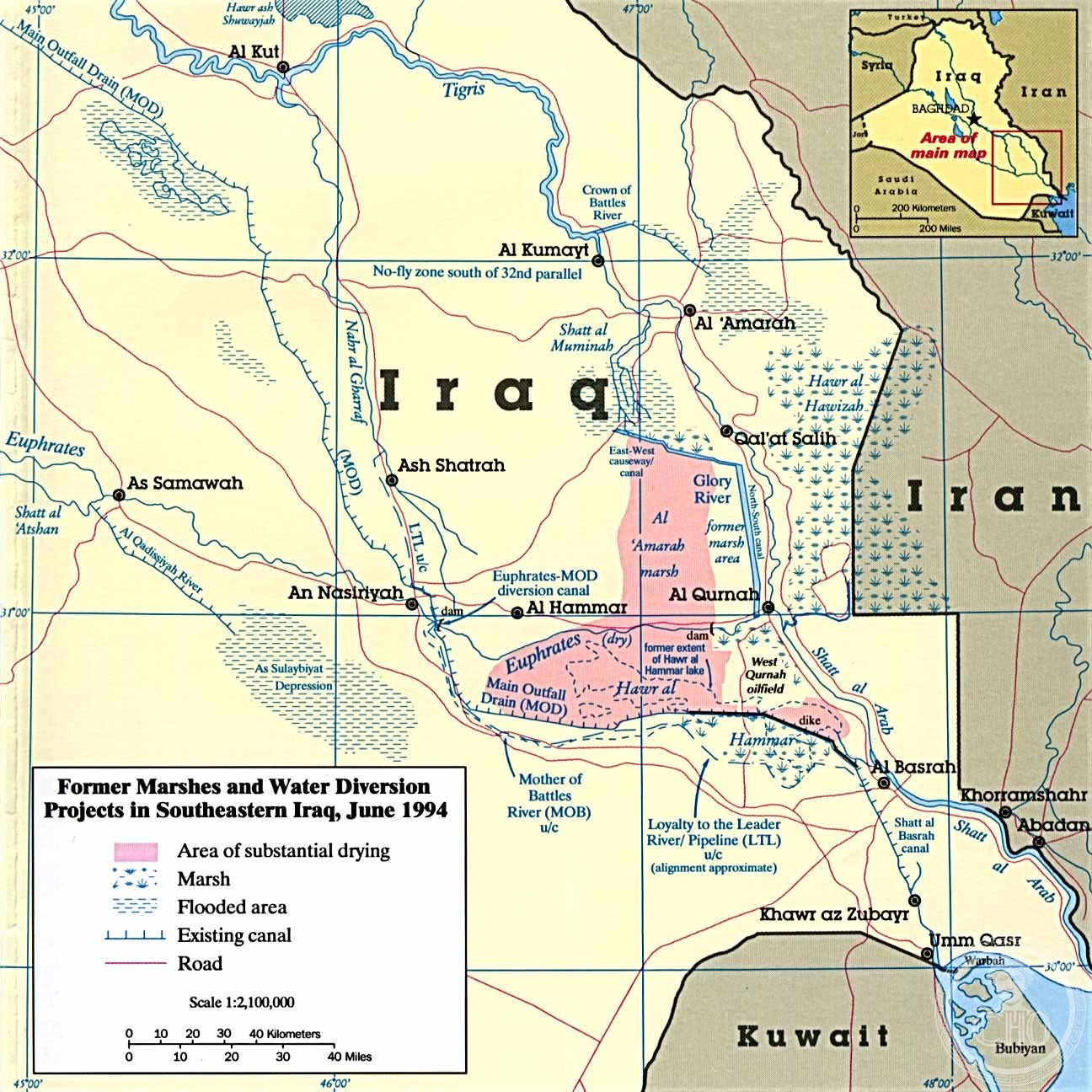
A vast wetland complex straddling the Iran–Iraq border, the Hawizeh Marshes have sustained human settlement for over five millennia. Fed by the Tigris and Karkheh rivers, these marshlands form a unique ecosystem and home to the Marsh Arabs and Hawizeh people, who navigate their water-bound cities in traditional reed boats.
At a glance
The Hawizeh Marshes comprise a complex of interconnected wetlands fed by two branches of the Tigris River (Al-Musharrah and Al-Kahla) in Iraq and the Karkheh River in Iran. The Al-Kassarah river drains the system, maintaining it as a flow-through ecosystem rather than a closed saline basin. Small cities built entirely on water host several thousand inhabitants who live with minimal modern infrastructure.
History
Human habitation of the marshes extends back more than 5,000 years. From the time of the Sumerians and Babylonians, people lived off the marshland’s resources through fishing, hunting, and cultivation. Around 3000 BC, the marshes formed at the confluence of the Tigris and Euphrates rivers, creating a new ecosystem that supported these early civilizations.
Over millennia, Islamic and Mesopotamian traditions blended within marsh communities, incorporating folklore and spiritual beliefs. In 1990–1992, the Hussein government deliberately drained the marshes, forcing the population to relocate to cities or Iran. After 2003, the Iraqi government restored water flow, and residents gradually returned. Today, approximately 5,000 Marshers inhabit the region.
What you see
Marsh cities are constructed entirely from reeds, with no permanent bridges or roads separating the Iraqi and Iranian sides. Residents travel between settlements in small canoe-like boats called Mashoof. Buildings lack electricity and modern amenities, reflecting centuries of adaptation to aquatic life.
Cultural significance
The Hawizeh Marshes are critical to the survival of the broader Mesopotamian Marshes ecosystem. They serve as a refuge for species that may recolonize or reproduce in other wetlands. The marshlands also sustain thousands of migratory animals, including wild squirrels, white eagles, hawks, and other birds that raise their young in this protected habitat.
The marsh communities preserve ancient ways of living that connect directly to Sumerian and Babylonian traditions, offering insight into millennia of adaptation to challenging environments.
Key facts
- Location: Iran–Iraq border
- Coordinates: 31.54°N, 47.71°E
- Inhabited for over 5,000 years
- Fed by the Tigris (two branches) and Karkheh rivers
- Current population: approximately 5,000
Practical information & getting there
The Hawizeh Marshes remain a remote and largely inaccessible destination for casual visitors. Access is challenging due to the political situation along the Iran–Iraq border and the marshes’ location in active conflict zones. Those seeking to visit should consult current travel advisories and arrange local expertise. The nearest significant city is Ahvaz in Iran.
Sources & resources
Find it on the map
See this place and what’s around it →📷 Become a Cultural Heritage Online photographer
Share your photos of places: they stay published under your name as the author. The more they're seen, the more you get noticed — and soon a contest will reward the most appreciated photos.
Log in or sign up free to add a photoIs this page about you?
This page is read by travellers and heritage enthusiasts who find it on Google. Tell us how you are connected to this place and we will take it from there.